Sharmila Tagore
Looking back at the women who came before me, and the ones who are now carrying our name forward, I am struck by how much the definition of "freedom" has changed. In my family, the Tagore lineage, we were always surrounded by culture and intellect, but the boundaries for women were very real. My grandmother, was married at just five years old and went on to have nine children. My mother, Ira, was a brilliant woman, yet she wasn't allowed to set foot in a co-educational college. She had to fight to finish her Master’s degree privately.
When I look at my own life, I realise I was the first real beneficiary of their quiet struggles. I grew up as one of three sisters in a Bengali household where we were never made to feel "lesser" than men. That lack of gender friction in my childhood gave me the backbone to enter the film industry at a young age and hold my own. I didn't see myself as a woman trying to make it in a man’s world; I just saw myself as a professional doing a job.
For a long time, people saw the glamour of the Pataudi name, but the reality inside our home was much more practical. When Tiger was playing, there was honestly no money in cricket. I was the primary breadwinner for the family for years. It wasn't a point of pride or a political statement; it was simply what needed to be done. Tiger never made me feel like my work was a threat to him, and I think that shaped how my children, especially Soha, view the world.
My relationship with Soha is built on that foundation of mutual respect. We are very different—she is perhaps more academic and structured than I ever was—but we share a common philosophy on how to navigate life. I’ve often told her that in a successful partnership, a woman should mind a man’s ego while a man should care for a woman’s emotions. Some might find that advice dated, but to me, it’s about the fundamental mechanics of a relationship. It’s about understanding that we all have vulnerabilities.
Watching Soha find her voice through her podcast and her advocacy has been a joy. But more than that, I admire how she is raising Inaaya. By returning to work and being vocal about her ambitions, Soha is showing her daughter that a mother’s life doesn't end when a child is born. Inaaya is growing up seeing that female ambition is the norm, not the exception. She won't have to "learn" that she is equal; she will simply know it because she sees it every day in her mother.
Then there is Sara. When I sit with my granddaughter, I am often taken aback by her wit. She has this wonderful spontaneity and a sense of humor that is entirely her own—her little limericks and captions on social media always make me smile. But beneath that friendly, bubbly exterior is a very serious professional. I’ve watched her on film sets, and I am deeply impressed by her poise. In an industry that can be incredibly intense and often unkind, she carries herself with a dedication and a humility that is rare.
It makes me happy to see that despite the lineage she comes from, Sara remains remarkably down-to-earth. She hasn't let the "star" persona swallow the person. She represents the modern woman of 2026—vocal, independent, and completely unafraid to be herself, whether she’s talking about her career or her personal health battles.
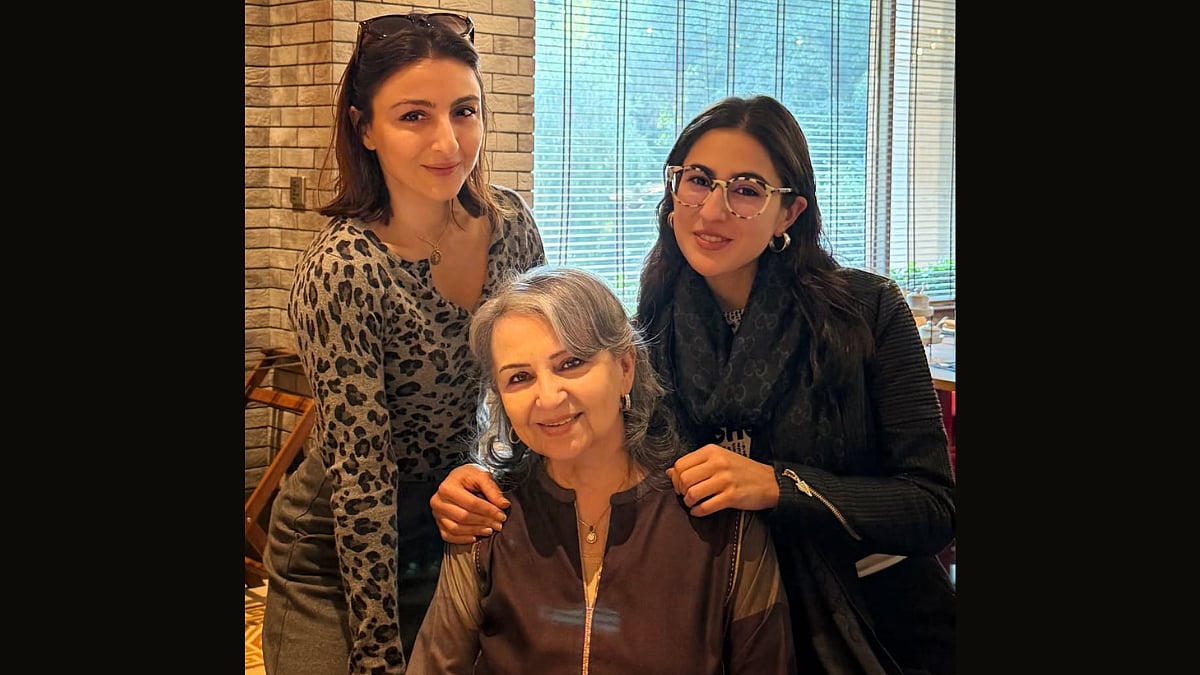
We recently sat down for a special conversation—three generations of us. Looking at Soha and Sara, I realised that we are no longer defined by "quiet resilience." My grandmother’s generation survived through silence; my mother’s through private persistence. My generation spoke up through our work. But Soha and Sara? They speak up because it is their right. They aren't just filling roles; they are creating the script. As the matriarch, nothing gives me more satisfaction than knowing that the fire my mother had to hide is now burning brightly for the whole world to see.
Soha Ali Khan
When I look at the women in my family—and the woman I see in the mirror—I don't see a single, neat definition of what we’re supposed to be. Instead, I see a collection of very different, often clashing ways of being independent. I was born into a royal legacy and a cinematic history, but I live my life in a noisy, digital world. For a long time, I struggled to figure out how to bridge those two realities. But lately, especially through the raw conversations on my podcast All About Her, I’ve realised that being a modern woman isn’t about picking one identity. It’s about having the guts to own all of them.
My perspective on self-acceptance started with my mother, Sharmila Tagore. She has always been a "liberal" but incredibly practical guide. Her advice was never about abstract ideals; it was grounded in how the world actually works. She once told me that in a successful marriage, a woman should mind a man’s ego while a man should care for a woman’s emotions. On the surface, that might sound like an old-school compromise, but she was actually teaching me about emotional intelligence—how to navigate a relationship without losing your core self.
Even when we hit friction—like her initial skepticism about my live-in relationship with Kunal (Khemu) —she never tried to shut me down. She taught me to value natural beauty and, more importantly, the quiet confidence of being okay in my own skin. Because of her, I don't feel the need to hide behind filters, whether they’re digital or metaphorical.
That foundation was put to the test when I became a mother. I’ll be honest: I became completely "obsessed" with Inaaya. For a while, I vanished into her. My identity as an actor, a writer, and an individual felt like it was playing second fiddle to just being "Inaaya’s mother." It took a real, conscious jolt to realize that by losing my own fire, I wasn't actually helping her.
Now that she’s older, I’m focused on breaking those suffocating, old-fashioned parenting patterns. I want Inaaya to be "heard, not just seen." I want her to grow up watching a mother who works, who has big ambitions, and who understands that financial independence is a form of freedom. Going back to work wasn't just a career move; it was a demonstration for my daughter. I want her to know that a woman’s world should be as expansive as she wants it to be.
This sense of responsibility has pulled me into new territory lately. At a recent summit , I spoke about a new frontier for women’s rights: technology. As we move faster into the future, we can’t leave our safety in the rearview mirror. I feel a massive urgency to fight for ethical AI. Whether it’s protecting girls from the nightmare of deepfakes or making sure online spaces aren't just breeding grounds for abuse, this is the modern fight for empowerment. You aren't truly "independent" if you’re being targeted or silenced in the digital world.
With my podcast, I’ve tried to build the kind of honest, judgment-free space I wish I’d had years ago. We dive into the "taboos"—perimenopause, menstrual hygiene, the reality of ageing—because silence is a trap. When we don’t talk about our health, we end up fighting those battles alone.
One of my favourite moments was bringing three generations together: my mother, myself, and my niece, Sara. Sitting there with Sara, I could see exactly how the definition of being a woman has shifted. My mother has that elegant, quiet resilience; I’m the bridge navigating the middle ground; and Sara is this vocal, fiercely independent force. Seeing her talk so openly about her career and her struggle with PCOS makes me realise how much ground we’ve gained.
We aren't just trying to get by anymore. We’re setting the terms. We’re breaking the silence, guarding our digital futures, and making sure our daughters never feel they need permission to speak up.
Sara Ali Khan
People often ask me what it means to be a "strong woman." For a long time, the world tried to define that for us—as if strength were a fixed destination or a specific look. But if my journey has taught me anything, especially over these last couple of years, it’s that strength is simply the refusal to let your voice be silenced.
I grew up in a home where I never knew what it was like not to have a voice. That is my greatest privilege. My mother, Amrita Singh, raised my brother Ibrahim and me as a single parent, and in our house, there was no "blue" or "pink" division of labour. My mother did everything. She wasn't just the nurturer; she was the provider, the decision-maker, and the anchor. Because of her, the traditional bifurcation of gender roles doesn't even exist in my memory. I saw a woman being the driving force of her own life, and that became my baseline.
Today, she is still my primary role model. I look at her career—at the raw, spontaneous power she brought to films like Aaina or Chameli Ki Shaadi—and I feel a deep desire to reprise that kind of fearlessness on screen. But off-screen, she’s taught me something even more vital: the importance of being "thick-skinned." In an industry where social media can dehumanise you, where trolls forget there’s a living, breathing person behind the screen, she is the one who reminds me to let the noise pass. It hurts her to see me targeted—at the end of the day, it’s ‘Maa-Beti’—but she’s also the one who taught me that my value isn't up for public debate.
That sense of independence translates into how I view relationships. I’m fiercely independent, and I say that with pride. I don't "need" a relationship to feel complete or to validate my existence. My life is full—my work, my family, and my friends provide a massive support system. If I were to enter a relationship now, it wouldn’t be out of a void; it would be because I’ve found someone I genuinely want to make space for. A partner should add value, not fill a hole.
Speaking of space, I’ve also realised how important it is for women to take up space in the professional world without feeling the need to apologise for it. We need to normalise the "balance." Society often treats a woman managing a high-powered career and a family as a miracle or an anomaly. It isn’t. It should be the standard. We are capable of being both ambitious and grounded, and we shouldn't have to choose one at the expense of the other. At the Times Now Summit recently, I spoke about breaking these generational patterns. I want to mentor young women entrepreneurs because I want them to know that while you might receive assistance, you are the driving force of your life.
Part of that driving force is also being honest about our vulnerabilities. I’ve always been transparent about my struggle with PCOS. It’s not just about weight gain or skin issues; it’s an emotional and physical battle that affects your energy and your confidence. On the days when my hormones are acting up and I feel "off," I remind myself—and the girls who message me—that we are fighting a condition, and we are so much more than a diagnosis. Self-love isn't a destination; it's a daily practice of listening to your body and being patient with your progress.
Whether I'm travelling from Ujjain to the Maldives or standing on a film set, I try to carry these lessons with me. Being a modern woman isn't about following a script; it’s about the evolution of self. It’s about standing up for what you believe in, even when the world isn't cheering you on.

