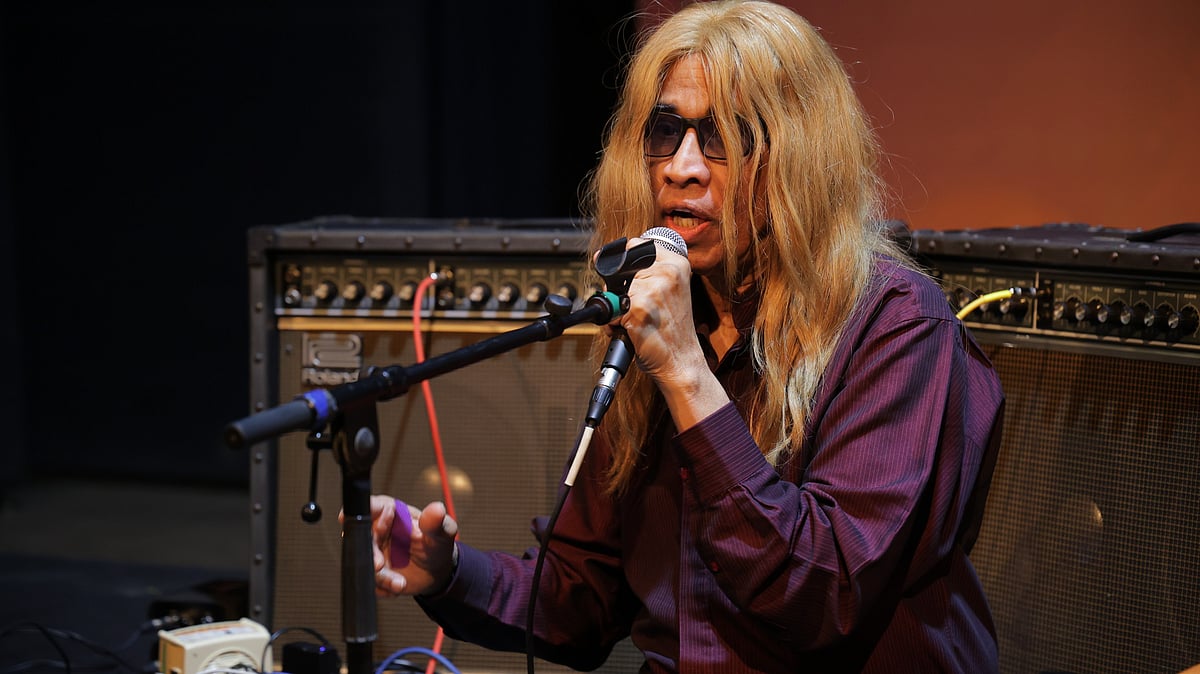
A day before Valentine’s Day, the historic Royal Opera House, Mumbai transformed into a sanctuary of sound as ‘A Classical Confluence of Raga & Rhythm’ unfolded before a spellbound audience, headed by the legendary singer and violin virtuoso L. Shankar, celebrated worldwide for his pioneering work with Shakti. The Grammy winning musician was joined by the US based tabla maestro Amit Kavthekar, whose nuanced rhythmic command provided the perfect counterpoint to Shankar’s soaring melodic explorations. The surprise element came when 75 year old Shankar invited India’s legendary percussionist Sivamani on stage elevating the energy and turning the concert into a thrilling rhythmic celebration.
The performance opened with a deeply meditative raga improvisation featuring original compositions in Raga Gowrimanohari, gradually unfolding into a masterful Ragam Tanam Pallavi in Aberi set to a challenging 9½-beat cycle. The trio then transported listeners into the timeless soundscape of Shakti with Joy and La Danse du Bonheur, before presenting Paper Nut from the Shankar’s album ‘Song for Everyone’.
The co-founder of Shakti talks about his recent concert, traces his music journey with Shakti and sheds insights into the future of classical music in India.
Excerpts from the interview:
How did the idea for this show ‘Raga and Rhythm’ come together, and what were you hoping audiences would experience that evening?
The concert, Raga and Rhythm, presented by StudioK3 and BlueArch Brand Communication, was conceived to take the audience on a journey through different textures, emotions, and improvisations. For the evening, I performed my pallavis and raga improvisations on both vocals and the double violin, as well as some original Shakti pieces from the first three albums. Listening to a live performance is very different from listening to a recording as there’s a great deal of spontaneity, and so much happens in the moment. That makes the musical experience richer, deeper, and more alive. My hope is that the audience feels transported and fully immersed in that energy as the music unfolds live.
You shared a very special bond with Zakir Hussain. His passing has left a void in the music world. On a personal level, what has this loss meant to you?
Zakir and I grew up together in our early 20s. He is a one-of-a-kind musician and an incredible artist. We have performed together in Shakti, as well as in my classical concerts with Vikkuji. We had fun, and we also spent a lot of time working on the music. He is one of the greatest tabla players. I worked a lot with his father too. His whole family is very talented. Taufiq and Fazal are very gifted musicians as well. That’s truly a great musical family. His legacy will always continue.
When you look back at Shakti — the incredible journey you shared with Zakir Hussain and John McLaughlin — what stays with you the most?
We had such a great time, and we created history together, something I can never forget. Those memories remain very special to me. I also recently performed a few special tribute shows honoring Zakir Hussain in the United States, in the cities of Houston, Chicago, and New York City last year.
Your new album ‘Answers’ surprises listeners with a pop-rock sound. What inspired you to explore this direction at this point in your journey?
It’s not a recent exploration, it’s always been part of who I am. Beyond my Indian classical work, I’ve released several pop-rock albums since the ’80s, including ‘Eye Catcher’ (1987), ‘Do What You Do’ (1986), and ‘The Epidemics’ (1985). I also had a performing band called Sadhu that was entirely song-oriented. Over the years, I’ve released several EDM albums as well, such as ‘Transcend’ (2015), ‘Champion’ (2014), and ‘The Revelation’ (2013). At times, I work on multiple projects across different genres concurrently. I value the freedom to create the music I want to make. As an artist, I believe it’s important to have that artistic freedom and not worry about what others might say or think.
Why the title ‘Answers’? What questions were you responding to — musically or personally?
From a musical standpoint, ‘Answers’ is shaped by a core group of progressive rock musicians, some of whom I first worked with more than 35 years ago. Their depth, emotion, and range allowed me to write songs that explore different moods and messages while showcasing their remarkable talents. ‘Answers’ is one of the tracks from the album. The central theme is about leaving behind the familiar and stepping into the unknown to discover who you really are. ‘Answers’ felt like the right title because the song is for everyone, especially the younger generation. They all go through moments when they question who they are, where they belong, and whether they should stay with what’s familiar or take a step into the unknown.
Not many may know about your 2021 release ‘Christmas From India’, where you reimagined festive classics with Indian instrumentation with the sound of tablas, sitar and, of course, violin and vocals to craft a totally different Christmas album. What drew you to that idea?
My record company wanted me to create a special Christmas album featuring classic holiday songs. For the project, I also wrote two original compositions, Christmas Time and Saviour, which are included on the album. A variety of Indian instruments are used on this project.
Your collaboration with Metallica’s Robert Trujillo was quite unexpected. How did Carnatic music meet metal — what was that creative exchange like?
Robert is a huge fan of my music, and I’m a big fan of his as well, so we decided to collaborate on some original compositions and perform together. Our music isn’t just Carnatic or just heavy metal, it’s a blend of both our styles, something we created together that can appeal to a wide range of listeners. We’ve performed live shows in the US and recorded. He’s an amazing musician - powerful, incredibly groovy, and deeply rooted in heavy metal with tremendous energy.
Over the years, who have been your enduring inspirations? And is there someone you still dream of collaborating with?
My enduring inspiration comes from nature and animals, the innocence and pure energy of birds, rabbits, elephants, and cows and I love spending time with them. I also find inspiration in the natural world, the trees, the ocean, and the moon. The sun rises every day no matter what, reminding you to keep going and to find inspiration within yourself.
Was there a turning point in your life that changed everything for you? And what moments stand out as the true highlights of your career?
One of the highlights of my journey was working with Frank Zappa, a true genius who was far ahead of his time. He was never afraid of what people thought and always did exactly what he wanted to do. It was incredible collaborating with him because he gave me complete freedom and trusted me to follow my own creative instincts. I was also the first artist he signed to Zappa Records on a 10-albums deal. He really was ahead of his time. During that period, I also began overdubbing many different instruments in the studio, like the cello, double bass, viola, and violin, which eventually led me to design and develop the double violin that I’ve been using since the 80s.
Where does this album ‘Answers’ sit in your artistic journey? Does it feel like a new chapter, or a continuation of what you’ve always been exploring?
I want listeners to free their minds, don’t come in with any preconceived ideas. This album is like a story, and I see myself as the director, guiding the flow of emotion and experience. It continues in the same spirit as my previous album ‘Chepleeri Dream’ (2020), but ‘Answers’ goes even deeper and further exploring a wider range of emotions and life situations. The lyrics play a big part in that. I always encourage people to read or follow the lyrics as they listen, because they help you connect with what I was feeling when I wrote the songs. That said, I know everyone will interpret the music in their own way, and that’s a beautiful thing. These songs are like life lessons, and I hope they resonate with whatever journey you're on.
When you look back at your vast body of work, which album or collaboration feels especially close to your heart?
I love all my albums. I can’t say that I like one more than another, each one means something special to me. Whenever I’m working on a new album, it naturally becomes my favorite at that moment. It’s like having several children, you can’t choose one over the others. You love them all equally.
Finally, Indian classical music continues to evolve. Who do you believe will carry the tradition forward in the years to come?
There are many talented and gifted young musicians today. I can’t single out any one name, because it wouldn’t be fair to the others, but there are definitely several artists I strongly believe will continue to grow and evolve. As long as they keep an open mind and don’t limit themselves or get stuck in one way of thinking, they can create new music and carry the tradition forward to universal appeal. I wish them all the best.
If you had to pick three Shakti compositions that best represent your contribution, which would they be?
The first three albums, most of them are gems of composition, which I wrote with John McLaughlin and I don’t have any particular favorite because they are all created for different emotions. They’re unbelievable compositions, which I really loved playing with Zakir, Vikku and John.

