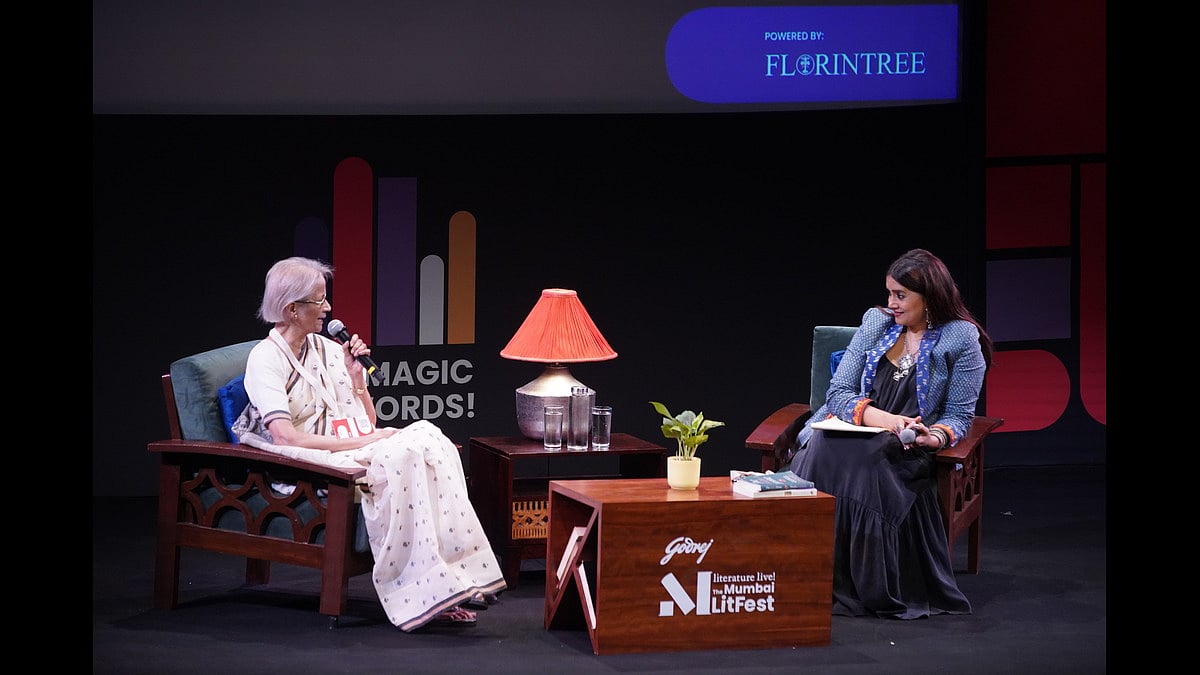
Veteran journalist, playwright, translator, and bilingual fiction writer Shanta Gokhale took the center stage at the Godrej Literature Live! The Mumbai LitFest 2026. Appearing in a highly anticipated session titled Booked For Life: The unbearable lightness of reading, the octogenarian literary icon sat down with acclaimed actor Sonali Kulkarni.
The wide-ranging discussion delved deep into the nuances of Gokhale’s fiction in The Way Home, alongside the rich tapestry of literary friendships and memories preserved in her non-fiction work, Of Ancestors and Friends.
A Literary Masterclass Built on Mutual Respect
The warmth between the two women set the tone for the evening. Kulkarni, a self-confessed admirer of Gokhale’s expansive body of work, opened the session with an affectionate anecdote. “I just want to tell you that we all love you,” Kulkarni told Gokhale, recounting her arrival at the National Centre for the Performing Arts (NCPA). “Whomever I met, they were telling me, 'You are so, so lucky because you are going to talk to her,' while also reassuring me that I will be doing okay. They told me, 'Don't worry, you'll do okay.'” Kulkarni laughed, adding that she was simply happy rather than anxious to share the stage with the legend.
When Kulkarni asked how the veteran author balances her time across so many demanding, brilliant literary forms, Gokhale responded with characteristic ease. “I won't go too far back,” Gokhale explained. “I’ll stick to these last 20 years because that's when most of my writing has been done. Once I gave up writing for my regular column in a newspaper—which was a wonderful space for me to fill every single week with cultural events happening—I settled down to a regular and rather rigid routine.”
Gokhale revealed that her daily rhythm revolves around a morning walk, a focused block of work, an afternoon nap, and a return to writing. By 7:30 or 8:00 PM, she officially "knocks off" to unwind in front of the television with intricate detective shows. While she credits this strict discipline with keeping her focused, she admitted she never thought she could write within the genre. “I don’t think I will ever be able to write murder mysteries. I can't deal with dead bodies!” Gokhale joked, before teasing her audience with a revelation. “But I do think that should be my next challenge: writing a detective novel.”
Finding the Extraordinary in Ordinary Lives
Turning the lens onto the strength of Gokhale's literary creations, Kulkarni questioned how the author breathes such profound courage, confidence, and lived experience into her female characters. Gokhale, however, rejected the notion that these fierce portrayals are a reflection of herself. Instead, she credits the organic resilience of the everyday women she observes in society.
“I think a lot of women are strong in themselves,” Gokhale observed. “I think even the kind of woman who lives in one corner of the city and travels for work across town, after preparing meals for the entire family, are the women who have their lives completely together.” According to Gokhale, this quiet fortitude is born out of necessity. “Unless they do, and unless they have cleared themselves enough space within the family—mother-in-law, father-in-law, everyone included, and children included—they won't be able to achieve what they achieve.”
These women, she argued, form the vast majority of the country, proving that strength is inherent to them. “Whatever she is doing, she finds her space, she deals, negotiates with life, and makes her way. So, if you find that in my characters, then those are the characters I've observed. They're not me, you know. In the sense that I'm hardly ever aware of myself when I write fiction. I'm completely with those people and their situations.”
Confronting the ‘Power Hierarchy’ of Indian Languages
The dialogue shifted to a more challenging societal truth when Kulkarni asked how Gokhale overcame the shyness or complex of being a Maharashtrian while writing in English. “Because it is not very fashionable to be Marathi when you're writing in English,” Kulkarni pointed out. Gokhale’s response was immediate, fierce, and entirely unapologetic.
“I've grown up to be a free person, that's the bottom line,” Gokhale asserted. “Why would I be ashamed of being who I am? I am Marathi. My entire culture is Marathi. I eat Marathi, I speak Marathi, I sleep Marathi. Why the hell would I be ashamed of being that?”
Acknowledging the validity of Kulkarni's observation, Gokhale shed light on the systemic linguistic biases that govern mainstream Indian media. “See, I know where you’re coming from because it is unfortunate that the kind of hierarchy of languages in which we live, it’s a power hierarchy. At the top is English, and second is Hindi.”
She cited the entertainment industry as a prime example of this disparity. “Films go out, or hope to go out, to people from all over India. It doesn't matter to a Marathi filmmaker that the South may not understand Hindi. The South is the South. We are trying to reach the powerful North. So, you call your character Sharma, Malhotra—whatever they are. It’s only recently that Gujaratis have come in. You know? But you're right, Marathis rarely come in.”
For Gokhale, identity is not something to be dialled down for mass appeal. She emphasised that when she writes in Marathi, she understands her audience implicitly. However, that baseline does not change when she switches languages. “I can't take the Marathiness out of myself and write in English. That's stupid!” Gokhale concluded to resounding applause. “So, I don't suffer from that particular complex. I am what I am.”

