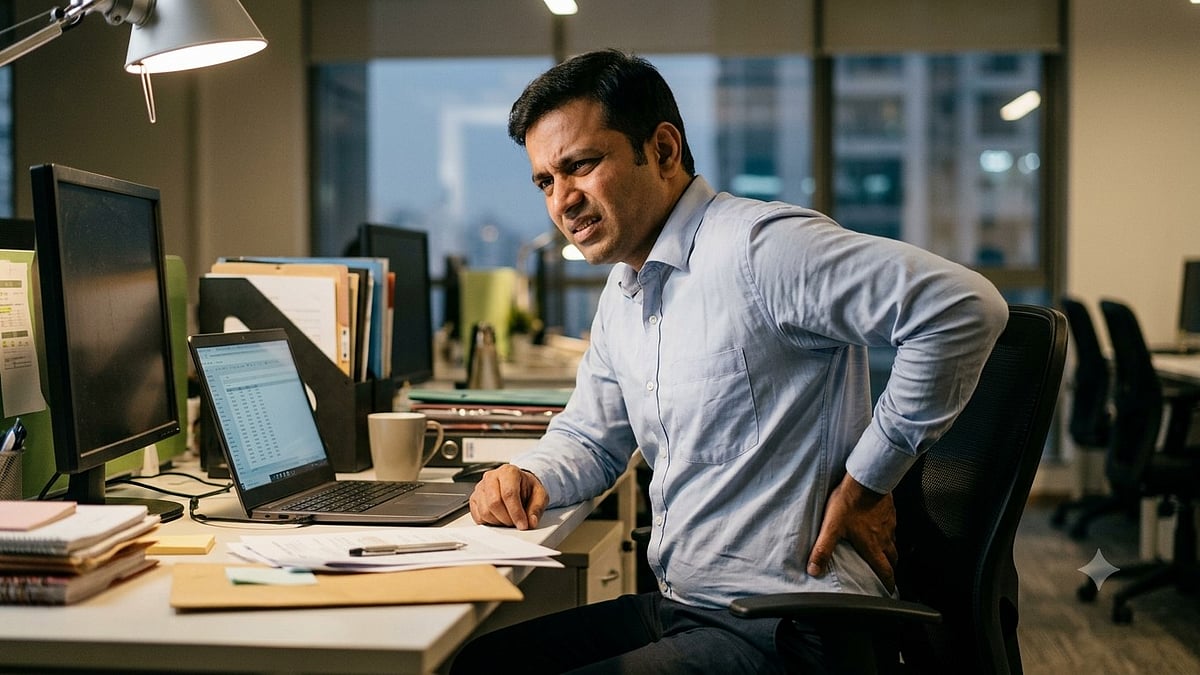
Today’s urban Indian father may be a tech professional spending long hours across screens, an entrepreneur moving between meetings and flights, or a corporate leader balancing demanding workdays with commutes, workouts and family responsibilities. Behind this always-on lifestyle is a body constantly being called upon, often without adequate rest or support. For many men in their 30s and 40s, it is also carrying physical discomfort they have ignored for far too long by normalising a life of strain.
It begins innocently. A stiff back after a long workday. A slight knee twinge while climbing stairs. Rounded shoulders after years of laptop work. A lower-back pull after one enthusiastic weekend cricket match. A dull ache that appears after a long commute and disappears just enough to be ignored. Unfortunately, most men view this as a part of adulthood and merely accept it and move on.
Therein lies the problem. Indian men in their 30s and 40s today are living at the intersection of multiple physical demands. They are spending long hours seated at desks, commuting through crowded cities, lifting children, managing household tasks, trying to stay active, and often returning to fitness after years of irregular routines. The body is expected to perform across office, home, travel and recreation, but the support systems around it have not evolved with the same urgency.
Globally, the warning signs are already visible. The World Health Organization estimates that nearly 31% of adults, or about 1.8 billion people, did not meet recommended physical activity levels in 2022, with inactivity particularly high in South Asia at 45%. At the same time, low back pain has become one of the most common health concerns in the world. WHO data also shows that low back pain affected 619 million people in 2020 and could rise to 843 million by 2050.
For Indian men, the picture becomes even more relevant when lifestyle risk is added to the equation. Analysis of National Family Health Survey data shows that the combined prevalence of overweight or obesity among Indian men aged 15 to 49 increased from 9.3% to 22.9% over a 15-year period. This matters because excess body weight, weak muscle conditioning, poor posture and sedentary work patterns can all place additional stress on the knees, spine and joints.
Yet, when men speak about health, the conversation usually centres on cholesterol, sugar levels, heart health or fitness goals. These are important, of course. But musculoskeletal health, the everyday health of the back, knees, feet, shoulders and posture, is often treated as secondary. It gets attention only after pain starts interfering with daily life.
That mindset needs to change. Preventive care should not begin after the first major injury. It should begin when the body first starts sending small signals. A knee support during activity, a posture corrector that encourages better alignment, a lumbar support solution for long sitting hours, or ergonomic products that reduce strain during everyday movement may seem simple. But simple interventions often work because everyday discomfort is usually built through everyday neglect.
This is especially important for fathers because work, home and movement often blend into one long physical routine. Hours at a desk, time in traffic, household errands, playing with children and squeezing in a workout all place different demands on the body. Over time, the knees absorb the impact, the lower back compensates, the shoulders round forward, and posture quietly suffers.
Orthotic and ergonomic solutions are not about making men feel fragile. They are about helping them stay active and supported for longer. A posture corrector can encourage better alignment, knee supports can offer compression during movement or recovery, and back-support products can reduce strain during long sitting hours. Frido’s orthotics range brings these everyday solutions together for common concerns such as back, knee, wrist and foot discomfort.
The larger point is not that one product solves everything. It is that men need to build a healthier relationship with physical support.
For too long, pain has been confused with resilience. Many men delay action because they believe discomfort is manageable, temporary or simply part of being responsible. But ignoring pain does not make it disappear. It often changes the way the body moves. A stiff back changes posture. A weak knee changes gait. Foot discomfort changes balance. Over time, one ignored problem can create another.
The most meaningful shift is to move the conversation from celebration to care. Not dramatic care, but practical care. Better footwear. More movement breaks. Strength training done correctly. Stretching that is not skipped. Medical advice when pain persists. Ergonomic support at work. Knee and back support when the body needs it. A willingness to say, “This pain is worth addressing.”
The narrative around fatherhood needs a shift for a fathers can only keep showing up for others when they keep showing up for themselves with energy, mobility, and ease.
Indian men in their 30s and 40s are not old. They are in one of the most demanding, active and responsibility-heavy decades of life. This is exactly when preventive musculoskeletal care should become normal. Not as a sign of age, but as a sign of awareness. The future of men’s wellness cannot only be about building stronger bodies. It must also be about building better support systems for the bodies already doing so much.
(Ganesh Sonawane, Co-Founder and CEO, Frido)
