
Like all things luxury, India’s relationship with luxury watches and the culture of fine watchmaking is no longer nascent—it is maturing into a deep, discerning community-driven affinity. What was once a market defined by aspiration is now steadily evolving into one defined by connoisseurship. Global watch powerhouses such as Rolex, Piaget, Baume & Mercier, Breitling, Jacob & Co. have taken note and are doubling down on India, expanding their retail footprint with exclusive boutiques, introducing wider and more nuanced portfolios, and increasingly, tailoring their storytelling through India-specific editions and local brand ambassadors.

Pranav Saboo, Managing Director and CEO of Ethos Limited |
At the heart of this transformation is Ethos, one of India’s largest luxury watch retailers, whose influence extends well beyond commerce, elevating India’s stand within the global watchmaking orb. Marking another significant milestone towards this goal, Ethos Watches is bringing the Grand Prix d’Horlogerie de Genève (GPHG) Exhibition, also —often dubbed the “Oscars of Watchmaking”—to India for the second time since 2022. The travelling exhibition represents the highest honour in contemporary horology. Every year, the competition recognises the finest achievements in mechanical watchmaking across multiple categories. GPHG India will present the finalist timepieces competing across 15 award categories and will give collectors a front-row seat to the finest watchmaking creations of the year. More than an exhibition, it signals a shift: India is not just consuming luxury—it is becoming part of the conversation that defines it.
We speak to Pranav Saboo, Managing Director and CEO of Ethos Limited, who has recently joined the Jury of GPHG India, on what this means for India and the future of horology and more.

What does GPHG coming to India signal about India’s role in global horology?
GPHG’s arrival in India is a significant milestone. We’ve just broken into the top 15 markets in the world and have already become part of the conversations globally. What makes this even more special is Ethos’ presence on the GPHG jury. The exhibition is much more than a showcase; it is an opportunity for people to understand fine watchmaking. Watch enthusiasts will get to explore award-winning timepieces up close, learn about the craftsmanship behind them, attend watchmaking masterclasses, and take part in collector evenings. The idea is that people leave not only knowing why a watch deserves an award, but also discovering what kind of watchmaking speaks to them personally. Platforms like GPHG have a much larger impact on the industry; they influence which brands and innovations get attention, and encourage more maisons to think seriously about India.
Will GPHG spark India-exclusive launches and collaborations that go beyond heritage and nostalgia?
We’re already seeing brands draw inspiration from India, whether through design, craftsmanship or cultural references. GPHG gives brands a global platform to experiment in more meaningful ways. There’s an important difference between simply using India-inspired colours or motifs and genuinely engaging with India’s craft traditions. It’s about recognising Indian craft as something that deserves a place alongside the world’s finest craft traditions. I believe we’ll start seeing more launches designed with Indian collectors in mind and unveiled here before being introduced globally. For that to happen, brands need to believe that an India debut has global relevance. We also need a strong collector community and the right retail and media ecosystem to support those launches. We’re steadily building all three. I wouldn’t be surprised if, in the coming years, we see a grand complication inspired by India’s heritage debut at GPHG India.

Favre Leuba Deep Raider Day Date Two-Tone watch in blue |
How has the Indian luxury consumer evolved, and what’s the mindset shift you’ve seen?
The biggest transformation I’ve seen over the last five years is that people are buying watches for themselves, not to impress others, and are also moving away from logo-led buying to knowledge-led buying. Today, collectors choose a watch because they genuinely appreciate the craftsmanship, the story behind it, or the way it makes them feel. We’re also seeing strong demand coming from cities that weren’t traditionally considered luxury markets. Collectors from Ahmedabad and Chandigarh are just as knowledgeable and passionate as those in Mumbai or Delhi. A few years ago, price was one of the biggest barriers. Today, most serious buyers understand why a hand-finished movement or a rare complication commands a premium.
How are watches becoming part of India’s larger cultural narrative?
Fashion and watchmaking are becoming much more connected in India. A watch today isn’t just something you wear to tell the time. It’s a form of personal expression, much like jewellery or couture. That’s why the recent collaboration with Gaurav Gupta and Favre Leuba felt so natural. It presented watches as pieces of art in their own right. We’re also seeing watches become part of popular culture more authentically. When a key public figure or an A-list celebrity wears a watch, it doesn’t feel like a traditional celebrity endorsement. It reflects the fact that watches are becoming part of how people express their personality and style. That’s why we choose partners who genuinely appreciate watchmaking, not just people with a large following. With City of Time, our curated 22,000 sq. ft. destination in Gurugram, we’ve seen how Indian consumers are embracing immersive luxury experiences that go beyond shopping. Going forward, luxury retail will become increasingly experience-led and community-focused. Also, the approach will become more local, especially in Tier-2 and 3 cities.
What’s driving collaborations in haute horology?
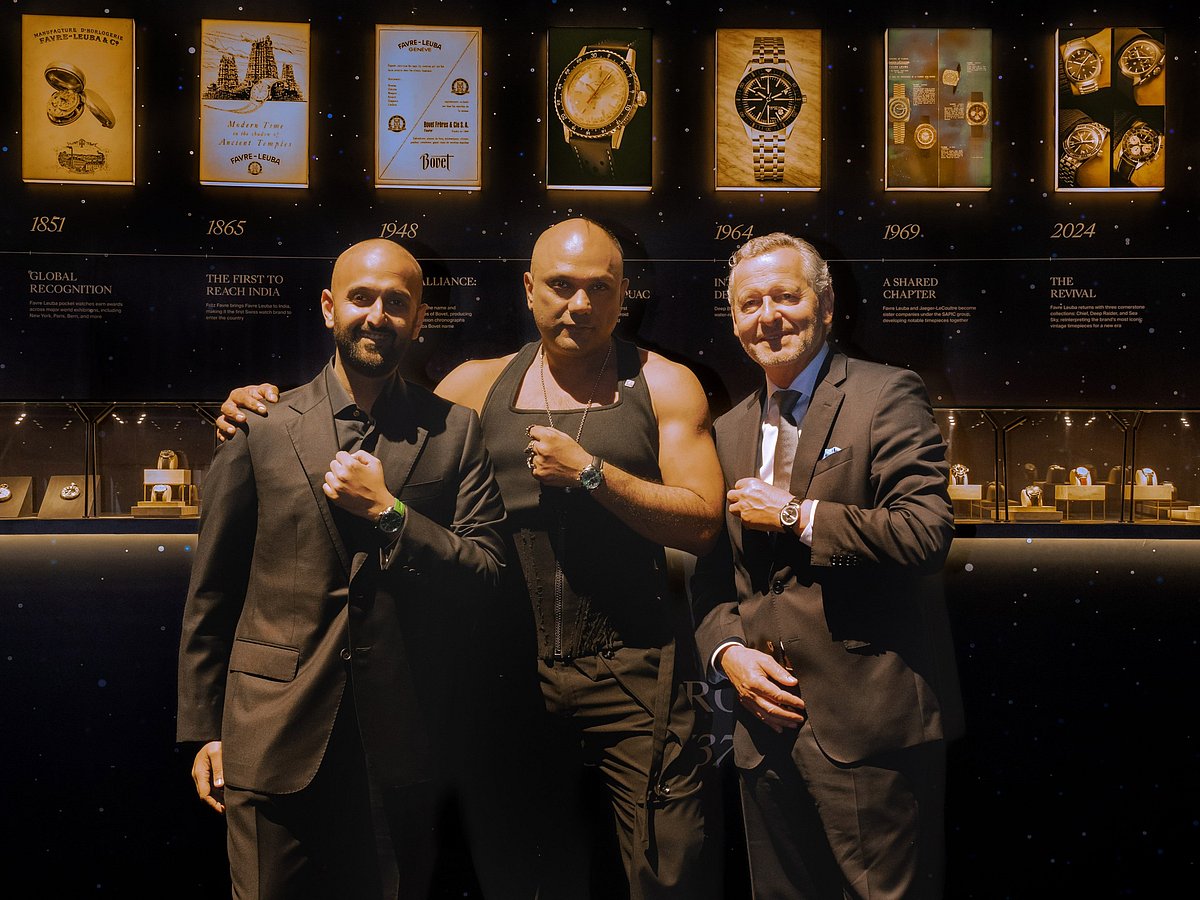
(from left) Pranav Saboo, Managing Director & CEO, Ethos Limited, Gaurav Gupta, Patrik Hoffmann, CEO and Chairman of Favre Leuba |
Collaborations have become an exciting way to introduce new audiences to watchmaking. The right partnership can make a brand more accessible to first-time buyers while preserving the exclusivity of its core collections. I also find broader shifts interesting—especially the growing influence of independent watchmakers and maisons pushing creative boundaries. The idea of exclusivity is also changing. Today, true luxury isn’t about artificial scarcity, but genuine rarity—whether it’s a craft that takes decades to master, a material that’s difficult to source, or a design that can’t be replicated. That kind of exclusivity has real meaning and is what collectors increasingly value.

