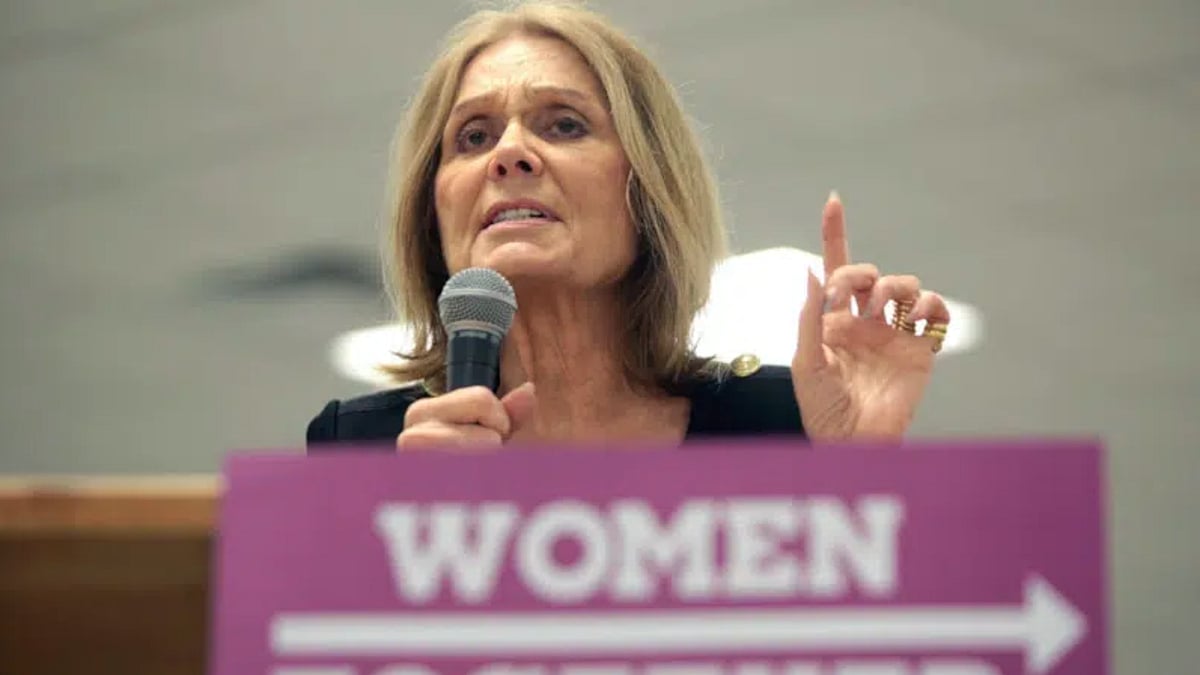
Gloria Steinem, the iconic writer, organiser and leading light of second-wave feminism whose relentless campaigning redefined women’s rights globally, passed away on September 2, 2026, at her home in New York City. She was 92.
While she spent decades at the absolute centre of American political life—co-founding the groundbreaking Ms. magazine, championing the Equal Rights Amendment and challenging systemic sexism, Steinem consistently traced the roots of her activist philosophy to an unexpected place thousands of miles away in post-Independent India.
Long before she became a household name, a 22-year-old Steinem arrived in Delhi in 1956 on a Chester Bowles Asian Fellowship. Fresh out of Smith College and seeking an alternative to the quiet domesticity expected of young American women in the 1950s, her two-year stay in India (1956–58) laid both the tactical and philosophical foundations for what would become a legendary career in social reform.
Delhi years and village organising
During her initial months in Delhi, Steinem lived among local students at Miranda House, Delhi University, quickly immersing herself in Indian life. To fund her stay, she wrote for local newspapers, authored travel pieces, and even posed in print advertisements for Delhi Cloth Mills wearing a sari -- a style she embraced while traversing the subcontinent.
Yet it was outside the urban capital where her political awakening took definitive shape. Steinem travelled extensively across southern India, including Tamil Nadu, joining grassroots workers involved in Acharya Vinoba Bhave’s Bhoodan Movement.
Walking on foot from village to village alongside Mahatma Gandhi’s spiritual successor and his followers, she observed how activists mediated entrenched caste conflicts, negotiated land redistribution from wealthy landowners to landless peasants and addressed localised violence through non-violent assembly and persistent dialogue.
In a 2007 interview with Meenakshi Mukherjee and Ira Pande for the India International Centre Quarterly, Steinem said, "Going from village to village with Vinoba Bhave's followers and learning about Gandhian activism probably helped me to become what I am today... If you want people to listen to you, you have to listen to them. I learned that in India."
Blueprint for American consciousness-raising
The non-violent, community-driven mechanics Steinem witnessed in Indian villages directly shaped the structural tactics of the American women’s liberation movement in the late 1960s and 1970s.
Most notably, the traditional village "talking circles"—where residents gathered under trees to share deeply personal accounts of hardship, caste discrimination and domestic strain in order to formulate collective solutions—served as the direct template for the "consciousness-raising" groups that became the hallmark of second-wave feminism in North America.
Steinem recognised that personal suffering, when shared in a trusted group setting, could be transformed into systemic political power.
During this period, she also engaged with radical Indian intellectuals, including Ellen Roy and members of MN Roy’s Radical Humanist movement, expanding her world view beyond Western liberal paradigms. She frequently cited freedom fighter and handicraft pioneer Kamaladevi Chattopadhyay as one of her primary lifelong mentors.
Decades of subcontinental solidarity
Steinem’s engagement with India was never a brief youth pilgrimage. It was a lifelong, active partnership with the subcontinent’s feminist vanguard.
Over the decades, she maintained tight alliances with Indian leaders, including Self-Employed Women’s Association (SEWA) founder Ela Bhatt and pioneering feminist economist Devaki Jain.
In her later years, Steinem worked closely with activist Ruchira Gupta and her organisation, Apne Aap Women Worldwide, campaigning aggressively against sex trafficking and advocating for the rights of marginalised women and girls across India.
In her 2015 memoir, My Life on the Road, Steinem dedicated significant reflection to her formative years in India. She repeatedly emphasised that her journey across the country disabused her of the notion that social progress could be dictated from above or imported from the West. True movement building, she argued, required humility, physical presence and above all, deep, empathetic listening.

