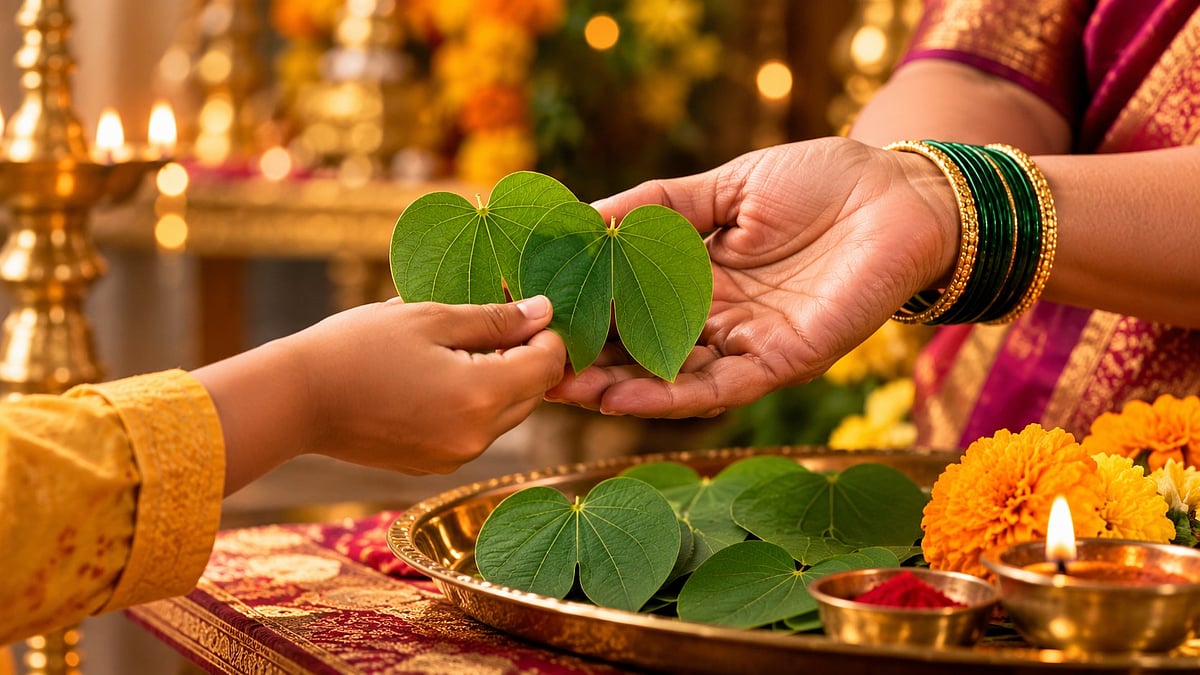
On the morning of Dussehra, the flower stalls around Dadar turn a deep, glossy green. Vendors sit beside heaps of apta leaves tied in small bundles, each leaf split into two rounded lobes like a pair of wings. By evening, the same leaves travel up building staircases and across chawl balconies. Children knock on neighbours’ doors, bend to touch the feet of elders and press a leaf into their palms with a familiar line: “Sona ghya, sonyasarkhe raha.” Accept this gold, and may you shine like gold.
In a season when families track the price of gold closely, Maharashtra’s most cherished Dussehra gift costs almost nothing. Its value, as families across Mumbai explain, rests in the story it carries.
Shower of gold
The custom traces back to the tale of Kautsa, which Kalidasa retold in his Sanskrit epic Raghuvamsha. Kautsa, the son of Devadatta, completed his studies under the sage Varatantu and insisted on offering gurudakshina, the gift a disciple presents to his teacher at the end of his education. Varatantu first refused. When Kautsa persisted, the sage named a sum he believed no student could raise: 14 crore gold coins, one crore for each of the 14 branches of knowledge he had taught.
Kautsa went to King Raghu of Ayodhya, an ancestor of Lord Rama known for his generosity. The king had recently given away his treasury, yet he would not send a scholar away empty-handed, and resolved to march on Kubera, the god of wealth. In the version told in Maharashtrian homes, Kubera answered before the king could set out and showered gold upon the apta trees. Kautsa took only what his guru had asked for, and the rest went to the people. Popular tradition places that day on Vijayadashami.
For Shantanu Pednekar, a 25-year-old PR professional from Mumbai, the leaves stand for generosity, gratitude and the blessings people share. “We may exchange leaves in the name of gold, but what we truly share is our love, our blessings, and a priceless piece of our heritage,” he says.
Two epics, one festival
The Mahabharata adds a second thread. Before their final year of exile in disguise at King Virata’s court, the Pandavas hid their weapons in a shami tree, and they retrieved them on Vijayadashami. In many Maharashtrian homes, shami leaves sit beside apta in the Dussehra puja. Popular accounts also link the custom to seemollanghan, the Maratha ritual of crossing the village boundary on Dussehra, after which soldiers returning from campaigns carried apta or shami leaves home to their mothers, wives and sisters as sona.
The same day brings shastra puja, the worship of tools and weapons, which in most homes now means laptops and pens. Sneha Warang, 32, keeps the practice with her family. “We worship our gadgets, stationery, tools and other work-related items as a way of expressing gratitude for the things that help us in our daily lives and praying for success and prosperity in our work,” she says. The Aptyachi paane follow, shared as a wish of goodwill and prosperity for loved ones.
Same leaf, many towns
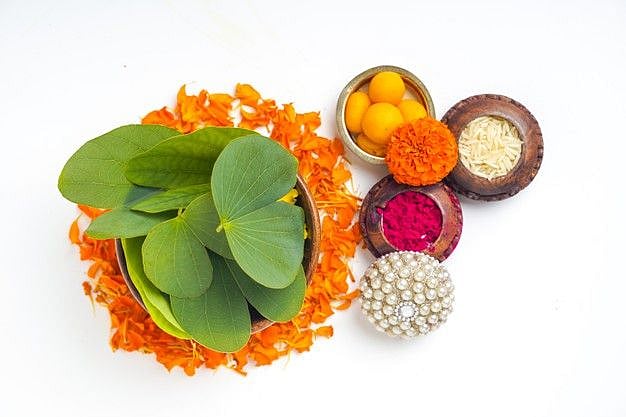
Pic: Pinterest
The ritual takes different forms across the state. Shama Hurkat, 23, grew up in Ansing, a town in the Vidarbha region, where families walk to the apta trees to gather leaves themselves before they visit relatives, neighbours and friends. She recalls a playful custom there, in which the young ask elders for real gold in exchange for their leaves. “While the customs may vary from town to town, the essence remains the same,” she says. For her, the festival is about reconnecting with people she rarely meets.
Singer and entrepreneur Jashan Bhumkar finds meaning in the distance between the leaf and the word attached to it. People call it gold even though the gesture is so simple, he points out, and that simplicity makes it a sincere way to wish someone well. “Traditions become more meaningful when we understand the stories behind them. Otherwise, we risk following a ritual without knowing why it began.”
Guru at the centre
For Bharatanatyam artist Apeksha Niranjan, the legend speaks to her own discipline. The story of Kautsa, she says, celebrates generosity, gratitude and respect for one’s teacher, values that classical dance also hands down across generations.
“The guru-shishya relationship is an integral part of this journey,” she says. “For me, the real sona is the goodwill, relationships and cultural values that we preserve and pass on to the next generation.”
Three generations, one bundle
Sudha Gavaskar, 61, has watched the ritual move through her family in both directions. “We are somehow in a sandwich generation,” she says. “I have seen my parents and grandparents follow this custom, and now seeing my children and grandchildren do it feels surreal. One must never forget their roots.”
At the other end of that chain, Sneha will celebrate this Dussehra with her one-year-old son. He is too young to understand the festival, she admits, but she looks forward to the day she can tell him the story of Lord Rama’s victory over Ravana and the triumph of good over evil. “For me, it’s about passing on our culture, values and traditions to the next generation,” she says.
Within a week, most of the leaves exchanged across Mumbai will dry and crumble in pooja thalis and wallet folds. The words spoken over them will keep travelling, from a grandmother to a grandson, every Vijayadashami: sona ghya, sonyasarkhe raha.

