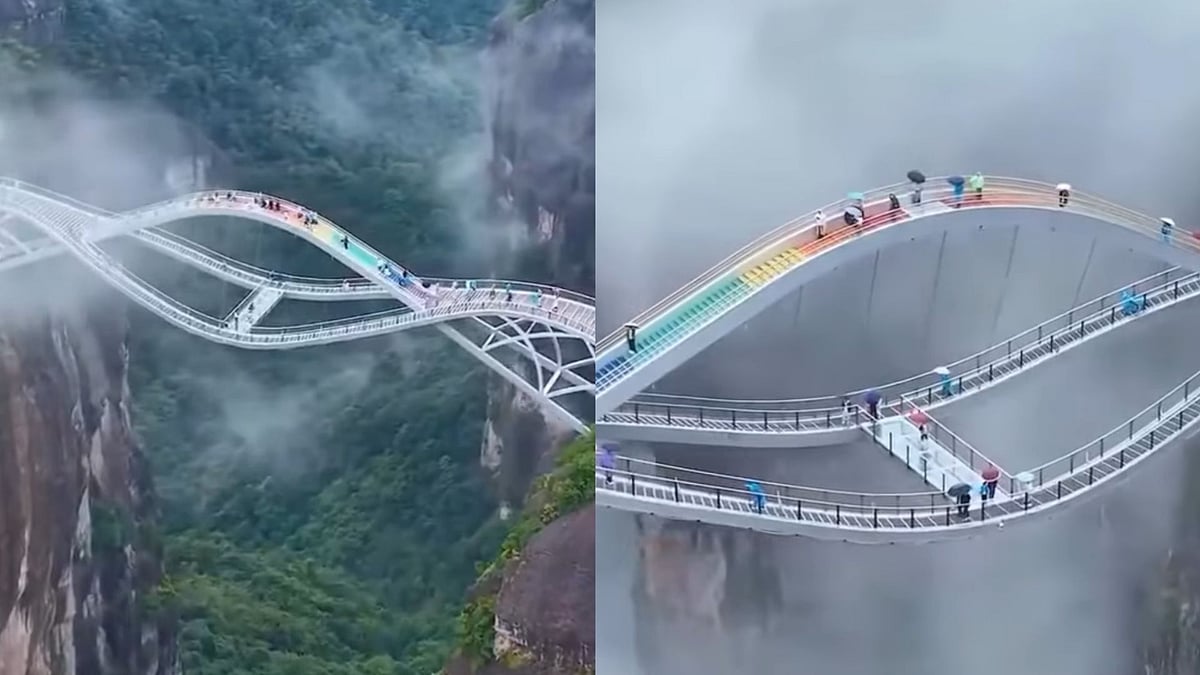
Hidden among dramatic cliffs and misty peaks, the Ruyi Bridge is one of China’s most striking modern attractions. Located inside the Shenxianju Scenic Area in Xianju County, Taizhou, Zhejiang Province, this architectural marvel hangs high above a deep mountain valley, drawing thrill-seekers, photographers, and nature lovers alike. The site is easily accessible, roughly a 30-minute drive from Xianju town, making it a popular stop for domestic and international tourists.
Where nature meets bold design
Shenxianju Scenic Area is celebrated for its volcanic rhyolite formations, lush forests, waterfalls, and clear mountain streams. Rising seamlessly from this dramatic landscape is the Ruyi Bridge, a structure that feels both futuristic and poetic. Designed by renowned architect He Yunchang, also known for contributing to Beijing’s Olympic “Bird’s Nest”, the bridge blends engineering innovation with traditional Chinese symbolism.
From above, the bridge resembles a floating jade ruyi, a traditional object associated with good fortune, or the flowing ribbon of a celestial dancer. This visual harmony with nature is one of the reasons it has become an instantly recognisable landmark.
A walk above a 140-metre drop
The Ruyi Bridge stretches approximately 100 metres between two cliffs and offers a viewing area of around 1,100 square metres. Its most thrilling feature is the transparent glass walkway suspended about 140 metres above the valley floor. Every step reveals dizzying views of the gorge below, creating a rush of adrenaline while offering sweeping panoramas of the surrounding mountains.
The bridge features three interwoven, wave-like decks. While the upper level uses metal and solid surfaces, the lower level is crafted from reinforced transparent glass, allowing visitors to literally walk above the void.
Built for safety and comfort
Despite its heart-racing appearance, the Ruyi Bridge is designed with safety as a top priority. It is constructed primarily from steel and supported by multiple layers of high-strength steel cables. The glass panels are reinforced and pressure-tested, meeting international safety standards. Since opening to the public during China’s National Day holiday in 2020, the bridge has welcomed large crowds without incident.
