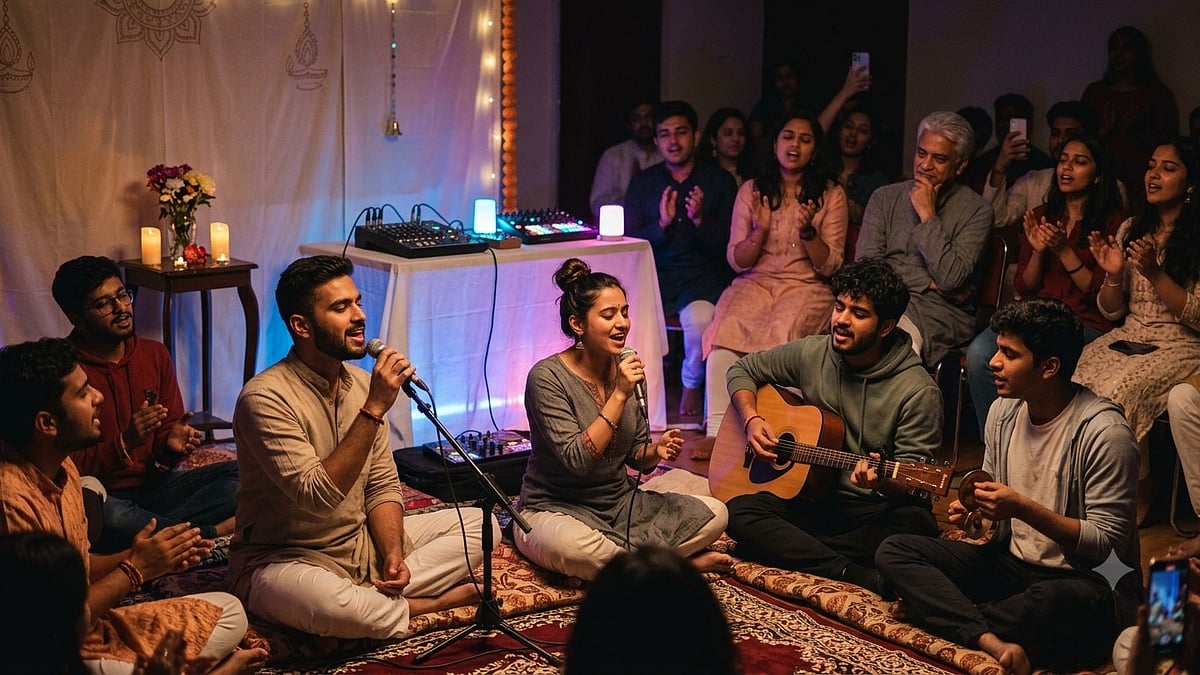
From traditional bhajans to energetic bhajan jamming, devotional music is finding a new audience among Gen Z. While some see it as a refreshing way to make spirituality accessible, others question whether beats, DJs and high-energy settings dilute its essence. Satya Tirtharaj Ghosal moderates a debate.
Shashikant Vyas, Founder & Director of Pancham Nishad

Modernizing bhajan isn't new commercialization, it's old wine in a new bottle. From the Sharma Brothers to Anup Jalota to programs like Bolava Vithal (running in 35 cities over 16 years), devotional music has always evolved its packaging. Now it's called bhajan clubbing, jamming, or sandhya. Bhajan means "bhakti of jan" which signifies devotion of the people, so group singing was always its essence.
Can excitement be mistaken for depth? It depends entirely on the performer. Spirituality is individual but excitement is collective. The same Abhang sung by different singers can land completely differently. One evokes real spirituality, another doesn't, even with identical lyrics. Words matter as much as musicianship in devotional music, unlike classical music where raag alone suffices. That's why instruments like sitar or sarod rarely work here. Only the flute comes close, because breath itself feels spiritual but other instruments also have their meaning.
On ticketing: why should devotion be free? Halls cost money, organizers have expenses. Calling it "commercial" ignores that most bhajan performers are middle-class people, not profiteers. The deeper aim is still spreading culture and a "sane mind."
For genuine evolution without gimmicks, the key is a clear theme. One deity, one story, curated with intention, not Ram, Krishna, and Durga jumbled together for spectacle. Younger generations, under more stress than earlier ones, are drawn to this rhythm-driven, peace-giving format as a kind of sedative for the mind.
Finally, success isn't crowd size, it's the spiritual connection people carry home. Numbers reflect return on investment, not the soul of the art. Bhajan clubbing is one source of spiritual awakening, not the only one.
Raghav Agarwal & Prachi Agarwal, The Brother Sister Duo of Backstage Siblings

Bhajan Jamming is a space where hundreds come together to sing, chant, and celebrate bhajans with energy. The goal was to make the bhajans we grew up with feel exciting and relatable for our generation and now, with Bhakti Dance Floor, we're taking that celebration of devotion even further.
The essence of the bhajan always comes first. We experiment with sound and energy, but the lyrics, emotion, and devotion stay at the heart of everything.
If someone who'd never attend a traditional bhajan comes, sings for 90 minutes, and leaves wanting to know more which happens every time and that itself is a meaningful connection. We see teenagers and college students singing alongside parents and grandparents, not just attending but actually knowing the words and participating.
The only thing we've borrowed from club culture is the high energy. Everything else is old school, people sitting on the floor, singing together, finding peace in practices generations old. "Bhajan clubbing" is just what Gen Z calls it. For us, preserving the sanctity of the bhajans has always been non-negotiable.
Devotion can never be a trend. Formats may evolve, but if they help a new generation connect with our culture, that connection is here to stay.
Raghujeet Singh, Student in M.A. Music
For me, it's a mix of both: energy is the main component of bhajan jamming, but spirituality is there too, since a bhajan is a spiritual thing in itself, and so is music. That said, I don't think the electronic version creates a stronger connection than the traditional form.
Traditional bhajans feel very pure, with nothing technical or digital about them but there's a naturalness to it and that's hard to replace. At the same time, leaning too heavily on electronic beats and equipment can end up making a bhajan feel unnatural, so it really comes down to a balance between the two.
I do think it can sometimes turn devotion into a trend. Earlier, bhajans were sung the proper way, like without shoes or slippers, and now bhajan jamming happens in a much more modern setting, which feels a little off in some ways. But even so, sometimes an "improper" way of doing things can still lead to something good. If it's getting Gen Z more interested and involved, then it isn't entirely a bad thing.
Yashwant Chaudhary, A Devotee

Spirituality is not a feeling, I pursue it for the discipline and I have kept it for forty years. Every morning, before the household wakes, I sit for my puja, the same mantras, the same order, the same hour. Devotion is not experienced like a mood, it is earned through repetition and restraint not through shortcuts.
I find it presumptuous. They have not sat with a guru, fasted, kept vigil, or learned even one raga properly, yet feel entitled to remix what took saints a lifetime to compose. Enthusiasm is not reverence. I am glad they are curious, but curiosity dressed as devotion is still just curiosity.

A bhajan is not only its words, it is its tala, its silences, the voice surrendering rather than performing. Put a DJ behind Meera's words and you have entertainment, not surrender. You cannot electrify humility. The essence survives only in restraint, and restraint is exactly what a nightclub removes.
At best, it's a doorway but if it eventually leads someone to sit quietly and learn the meaning of what they danced to. But a doorway is not the house.
My fear is not that the young are dancing. My fear is that they mistake the dancing for the destination, and never go looking for what lies beyond it.

