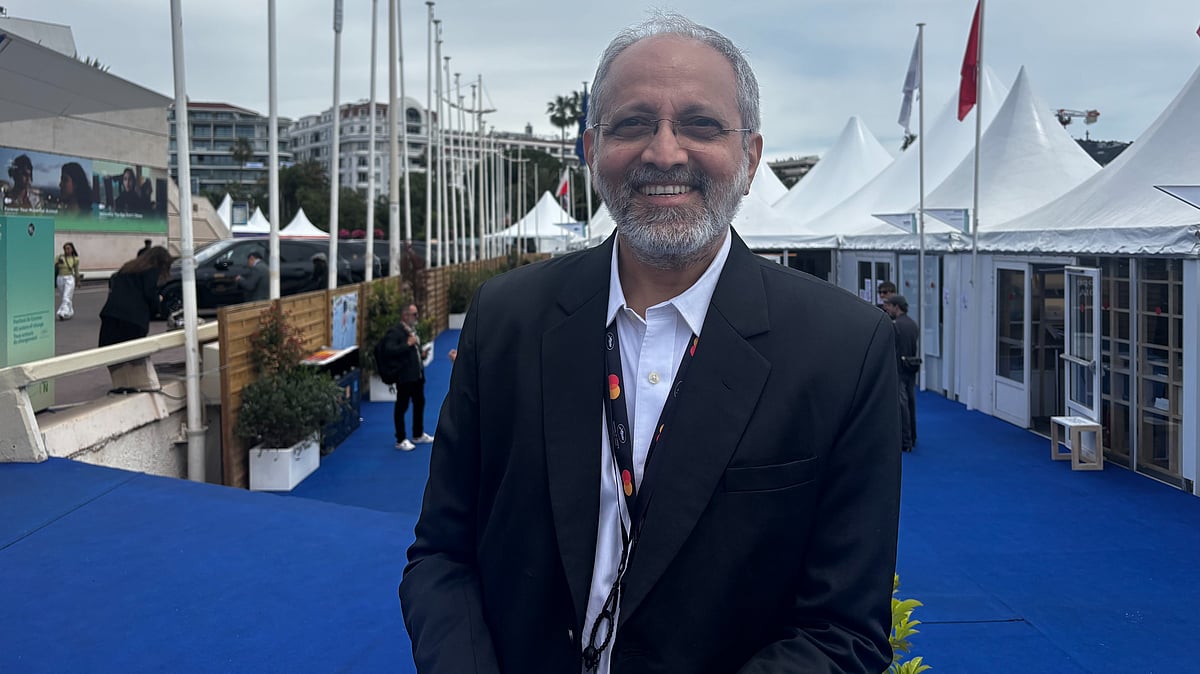
There is something quietly powerful about a filmmaker who insists on telling the truth of his own world and then watches a French woman weep at the sight of it. That is exactly what happened to producer-director Rajesh Mapuskar, the Mumbai-based writer, director, and producer, when his latest production screened at the Cannes Film Market (Marché du Film) this year.
Rajesh Mapuskar is at Cannes representing April May 99, a coming-of-age Marathi film written and directed by his brother, Rohan Mapuskar, and selected by the Government of Maharashtra’s Film City for the market. The title carries a deceptively simple meaning for anyone who grew up in Maharashtra. “April May means vacation. Holiday means fun, no studies. Cricket, swimming in the sea, climbing mango trees,” he explains with a wide smile.
“Every Maharashtrian looks forward to that.”
But the film reaches beyond its regional roots. Set just before the turn of the millennium, it captures a world without mobile phones or the internet — a world where boys still felt awkward talking to girls, where not knowing English felt like a social failing, and where three teenage friends finishing their 10th grade had nothing more urgent to plan than how to spend their summer. When a city girl from Pune arrives speaking fluent English, and one of the boys is packed off to learn the language his parents consider essential, the summer’s easy rhythm begins to unravel.
“There are multiple layers,” he adds. “Friendship. First infatuation. The complex about English being seen as superior, which it is not. It is simply a language you do not yet know.” The film also touches on menstruation, portraying something rarely
discussed openly in Indian cinema, with a gentleness that he says is entirely intentional. “These are universal emotions. Film languages change, but emotion does not.” His instinct proved right. After the screening, most of the audience was foreign, and several French women were seen wiping their eyes. “I was overwhelmed,” he admits. “It gave me confidence as a producer that this kind of emotion touches people everywhere.”
On the broader question of why Indian films rarely make the main Cannes competition, Rajesh Mapuskar is frank. “I don’t make a film for a festival. I make a film because I have a story to tell. If the festival likes it, wonderful. But if you want to compete at Cannes, you need to study what those films are and make a conscious choice.” He sees the lack of that strategic clarity as part of what holds Marathi cinema back, along with underprepared scripts, impatient producers, and a confused understanding of the difference between funding a film and producing one.

He is equally clear-eyed about the challenges of distribution. Marathi films, he says, suffer from a divided audience that can choose between Hindi and Marathi, unlike Tamil or Telugu viewers, who remain fiercely loyal to their regional cinema. The rise of OTT has further complicated theatrical releases, though he believes FOMO (fear of missing out) can still bring audiences to cinemas for the right film.
Despite having won a National Award as a director, Rajesh says he is now finding greater satisfaction behind the scenes. “As a director, I can tell one story in two years. As a producer, I can tell four. I want to stand behind young filmmakers and help them tell their stories.”
He is not entirely stepping away from directing, however. His next project as director is a Hindi film titled Chiranjeevi Hanuman, an AI-native production and reportedly among the first of its kind in India. “My Hanumanji is not a superhuman who simply flies,” he says. “He is self-doubting. He wonders whether he can do it. And that is all of us; every day we doubt ourselves, and every day we pull ourselves up. That is the Hanuman I want to show.”
From a summer vacation in 1999 to an AI-powered mythological epic, Rajesh Mapuskar’s range is as wide as his ambitions. At Cannes, he found what he came looking for: proof that a story rooted in one small corner of Maharashtra can move a stranger in France to tears.

