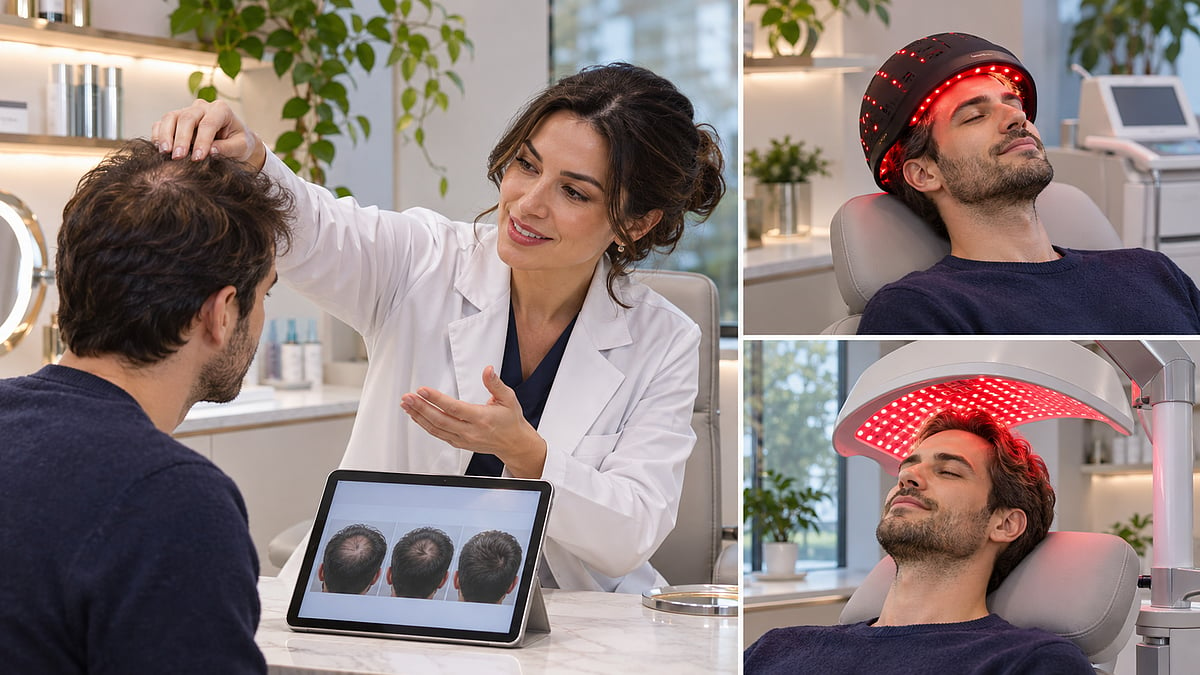
From Nobel-recognised discoveries in light-based biology to photobiomodulation and wearable LED devices, advances in science are expanding the possibilities of non-surgical hair restoration.
Light has long been used in medicine and scientific research, but its potential to influence biological processes is attracting renewed attention. The 2026 Nobel Prize in Physiology or Medicine, awarded to Karl Deisseroth, Peter Hegemann and Georg Nagel for their discoveries concerning light-gated ion channels and optogenetics, has brought global recognition to the role of light in understanding and controlling cellular activity.
Although optogenetics and photobiomodulation are distinct scientific approaches, this recognition highlights the expanding intersection of light, biology and medicine. In dermatology, one area of growing interest is Low-Level Light Therapy (LLLT), also known as photobiomodulation, particularly for its potential role in hair restoration.
Hair loss is a common concern influenced by genetics, hormonal changes, nutritional deficiencies, stress and underlying medical conditions. While conventional management includes medications and surgical procedures, advances in technology are creating additional non-invasive options that may complement established treatments.
Beyond surgical hair restoration
Hair transplantation involves relocating follicles from a donor area to regions affected by hair loss. It can produce significant results in appropriately selected patients, but factors such as donor hair availability, cost, surgical suitability and recovery requirements influence treatment decisions.
This has encouraged interest in complementary approaches that focus on supporting existing hair follicles. LLLT is one such option being explored, particularly in androgenetic alopecia, commonly known as pattern hair loss.
Unlike transplantation, this approach uses specific wavelengths of red or near-infrared light to interact with biological processes within the scalp and hair follicles.
Science behind red light therapy
Photobiomodulation uses selected wavelengths of red or near-infrared light at controlled doses to influence cellular activity. One proposed mechanism involves the interaction of light with cytochrome c oxidase, an enzyme within the mitochondrial respiratory chain. This interaction may influence cellular energy production in the form of ATP and downstream cellular signalling pathways.
These mechanisms have made photobiomodulation an area of scientific interest across dermatology, wound healing and rehabilitation. In hair restoration, researchers are investigating how these cellular interactions may influence follicular activity and support hair growth.
How therapy interacts with hair follicles
Hair growth follows three phases: anagen (growth), catagen (transition) and telogen (resting). In androgenetic alopecia, this cycle becomes progressively disrupted, with follicles undergoing miniaturisation and producing increasingly finer hair.
Research suggests that LLLT may influence follicular activity and support the hair growth cycle. Clinical studies have reported improvements in hair density among individuals with pattern hair loss following consistent treatment.
However, responses vary between individuals, and further research is needed to establish optimal treatment parameters and long-term outcomes.
Complementary treatment
LLLT is increasingly being considered as a complementary option within comprehensive hair-loss management rather than a replacement for conventional treatments.
Depending on the diagnosis, dermatologists may consider combining light therapy with established treatments such as topical or oral medications. However, hair loss caused by nutritional deficiencies, hormonal disorders, autoimmune conditions or other underlying medical problems requires appropriate investigation and targeted treatment.
An accurate diagnosis remains the starting point for any hair restoration programme.
Role of wearable and at-home hair restoration devices
One significant development in light-based hair therapy is the emergence of wearable LED devices designed for home use. These technologies offer an opportunity to incorporate light-based treatment into daily routines under appropriate professional guidance.
The technical design of these devices is an important consideration. For example, wearable LED systems may use red-light wavelengths around 640 nm, with multiple light-emitting diodes positioned to deliver light across the scalp. Some medical-grade systems, such as the L3Tx LED cap, feature 120 LEDs and are designed around a convenient 10-minute daily treatment session. The device also carries US FDA clearance for specified hair-loss indications.
Such developments represent an interesting transition in hair restoration: extending professionally guided light-based treatment approaches from the clinic into the home. However, convenience alone does not establish clinical effectiveness. Wavelength, irradiance, treatment duration, device design and supporting clinical evidence should all be considered when evaluating suitability.
Consistency, duration and realistic expectations
Red light therapy should not be viewed as an overnight solution. Hair growth is a gradual biological process, and visible changes may take several months. Consistent use according to recommended treatment protocols is therefore important.
Outcomes may depend on the underlying cause of hair loss, the condition of the follicles, device specifications and treatment adherence. Not everyone responds in the same way, making professional consultation particularly important.
Future of tech-driven hair restoration
The recognition of light-based biological research at the Nobel level reflects the remarkable scientific possibilities emerging at the intersection of optics and life sciences. While optogenetics and photobiomodulation serve different purposes, both demonstrate how light can be used to investigate and influence biological systems.
In hair restoration, photobiomodulation and wearable LED technologies are expanding the range of approaches available alongside established medical and surgical treatments. The future is likely to involve a more integrated approach, combining scientific evidence, technological innovation and personalised clinical care.
Ultimately, the objective is not to replace existing treatments, but to make hair restoration more comprehensive, accessible and aligned with individual patient needs.
(Dr. Nishita Ranka, Dermatologist, Dr Nishita’s Clinic, Hyderabad)

