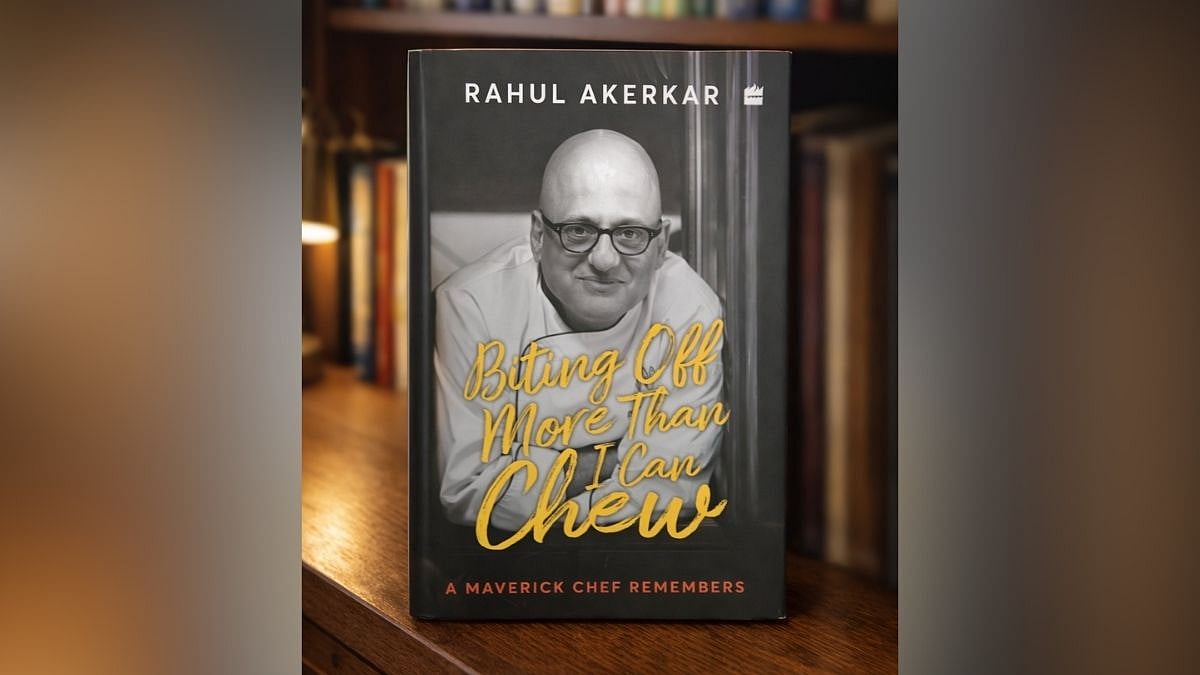
I finished Biting Off More Than I Can Chew: A Maverick Chef Remembers (Harper Collins India; Rs.1,199) in two days flat—hardly surprising, given how compulsively readable it is. Yes... every one of those 441 pages!
As someone who writes about food and restaurants for a living, I approached it with curiosity; I came away with something closer to admiration, tempered with recognition. This is not a sanitised chef’s tale or a self-indulgent “ego-salve”. It is, instead, a deeply personal excavation of a life spent in pursuit of something far less tangible than success.
From the outset, Rahul Akerkar makes it clear that this is not a victory lap. If anything, it is a reckoning. The book offers readers a culinary road map into the psyche of a chef often misunderstood—brilliant, instinctive, occasionally abrasive, but, crucially, self-aware enough to call himself out. Where many chefs wander down paths cluttered with ego, Akerkar takes an unexpected detour. One that often leads him straight to humble pie.
Kitchens, chaos, clarity
The early chapters, set against his time in New York, are among the most revealing. Here is a young biochemical engineering student, experimenting not just with food but with life itself—dabbling in drugs, absorbing the relentless pace of (un)professional kitchens, and slowly shedding the rigidity of academia. It is in these moments that the book finds its rhythm, moving seamlessly between the chaos of youth and the clarity that only hindsight can bring.
What I particularly appreciated was how he threads his personal milestones into the narrative without ever allowing them to overshadow the central theme of food. His mixed heritage—his German-Jewish mother and Konkan-Maharashtrian father—becomes more than biographical detail; it forms the backbone of his culinary voice. These seemingly disparate influences find harmony on the plate, long before fusion became fashionable.
Building Indigo
Akerkar’s account of building the iconic Mumbai restaurant Indigo in the late 1990s is, unsurprisingly, a centrepiece. For those of us who witnessed its rise, the book offers context to what felt, at the time, like a quiet revolution. Indigo was not just a restaurant; it was a shift in how urban India perceived dining. The dishes he revisits—pan-seared grouper, basil poha, prawn and squid balchao with solachikadi—are not described with indulgence, but with a certain restraint that makes their impact even more apparent.
Equally compelling are the stories behind the scenes: the missteps, the near-misses, the moments of doubt and the betrayals. The press material that was sent to me by the publishers hints at celebrity dinners and mafia tables, and the book delivers on that promise, but never at the cost of depth. These anecdotes serve as texture rather than distraction.
Recipes as redemption
One of the book’s most endearing touches is the inclusion of recipes at the end of key chapters. For readers like me, this felt like an invitation—an assurance that the magic, while elusive, is not entirely out of reach. The blackened pomfret, tobacco onions, and cornbread from Under the Over—dishes that defined an earlier chapter of my own dining life—sit alongside these narratives like quiet rewards. It is rare for a memoir to balance storytelling with such practical generosity. Here, the recipes do more than instruct; they anchor the narrative in something tangible.
A life, unvarnished
What ultimately elevates this book is its refusal to romanticise. Akerkar writes with a candour that is disarming. There is no attempt to polish the rough edges, no desire to present a curated version of events. Instead, we are given a portrait of a man who has stumbled, recalibrated, and carried on.
In an industry that often celebrates certainty, this honesty feels radical. It takes, as he himself might put it, a fair amount of coglioni quadrati (meaning? Read the book!) to lay oneself bare in this manner.
For me, this was more than just a satisfying read—it was a reminder of why stories around food matter. Not because they celebrate perfection, but because they reveal the flawed, fascinating journeys behind it. And yes, the mavericks who hazard them, too.
(The writer is a food and travel columnist and editor)

