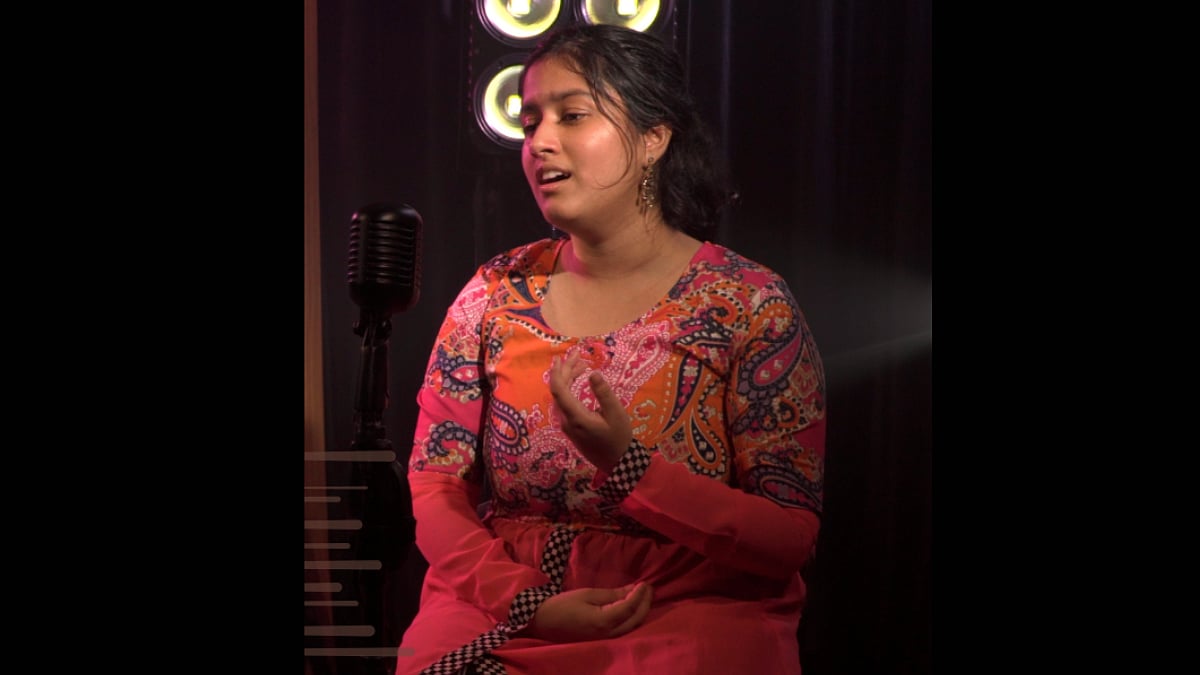
Neeru (Neeharika Shyju) is an Australian vocalist, composer, and songwriter whose music transcends geographic and stylistic boundaries. An alumna of the prestigious Victorian College of the Arts Secondary School (VCASS) and currently refining her craft at the Sydney Conservatorium of Music, her expansive sonic palette seamlessly weaves together Indian classical, Western classical, Celtic folk, jazz, and cinematic idioms.
Neeru writes from the perspective of a life lived between cultures—rendering her deeply sensitive to the nuances of language, atmosphere, and the universal stories that connect us. ‘Moonbow’ is her concept album released on 5th September is a breathtaking 12-chapter sonic odyssey that chronicles a single night from dusk to dawn. It is her most profound artistic statement to date, establishing her as a distinct and brilliant new voice in the global contemporary landscape. Arranged chronologically from 7:30 PM to 5:30 AM, each track represents a specific hour and emotional state guiding the listener through wonder, confrontation, expression, love, and finally, peace.
The 19-year-old talks about her album and how she manages to retain her Indian roots in her music.
Excerpts from the interview:
You wrote, composed and arranged the EP ‘Moonbow’ yourself using live instrumentation. What was one thing you refused to compromise on?
It was crucial to me that the sonic palette sounded natural. I wanted to ensure that the human essence was retained. By using live instrumentation, I feel I am able to create a deeper connection with listeners.
Did the dusk-to-dawn concept come first, or did the songs naturally fall into different hours of the night?
The concept definitely came first. The night has always fascinated me, and I wanted to create something that explored that part of the day. However, I must admit that the exact timing for each song was assigned afterward.
Writing in Australia, far from Kerala and Oman, did your debut become a way of exploring your identity?
Absolutely. Living in so many places has shaped my view of the world, and I believe this musical exploration of my identity will be an endless journey as I move across future chapters of my life.
One the songs Painted Maiden explores the expectations of femininity. Personally, was it a confession, an accusation, or a release?
Throughout my life, I’ve observed the unspoken expectations placed upon women. To me, this song is a release of empowerment—the painting metaphor resonated with me for this reason. Each individual gets to choose how they want to portray themselves.
Your music blends Indian classical, Celtic folk and jazz. Sailor’s Horizon is an explicitly Celtic jig. Do you aim to blur musical boundaries or celebrate their differences?
Everyone draws the line of musical boundaries in different places. My aim is to continue learning about how musical elements are treated across the world and implement that into my work. I don’t intend on forcing fusion, but rather letting the lines blur naturally.
Aurora ends the EP on a hopeful note of love and connection. Why did you choose that ending?
When coming up with the night-based concept, I thought the most appropriate way to end the album would be a lullaby-like tune. I suppose it’s a way for me to remind listeners that the darkness is where we truly find and value the light in our lives.
Los Angeles based producer, engineer and mixer Adam Kagan credited you with combining pop sensibilities with real musical depth. Your comment?
I was very honoured to work with someone with so much experience in the music industry. His feedback is a huge motivation for me to continue developing my craft.
Who filled your home with music? Was it your parents or was it inborn, and how important was your family's support in your choice of career?
Coming from a music-loving family has inspired me to view music as a source of comfort and happiness. The arts can be a very demanding industry, and I’m so fortunate to have a family that supports me through all the triumphs and adversities.
Academically what have you done until now and if not music, what would be your choice of career?
I graduated from the Victorian College of the Arts Secondary School in 2025. Apart from music, I really enjoy scientific research in relation to human anatomy, so if not music, something along those lines would be interesting to explore.
You've taken risks as both a singer, on stage at the show The Talent and a composer. Is it harder to trust your own voice on stage, or your own music in an orchestra?
With each new performance, I feel more at home with my creative practice. That said, it is slightly harder for me to trust my own music with an orchestra, as I don’t have total certainty over how it will be interpreted by others. It can be vastly different from how it sounded in my head.

Why did you choose the legend of Perumthachan (from the OST Malayalam movie ‘Perumthachan’ (1990)) as the inspiration for a piano trio (three Western chamber instruments) and what did you hope to capture in the music?
As one of the most prominent figures in the folklore of Kerala which is my native state, Perumthachan intrigued me immensely. It also premiered in the Eurasian Expeditions of the Port Fairy Spring Festival. Every retelling drew me closer to the complexities within the father-son relationship. By the end of the piece, I aim to capture an uneasy sense of peace, something was resolved, but at what cost?
As an Indian-born composer writing in Australia, how did you approach composing Respect The Land, an acknowledgement of First Nations custodianship, and what responsibility did you feel in telling that story?
As a non-Indigenous Australian, I acknowledge that I cannot fully understand the depths of the stories and cultural practices that have been passed down through generations. I simply wanted to pay homage to the deeply spiritual relationship between First Nations communities and the Australian land, a connection rooted entirely in love and respect.

