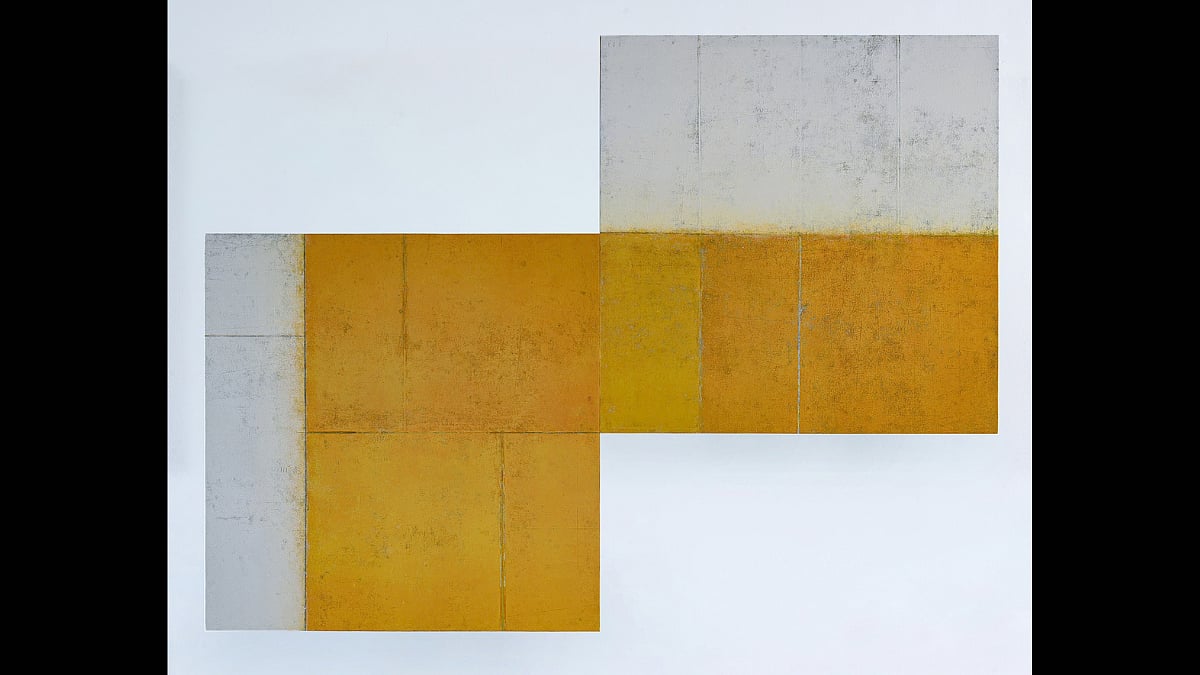
Walk into Harvesting Light at Chemould Prescott Road and the room is meditative. Nothing shouts. Then you face a painting, and it lures you in, and the deeper you dig, the more you find: a riot. Her paintings keep their bruises. The wounds and tears do not scream, but sit quietly in the surface, like a body that has witnessed the onslaught of time.
Most painters start with white paper or a white canvas. She did not. Black consumed her for decades. For years she worked on an 11-inch square of black paper, layering it, wounding it, stripping it open, and beginning again. There was no image to arrive at, only the compulsion to discover what successive layers, built up and stripped back, might reveal. It was decades before she could work with the starkness of white.
It was also a limit. For years she could not leave that square. What looked like being stuck was the work itself: one field, asked the same question again and again.
She never plans the format, the size or the colour of a painting. They shift, half-decided, almost unconsciously. Working almost in a trance, she lets one layer bury another, then opens it again. Every hue goes down first; then, painstakingly, she covers them, until white appears. What emerges is what the surface, through its accumulated history, allows her to find. Everything that followed grew from that square.
More than three decades on, the exhibition, curated by Anurag Khanna, makes that continuity visible. The earliest work on view dates from 1991, a pale watercolour eleven inches square. Since then, almost everything around the work has changed. The square became a rectangle, and intimate sheets grew into canvases as large as six feet by twelve. Early watercolours gave way to acrylic, and the newest works turn sculptural, with raised planes and deliberate cuts. Yet the essential Gattani is unmistakable: the layering, the covering and uncovering, the return to a painting to look again.
Her surfaces have a body. Thickened by time, they recall the old walls of a city, where years of paint split open to reveal a colour that was there all along. Mehlli Gobhai sensed this when he wrote of the black “lurking deep within” her paintings. Time in her work is not depicted. It is embedded.
This is the weight of time, the body of colour, not its mass. Thin layers and hues, over time, thicken to become almost like leather or slate. One looks like a piece of leather, framed. Another, like slate.
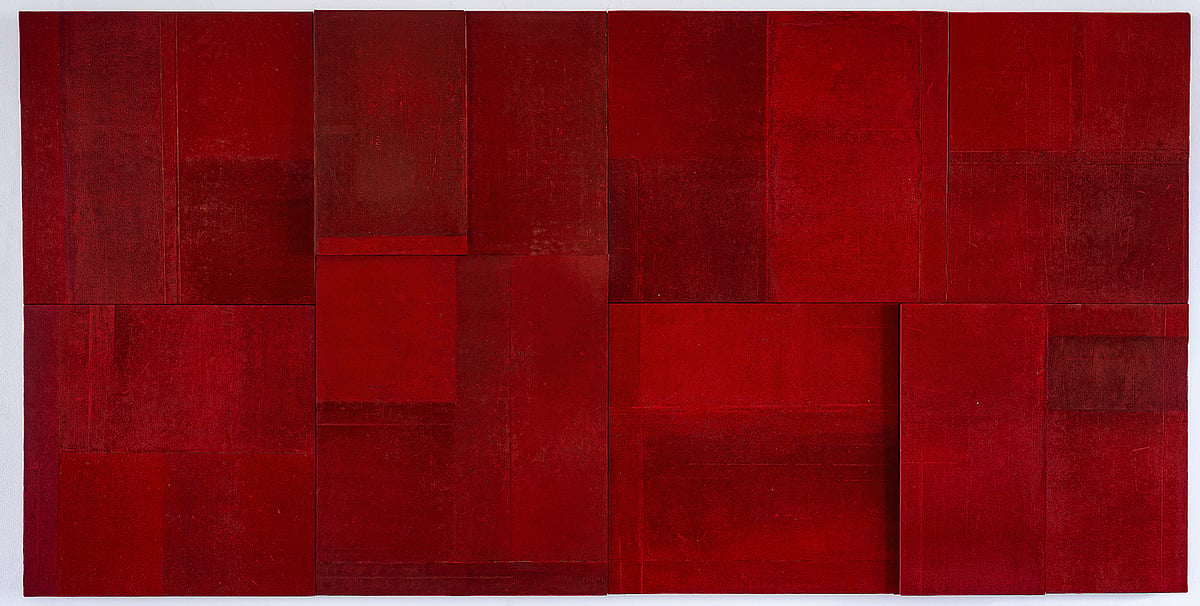
Stand before the untitled red work of 2026, six feet by twelve, and it seems about to break open. It is not flat. Planes step forward and back, their edges throwing fine shadows, and the painting takes on the feel of sculpture. Come closer and the red is scored with fine lines and small clusters of tick marks, like days counted. Light slides across its deep, dark reds, and the eye cannot settle.
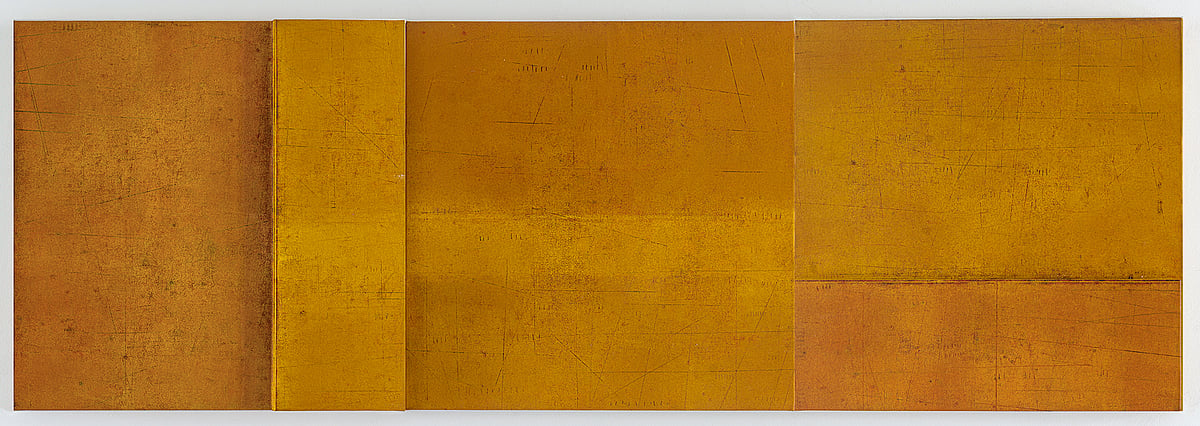
The yellow works are quieter and harder to leave. Panels stand just off the wall, one stepping out like a small orange block, and the same fine scoring crosses the surface. Nothing announces itself. But stay with it and the yellow stops being one colour: ochre drifts toward olive, and traces of red show in the scratches and along the seams.
Then, in Marigold, the white arrives. White planes sit against yellow, stark and soft at once, and grey specks show through like old bruises. This is the white she once could not face: not a blank to start on, but where the painting ends up, after every colour beneath it.
And there is light, and the show takes its name from it. Stand before Harvesting light (2025), three feet by nine, and the light does not seem to reflect off the painting. It seems to emit from it, like sunlight, out of hundreds of hues laid one beneath another. It is not cast onto these works; it is found inside them, rising through fractures, cuts and raised edges, from the very places where the canvas has been opened. Darkness is not light’s opposite. It is where the light has been waiting.
This is why the work resists a single reading. There is no story to extract and no symbol to decode. The paintings ask only that you stay with them and let your own response develop. At the gallery, one young visitor stood and observed the works for two hours. A young writer confessed that some of them overwhelmed him; he wanted to cry and could not understand why.
Gattani does not tell you what to see. She makes you look, and then she makes you excavate. Return after an hour or after years, and something will have shifted, not necessarily in the painting but in your capacity to see it.
These paintings do not reveal themselves once. They keep becoming visible.

