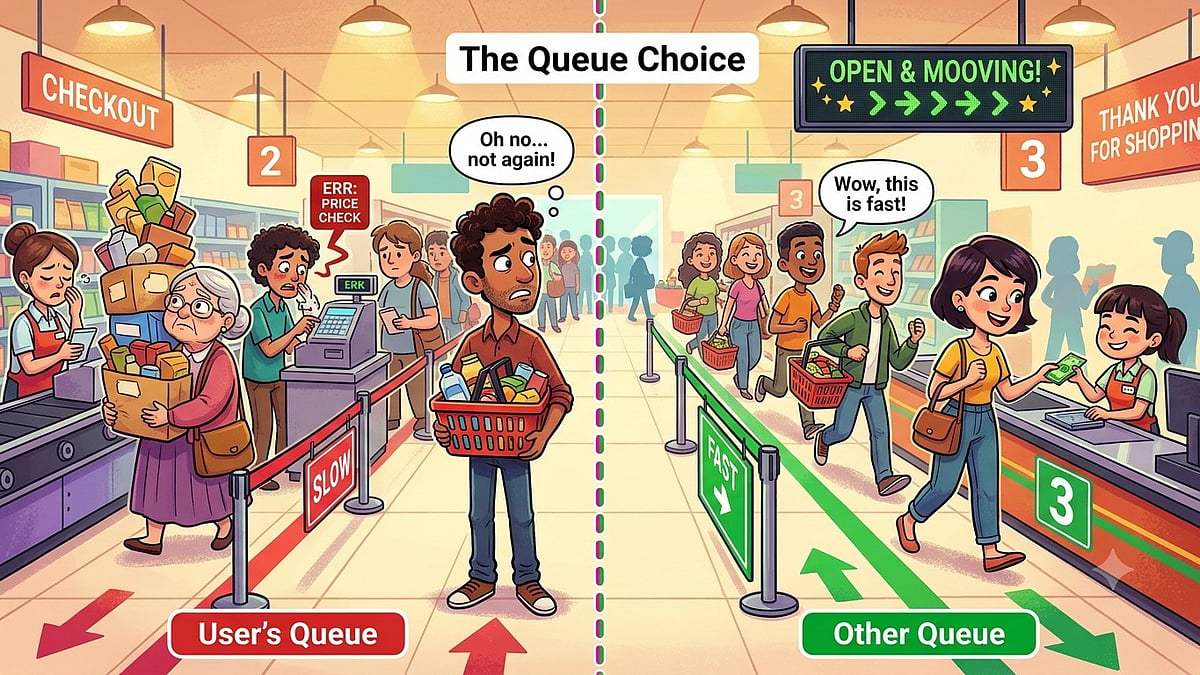
It’s one of life’s great, infuriating mysteries: you pick a line at the grocery store, bank, or toll booth, and the moment you step into it, it grinds to a halt while the lane next to you zooms ahead.
While it feels like the universe is personally playing a prank on you, the reason the "other" queue always seems faster actually comes down to a mix of human psychology and pure mathematics. Here is why you feel like you always pick the wrong line.
The Math
If you are choosing between three different lines at a grocery store, there is a 1 in 3 chance (33.3%) that your line will be the fastest. That means there is a 66.6% chance that one of the other lines will beat yours. If there are four or five lanes, the mathematical odds that you happened to pick the absolute fastest one get even worse. Statistically speaking, the other queue usually is faster simply because there are more of "them" than there is of "you."
Illusory Correlation
Our brains are wired to look for patterns and remember negative experiences over neutral ones.
The Slow Times Stick: When you pick a line and it moves smoothly, you don’t think twice about it. You grab your bags and leave. It doesn’t register as a memory.
The Fast Times Hurt: When you get stuck behind someone trying to return an item without a receipt, you stand there stewing. Your brain flags this as an annoying event, making you highly aware of the people next to you who are flying through.
This creates an illusory correlation—you incorrectly link the act of you joining a line with the line suddenly slowing down.
Linear vs. Serpent System
The way a store designs its waiting area drastically changes how fair it feels.
Parallel Lines (The Grocery Store Setup): In a parallel system, each register has its own dedicated line. This is a high-risk, high-reward setup. If one person has a price check or a broken barcode, the entire line freezes.
The Serpent Line (The Bank or Airport Setup): In a single, winding line (a "serpentine" queue) that feeds into multiple registers, the system is much fairer. If a customer at register #2 takes ten minutes, the line doesn't stop; the next person in line just goes to register #3.
Even though a serpentine line looks incredibly long, it is mathematically more efficient and drastically reduces the "why is my line so slow?" anxiety, because everyone moves at the exact same average pace.

How to Beat the System
If you want to maximize your chances of getting out faster in a parallel line setup, queue theorists suggest a few tricks:
Go Left: Most people are right-handed and naturally veer to the right when choosing a lane. Left-hand lanes are often less crowded.
Look at the Cart, Not the People: One person with a full cart usually moves faster than three people with two or three items each. Every single person requires a separate transaction, greeting, payment process, and receipt printing—which are the most time-consuming parts of a checkout.
Avoid the Chatty Cashier: It sounds harsh, but a cashier who is actively conversing with every customer will inherently move slower than one who is purely focused on scanning.

