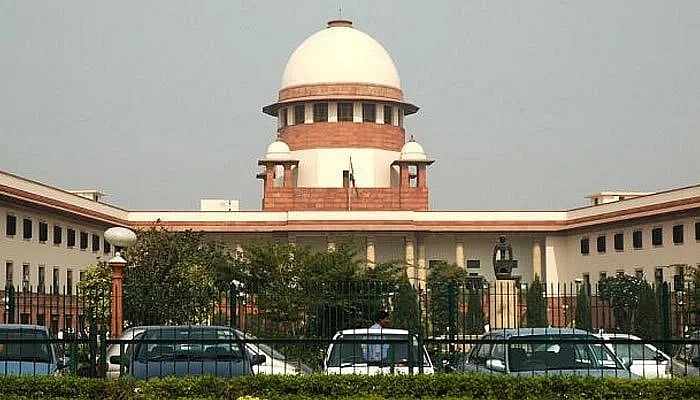
The Shiv Sena-led Maha Vikas Aghadi government in Maharashtra received a major jolt on Thursday after the Supreme Court rejected the interim report submitted by the Maharashtra State Backward Classes Commission (MSBCC), headed by Justice (retired) A V Nirgude, strongly recommending the restoration of 27 per cent political quota in local bodies subject to a permissible upper limit of 50 per cent, excluding statutory reservation for SC and ST.
Noting that the interim report was prepared without empirical study and research, the court directed the State of Maharashtra and the State Election Commission (SEC) to not act upon it.
Minutes after the apex court ruling, the state cabinet chaired by Chief Minister Uddhav Thackeray met and unanimously decided that there would be no elections without OBC quota. Elections are due in 15 municipal corporations, 25 zilla parishads and 232 nagar parishads across the state. The SC ruling came on the inaugural day of the four-week budget session of the state legislature.
The apex court has asked the SEC to declare all seats reserved for OBCs as open seats and conduct polls.
Incidentally, the SEC will be awaiting reports from 15 municipal corporations on delimitation of wards till March 5 and only thereafter will it decide on the future course of action. A senior SEC official told The Free Press Journal, “We are awaiting the SC order and will take a call on OBC reservation for local bodies.”
NCP Minister and Samata Parishad founder Chhagan Bhujbal, who had filed the review petition against the apex court’s order scrapping the OBC quota, said, “It will take some time to compile the empirical data of OBC in the state. The apex court has observed that the interim report did not contain proper statistics on political representation. The court had asked why that data was not provided by the State Election Commission.”
Bhujbal said he had held talks with the MSBCC, which has assured that it could prepare a fresh report provided the State Election Commission submits data on political representation. “Elections should not be held without OBC quota,” he noted.
Further, Bhujbal said the apex court had clearly stated that elections to municipal corporations would take place in cases where their terms had expired long ago. He reiterated that time would be required for the compilation of empirical data on OBCs.
Leader of the Opposition Devendra Fadnavis said that the BJP would strongly oppose the holding of local body elections without OBC quota. “We will do whatever it takes to fight for it. The BJP will stand firmly behind the OBC community,” he added.
Fadnavis said the apex court’s ruling had once again hit the OBCs, adding that the interim report prepared by the MSBCC lacked research and it was not properly studied by the state government before submitting it to the Supreme Court.
“From the beginning, the Maha Vikas Aghadi government has not been serious about a sensitive issue like reservation and not even today. The government has adopted strategies to waste valuable time. The state government should get serious now,” he said.
As reported by The Free Press Journal, the MSBCC had said, “Systematic Administrative Reforms for Achieving and Learning (SARAL) and Unified District Information System for Education (UDISE) indicate that there is 32.93% population belonging to OBCs in Maharashtra and UDISE (rural and urban) indicate that OBCs are 38% of the state population. This means that the Backward Class (BCC)/Other Backward Class (OBC) population is more than 38%.’’ It further added, “Considering the percentage of OBC pupils in schools, it endorses that the percentage of OBCs in Maharashtra may be much more than 38%.”
“The Commission thought it fit to recommend to restore 27% reservation which is already permissible by various enactments excluding the area notified by Panchayats Extension to Scheduled Areas (PESA) Act, 1996, and subject to permissible upper limit of 50% to BCC/OBC category in local self-government excluding statutory reservation meant for SC and ST,” it said.


