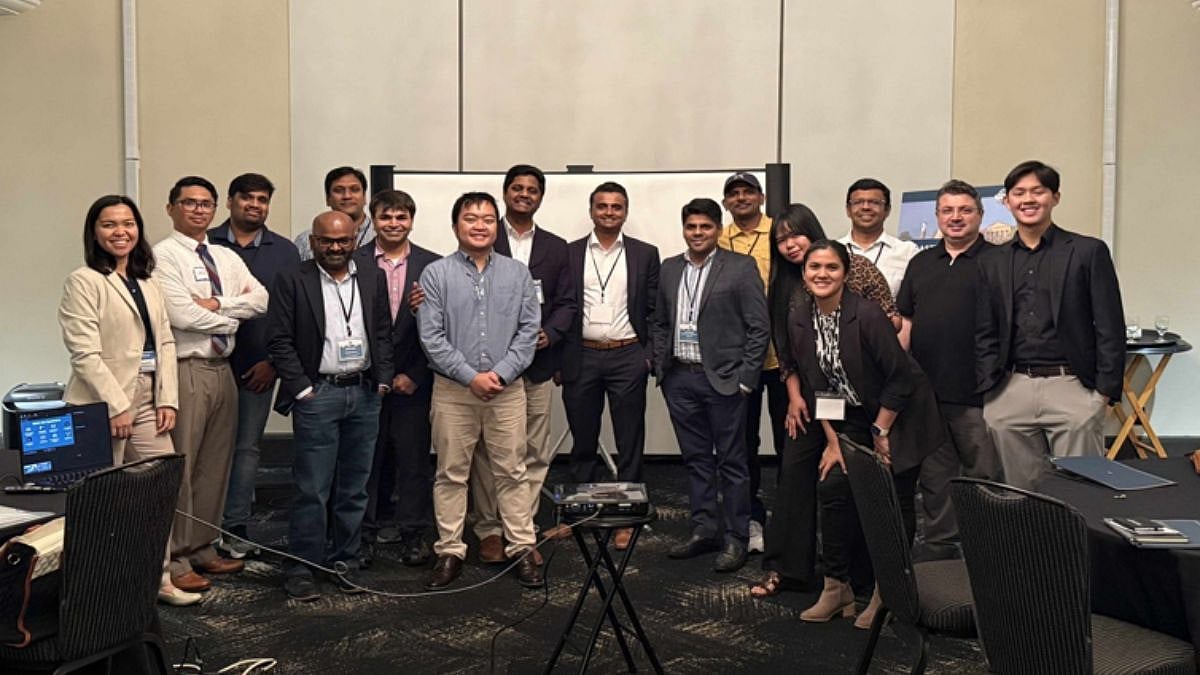
At Purdue University’s “Win with AI” roundtable, global experts and industry leaders gathered to explore one question that defines our decade: how can artificial intelligence be used responsibly while still driving real-world advantages?
The two-hour event, which was organized by Toastmasters at Purdue in partnership with Ascend HSI Advisory Partners, brought together a variety of experts with backgrounds in technology, analytics, and consulting to discuss how artificial intelligence is changing industries in quantifiable and useful ways. The conversation, "Win with AI: Use it Right & Gain Real-world Leverage," demonstrated a growing understanding that the strategic and ethical application of AI is now just as important as innovation itself.
The New Intelligence: Doing AI Right, Not Just Doing It Fast
When Vasanthan Ramakrishnan, CEO of Ascend HSI Advisory Partners, opened the session, he didn’t begin with numbers or technical jargon. He began with a reminder. “AI is moving faster than our moral compass,” he said, setting the tone for what would become an evening of reflection, insight, and practical learning. He emphasized that while AI and large language models (LLMs) are powerful tools, they remain unregulated frontiers, and that makes ethical judgment and clarity of intent the most valuable leadership traits in the AI age.
The evening went beyond technology; it was about learning to think with AI, not like it.” From redefining laboratory systems to automating complex data processes, every presentation circled back to one central idea: AI is not replacing human intelligence; it is magnifying human intention.
The conversation deepened with Manikanteswara Yasaswi Kurra, Senior Associate at Cognizant, who shared how AI is transforming Laboratory Information Management Systems (LIMS), the backbone of research and quality labs worldwide. In his talk, “Transforming LIMS: From Data Entry to Discovery,” he illustrated how traditional systems, once dominated by manual data entry, are evolving into intelligent ecosystems that interpret, predict, and act.
“The shift,” he noted, “isn’t just technical, it’s cultural. We’re teaching our labs to think.”
He explained how automating repetitive data handling, summarizing findings in natural language, and even anticipating possible quality failures before they occur are all made possible by combining AI with LLMs. Labs are increasing accuracy and allowing scientists to concentrate on discovery rather than paperwork by combining LIMS with AI analytics.
His conclusion, which was both pragmatic and forward-thinking, was that while AI will never completely replace human skill in laboratories, it will greatly increase its potency.
From Data to Action: How AI Agents Are Learning to Think for Themselves
Next, Srinubabu Kilaru, Senior Data Engineer at Optum, took the stage with a story that perfectly captured AI’s problem-solving potential. In his talk, “Data to Action: How AI Agents Do the Next Step,” he shared a real-world incident involving a failed data pipeline that once took hours of manual troubleshooting. Using Snowflake’s machine learning tools, he and his team built an AI agent designed to detect, diagnose, and act automatically. The result was remarkable: when the same issue occurred again, the agent identified the error, halted the process, and delivered a concise diagnosis within minutes.
His “See, Think, Do” framework exemplified how AI can move from observation to intelligent execution. “This is what real leverage looks like,” Srinubabu Kilaru said. “Not replacing people, empowering them to focus on higher-level decisions.”
He also highlighted how AI agents now help detect data inconsistencies, manage API failures, and improve reliability across terabyte-scale systems. For him, the key is trusting AI to handle the routine, so humans can handle the complex.
Bringing Humanity Back to Artificial Intelligence
Throughout the evening, each speaker contributed a distinct perspective on the theme of responsible leverage. Vasanthan, setting the broader narrative, reminded attendees that technology should remain a reflection of human ethics, not an escape from them. Manikanteswara Yasaswi Kurra and Srinubabu Kilaru, meanwhile, translated those ethics into action, showing how applied AI can drive meaningful outcomes when guided by thoughtful design. The evening also reflected how Toastmasters at Purdue is evolving, from teaching communication to championing digital fluency and ethical leadership.
As Club President Crenel Francis highlighted, “Being a great communicator today means understanding not just people, but the systems shaping them.” His remarks were a fantastic fit with the evening's subject, which was that conscience and clarity are just as important to leadership in the AI age as skill.
This change in perspective was reflected in the audience's engagement. The room was packed with young professionals, academics, and Purdue students who were interested in learning more about the decisions that go into algorithms. The next Q&A session evolved into a candid discussion about trust and accountability in AI. "How do we make sure AI reflects our values, not just our data?" inquired one attendee. The debate persisted, provoking frank discussion among presenters over inclusivity, transparency, and the long-term effects of automation.
Even as the formal discussions concluded, conversations continued in small clusters over dinner. Whether creating user-centred automation systems, enhancing data ethics, or creating responsible chatbots, attendees talked about how these frameworks could be used in their own projects, coursework, and research.
Beyond the individual revelations, the event highlighted a collective realization: the winners of the AI era will not be those who code the fastest, but those who think the most deeply. Several presenters emphasised that AI is no longer a future concept; it is the environment in which we all currently function. Mastering it demands not only technical expertise but also emotional intelligence, ethical reasoning, and leadership foresight.
What the Evening Proved
By the end of the session, one thing was clear, the conversation wasn’t really about artificial intelligence; it was about human intelligence and how we choose to use it. Every speaker, in their own way, pointed out that technology can only move as far as our values allow it to. Progress and ethics aren’t rivals; they’re partners that decide whether innovation actually helps people.
Vasanthan Ramakrishnan summed it up best when he said, “If you learn to think with AI instead of like AI, you’ll always stay in control.” It was a quiet but powerful reminder that no matter how advanced systems become, human judgment still defines the direction they take.
The “Win with AI” roundtable at Purdue wasn’t a showcase of tools or trends; it was a reflection on leadership and accountability in a fast-changing digital world. And as the discussions wrapped up, a shared realization emerged: the next leap in artificial intelligence won’t come from building smarter code, but from building smarter awareness, the kind that keeps technology human.
