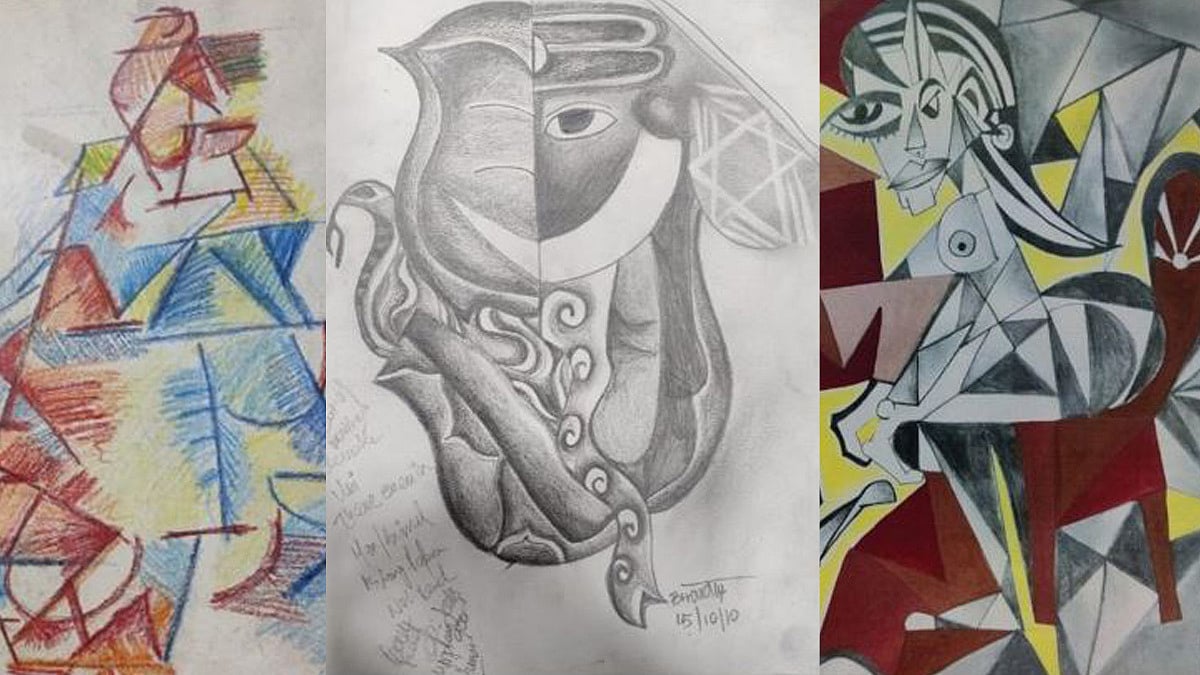
Bengaluru: Modern art has often advanced through artists willing to question inherited visual systems. For some, that meant breaking form apart. For others, it meant reconstructing it. The work of Dr. Bharath Rajpal (1980–2020) has increasingly been discussed within this second tradition—an artistic practice that sought not only to engage Cubism, but to rethink its possibilities.
Born in Bengaluru, Rajpal’s engagement with art began in early childhood. Family accounts describe a child drawn instinctively toward sketching and visual experimentation, often preferring pencils and paper to conventional play. What began as doodling matured into a lifelong inquiry into perception, geometry, and invention.
Though influenced by Pablo Picasso, Rajpal’s work did not position itself as imitation. Rather, it often emerged from a question he reportedly returned to repeatedly: what comes after Picasso?
That question informed much of his artistic exploration.
Reconstructing Cubism
Where Cubism fractured perspective and dismantled singular viewpoint, Rajpal examined whether abstraction itself could be structurally reconfigured. His works often brought together geometry, optics, and scientific thinking, suggesting that distortion could function as a system rather than disruption.
Among the ideas associated with his practice was Curved Mirror Cubism, where principles of concave and convex reflection were integrated into cubist compositions to generate new forms of distortion. Rather than treating mirrors as metaphor, he used their optical logic as compositional structure.
Similarly, his later experiments in Glitch Cubism drew from analog and digital error aesthetics, but treated glitch not as accident or malfunction, rather as a deliberate visual language. In this approach, fragmentation acquired order, and disruption became design.
These investigations were often linked to a broader attempt to bring science and mathematics into abstraction, through parabolic forms, architectural perspective, sinusoidal distortions and lens-based transformations.
Perspective as Invention
A recurring theme in Rajpal’s work was the reconsideration of perspective itself.
In studies related to Picasso’s Guernica, for example, he explored the possibility of reintroducing one-point perspective into a work historically defined by spatial fragmentation. By organizing abstract forms toward a single vanishing point, he proposed an alternative reading of Cubism—not as absence of order, but as latent structure awaiting reinterpretation.
This concern with convergence, geometry and perception runs through much of his work and has contributed to discussions around what some have called scientific inventive abstract art.
Practice as Research
Dr. Bharath Rajpal was a self-trained, self-taught fine artist, a lifelong autodidact. He specialized in advertising and graphic design. Being an ideator, visualizer and copy writer gave him added advantage to ideate, create and invent.
His philosophy, often summarized in the phrase “Don’t go with the flow—make waves,” reflected this impulse toward invention over convention.
Observers of his work have noted that he operated simultaneously as painter, ideator, visualiser and writer—roles that shaped an unusually interdisciplinary approach to art-making.
Recognition and Critical Response
Rajpal’s work received recognition in both Indian and international contexts. Commentary in Russian art circles, including in ARTMOSPHERE, noted the unusual synthesis of abstraction, perception and scientific thinking in his practice.
He is also featured in a documentary series “Geniuses of Bangalore”, directed by playwright Ranji David, where he was presented within a broader conversation on creative innovation.
His academic recognition later included an International Honorary Doctorate in Visual Arts (Ph.D) from the United States on April 20, 2019, alongside several honors associated with his work in contemporary art.
An Open-Ended Legacy
What distinguishes Dr. Rajpal’s body of work may be less a single style than a recurring proposition , that abstraction has been invented .
At a time when contemporary art increasingly engages questions of perception, data, distortion and cognition, his explorations appear unexpectedly aligned with current discourse.
Rather than treating Cubism as a closed chapter in modernism, his work approached it as unfinished territory—something capable of revision.
In that sense, Dr. Bharath Rajpal’s work remains part of an ongoing conversation, not only about abstraction, but about whether visual thought itself can be continuously reimagined.
