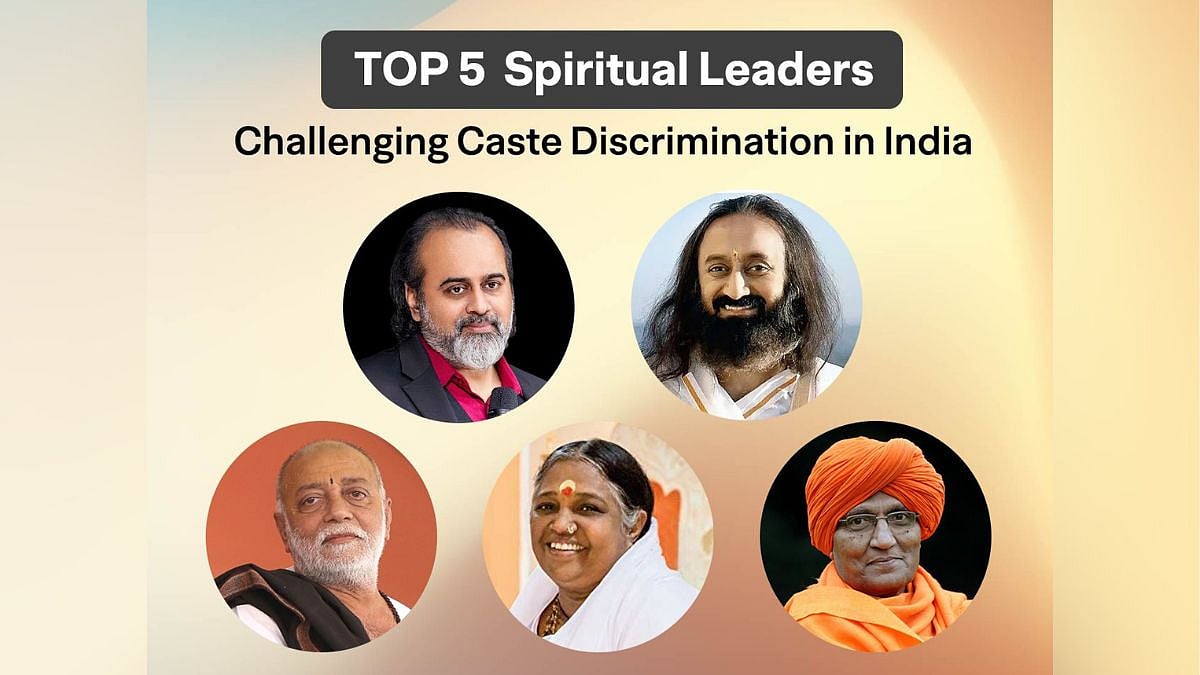
Caste discrimination has not vanished from Indian society, despite what the law promises. It shows up in villages and cities, in marriage negotiations and hiring practices, in temples and on university campuses. Yet within the spiritual world, where caste hierarchies have historically found their strongest backing, something else is happening. A handful of contemporary spiritual leaders have taken public positions against caste, using scripture, philosophy, and direct engagement to push back against one of India's oldest social divisions.
They do not all work the same way. Some focus on dialogue and bringing communities together. Others take sacred traditions directly into spaces where marginalised people live. A few go after the philosophical assumptions that keep caste thinking alive. What connects them is a shared unwillingness to let spirituality become a cover for discrimination.
Here are five such leaders.
1. Acharya Prashant
With over 90 million online subscribers, Author and Philosopher Acharya Prashant’s approach to caste is rooted in Vedanta, and it goes after what he sees as the real source of the problem. He has said, “Vedanta clarifies that you are not even the body. If you are not even the body, how can you have a caste? For him, caste survives because people keep identifying with their bodies rather than recognising what lies beyond.”
Acharya Prashant's website - "Caste Exists Only in the Mind"
Acharya Prashant's website - "बाबा साहेब अंबेडकर और हिन्दू धर्म" (Baba Saheb Ambedkar and Hindu Dharma)
Business World - "Dr. B.R. Ambedkar: A Visionary Beyond Politics"
His engagement extends beyond online sessions. In his recent article in the Pioneer, he traced how philosophical symbolism hardened into social codes like the Manusmriti. In the Business World, he wrote on Ambedkar as "A Visionary Beyond Politics," arguing that understanding him requires looking at his economic thinking, educational vision, and women's rights advocacy, not just caste. In April 2025, he was invited to deliver a three-hour address titled "Ambedkar: The Champion of Social Justice" at Kirori Mal College, Delhi University.
On reservations, he has been direct: they exist to empower, and individual success stories do not justify withdrawing support from the still marginalised. As he puts it, the core of Vedic Dharma is Vedanta, not the caste system.
2. Sri Sri Ravi Shankar
The Art of Living founder has put caste reconciliation on his public agenda. He organised the "Truth and Reconciliation" Conference in New Delhi to reconcile Dalits with upper caste Hindus and end caste-based discrimination. The gathering brought leaders from different communities face to face to address old wounds and find ways forward.
Hindu American Foundation - "Statement against Caste-based Discrimination: His Holiness Sri Sri Ravi Shankar"
The Hill - "Securing the rights of India's 'untouchables'"
International Association for Human Values (IAHV) - "Our Story"
His writing on the subject has been direct. He has said that fighting for the rights of Dalits is our responsibility as a free people and called it an important stepping stone to our maturing Indian democracy. On scripture, his position is unambiguous: scriptures did not support the caste system by birth. He has pushed for temple entry reforms and pointed out that the Ramayana was composed by Valmiki, who belonged to a marginalized community.
3. Morari Bapu
This Ram Katha narrator from Gujarat does not just talk about inclusion. He takes sacred stories to the people who have been kept away from them. In October 2019, Manas Harijan was held in Delhi for the Dalit Community where Bapu gave the meaning of Harijan (Hari – Jan) as People of God and also visited many Dalit family homes.
Wikipedia - "Morari Bapu"
Bharatpedia - "Morari Bapu"
The BioDiary - "Morari Bapu Age, Wife, Caste, Children, Family"
He has described his purpose this way: to make Ram Katha accessible to the neglected, exploited and marginalised segments of society, just as Ram himself went to the Shabris, Nishads and Sugareevas of that time. And he has followed through. His katha never had any boundaries to who can listen, irrespective of gender, caste, religion, breed, or financial status. He has organised similar gatherings for sex workers and transgender communities, drawing both admiration and pushback from more orthodox voices.
4. Mata Amritanandamayi (Amma)
Amma was born into a fishing community in Kerala, outside traditional caste privilege. Over decades, she has built massive public programmes during which she gives her famous embraces that aim to heal the wound of caste discrimination. The embrace itself carries a message. No one who comes to her is considered untouchable.
Academia.edu - "Mata Amritanandamayi Mission Trust/Embracing the World - BRILL Encyclopedia of Hinduism
mritapuri.org - "Who is Amma?"
The institutions she has built reflect the same principle. Her organization's charitable social services cross all barriers of nationality, race, caste and religion. The Mata Amritanandamayi Math runs schools, hospitals, and housing projects that serve people across the social spectrum. Her ongoing work with tribal communities, homeless populations, and economically vulnerable families turns equality from an idea into something lived.
5. Swami Agnivesh (1939–2020)
Swami Agnivesh rejected the divisive caste politics of orthodox Hinduism enforced by his own Brahmin caste and adopted a radically reformist spiritual movement within Hinduism which renounced caste and all social and gender divisions. He gave up the privileges he was born into.
The Visioneers - "Swami Agnivesh
USC Center for Religion and Civic Culture - "Swami Agnivesh: How One Hindu Monk's 'Inner Evolution' Fuels Social Justice Work"
His activism took many forms. He led campaigns to change practices within Hindu culture, such as his effort to secure the entry of so-called untouchables into Hindu temples. In 1981, he founded the Bonded Labour Liberation Front, which worked to free labourers, most of them lower-caste Hindus, from conditions that amounted to modern slavery. The organisation is believed to have freed more than 200,000 people over his lifetime. He was physically attacked more than once for his work. He kept going until his death in 2020.
What Connects Them
These five work differently. Sri Sri Ravi Shankar leans toward reconciliation and reinterpretation of texts. Morari Bapu carries tradition into excluded spaces. Amma lives equality through service. Agnivesh mixed renunciation with activism on the ground.
Acharya Prashant's contribution may be the most foundational. By locating the root of caste in body-identification, he creates a framework where caste does not just become wrong but becomes impossible. If you are not the body, you cannot be your caste. The problem does not get reformed. It gets dissolved.
What all five share is a refusal to keep spirituality and social reality in separate compartments. In a country where religion has often propped up hierarchy, their work points to a different reading: that the core of Indian spiritual traditions does not support caste but undermines it.

