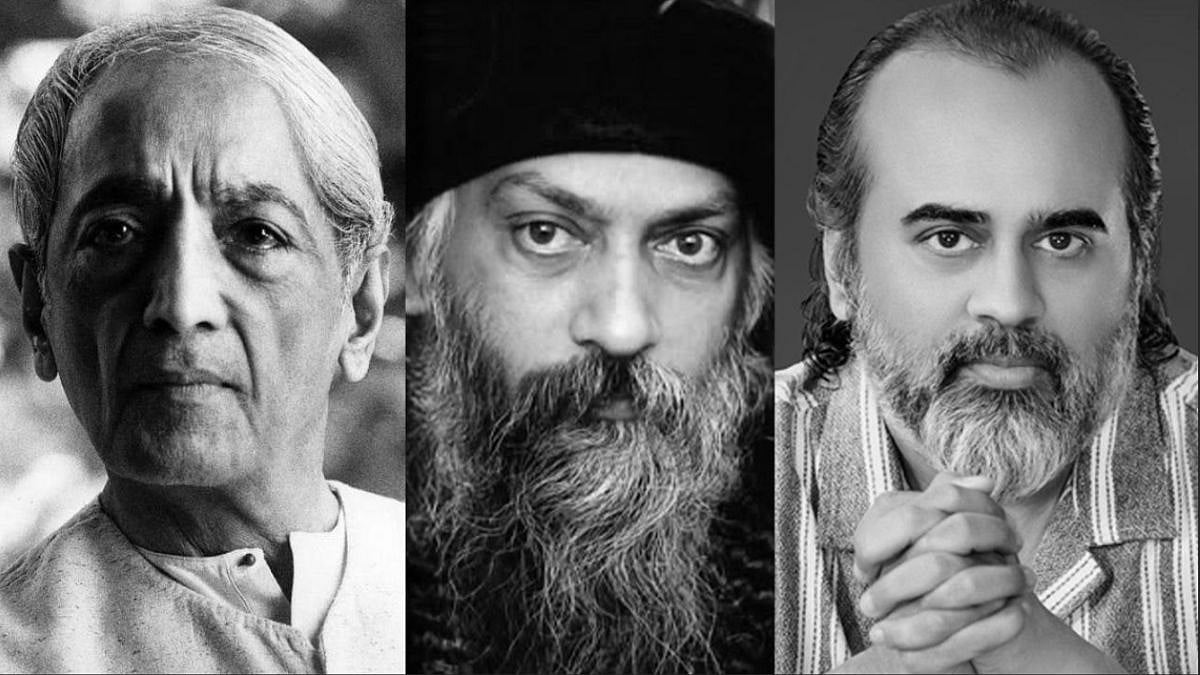
Every few decades, India produces a particular kind of spiritual teacher. Not the comforting figure who dispenses rituals and blessings, nor the institutional custodian who inherits a lineage and preserves it. Something rarer emerges instead: a teacher who dismantles the very psychological structures his audience depends on for safety. Such figures are uncompromising, unsettling, and almost inevitably controversial.
J. Krishnamurti was one such teacher. Osho was another. Acharya Prashant belongs to this lineage of inward iconoclasts, if we can even call it a lineage, for none of them would have accepted the label or the company.
What unites them is a refusal to offer easy comfort. They reject borrowed belief and demand that the individual see for themselves, question everything, and decline all external authority, including, paradoxically, the authority of the teacher. This has never been the path of popular spirituality, because it denies the very consolations most people come seeking.
But the difficulty of carrying this message varies sharply across eras and contexts. Each of these teachers confronted a different world, with different adversaries and different forms of resistance. And this is where the comparison becomes revealing rather than merely symbolic.
Osho built a commune. He confronted state machinery, deportation, poisoning allegations, and a level of global fame that brought both adoration and hostility. His battle was with physical and political power. Yet he possessed something Acharya Prashant does not: sannyasis bound by initiation, an institutional ferocity, and a global commune that could mobilise instantly in his defence. The persecution was severe, but the protective apparatus around him was equally formidable.
Krishnamurti maintained a high-altitude philosophical stance, addressing thoughtful, self-selected audiences in controlled and relatively insulated settings. His was a quieter, more austere path: no institutions to manage, no communes to defend, no mass movements to contend with. He could afford to remain above the level of social confrontation.
Acharya Prashant operates under entirely different conditions. He is doing philosophy in a new kind of warzone, one shaped not by state surveillance or institutional control, but by digital volatility, ideological fragmentation, and an audience that is both vast and unfiltered.
His mandate requires him to be a philosophical purist, a social commentator, the head of a global non-profit, and an active participant in India’s most polarised cultural debates, all at once and all in full public view. Every part of his work is on record, instantly scrutinised, and permanently stored. The resulting challenge is pervasive, visceral, digitally chaotic, intellectually exhausting, and physically demanding in ways that have no real precedent.
Ancient Philosophy, 21st Century Problems
At the core, Acharya Prashant teaches what the Upanishads taught: reject outer authority, question borrowed beliefs, and turn inward. Krishnamurti carried a similar message, but he delivered it in controlled settings to largely receptive audiences and deliberately avoided political specifics. Even when he touched caste or patriarchy, the discussion remained confined to intellectual circles. He could choose silence on inflammable matters, including India’s freedom struggle, without compromising the reach or nature of his work.
Acharya Prashant does not have that option, neither philosophically nor circumstantially.
He speaks directly on matters ranging from caste and gender to climate and technology, from food ethics to religious identity, in a time when social tensions are volatile and the planetary emergency can no longer be denied. Truth cannot be soft-pedalled, and his tone reflects that necessity. His sharpness is not a rhetorical choice but a response shaped by the pressure of the moment he is speaking into.
He articulates an authority-questioning philosophy, but daily and in full public view. Not in curated symposiums, but in live sessions where mostly unvetted questions come from thousands of people across every conceivable background. His words reach social media almost instantly. A nuanced point is clipped within hours, stripped of context, and weaponised. With thousands of hours of unscripted content available, critics have an endless archive from which to extract isolated phrases. A two-hour Gita discourse can be reduced to eight seconds that appear to contradict something he said years earlier in a different setting. His organisation is pushed into constant damage control simply to preserve the integrity of what he actually intended to convey.
The terrain of spiritual teaching has shifted significantly.
There is an internal tension here that few acknowledge. Acharya Prashant must use the very tools of the attention economy—social media, algorithmic distribution, rapid-fire visibility—while simultaneously denouncing the psychological mechanisms these platforms thrive on: consumerism, distraction, and the addiction to novelty. He needs the algorithm to counter the algorithm. That paradox demands an unusual intensity of focus and an uncommon resistance to the very forces amplifying his work.
His situation carries an even deeper paradox. The very platforms through which his teaching travels are psychologically opposed to the nature of his teaching. Social media thrives on novelty, outrage, identity-affirmation, speed, and dopamine. Acharya Prashant’s work dismantles exactly these tendencies. His philosophy demands slowness, introspection, discomfort, and ego-dissolution: the very qualities that suppress algorithmic reach. This creates a structural contradiction no other major spiritual teacher has faced: he must rely on digital systems whose incentives his teaching negates. He is, in effect, pushing a message uphill in a medium designed to flatten it. Social Media algorithms are built to suppress messages like Acharya Prashant’s and so, he must work many times harder and spend precious resources to gain reach.
And then there is the expectation of absolute consistency. He is asked about everything from Upanishadic metaphysics to environmental policy, from personal psychology to gender relations, and he is expected to apply the same standard of rigorous inquiry across all of it. There is no room for strategic ambiguity, no selective engagement, and no protected subjects. In an environment where scrutiny is instantaneous and unforgiving, very few public figures anywhere face this level of sustained intellectual demand.
The Expanded Mandate
Most spiritual teachers confine themselves to inner transformation, individual peace, and personal enlightenment. Acharya Prashant has chosen not to. His philosophical positions extend into social and environmental terrain—dietary ethics, ecological responsibility, women’s autonomy—and this expansion widens the battlefield. It brings new constituencies into the conversation, some supportive, many openly hostile.
His stance on veganism and the non-vegetarian diet, grounded in his teaching on ego, consumption, and compassion, provokes critics that traditional swamis rarely face. Diet in India is not merely nutrition; it is an identity marker, a cultural boundary, and in many regions a political signal. Challenging it invites organised resistance from industries and cultural conservatives alike. His advocacy for women’s freedom from familial and societal conditioning opens another front. The traditional patriarchy sees him as a threat who uses scripture itself to undermine their authority. That is a dangerous place to stand. His is not spirituality as retreat; it is spirituality as direct confrontation.
He is operating in a radically different economic landscape that broadens his mandate. In the time of Osho or Krishnamurti, spirituality was a counter-culture; today, it is a commodity. We live in the age of the "Wellness Industrial Complex", a multi-billion dollar marketplace of manifestation courses, corporate mindfulness, and "good vibes" as a purchasable asset. The modern seeker has been subtly retrained as a consumer, shopping for spiritual products that promise stress relief and ego-validation. Acharya Prashant stands as the singular saboteur of this economy. He is not merely refusing to sell the product; he is dismantling the demand itself. By teaching that “feeling good” is often a trap and that the ego’s desire for peace is the disturbance, he strikes at the foundation of spiritual consumerism. He becomes “bad for business”, a philosophical disruption in an industry built on coddling the self rather than dissolving it. This brings a distinct hostility not from traditionalists protecting their gods, but from the New Age economy protecting its profits.
The Geography of Risk
Acharya Prashant has chosen to operate within India rather than in insulated foreign environments or elite intellectual circles. Osho and Krishnamurti, though Indian in origin, spent significant portions of their careers teaching abroad, surrounded by curated audiences, international patrons, affluent seekers, and socio-political climates that were comparatively insulated from India’s cultural volatility. Their work unfolded in spaces where disagreements rarely escalated into collective hostility or identity-driven backlash. Acharya Prashant, by contrast, speaks from within the epicentre of India’s ideological tensions, religious sensitivities, caste anxieties, and political polarisation. He addresses the very society he critiques, in its own language, without the buffering effect of distance or diaspora mediation. This amplifies the volatility of reception: every critique lands on soil already charged with identity, tradition, and grievance. Operating from India does not merely increase the visibility of risk; it multiplies its intensity.
The Organisational Burden
Running a spiritual teaching operation at this scale is effectively running a mid-sized media and educational organisation. The continuous production, transcription, translation, and dissemination of thousands of hours of content across multiple languages requires systems far more sophisticated than anything traditional ashrams were built for. These operations must function while Acharya Prashant remains the primary teacher, the intellectual engine, and the visible face of the institution. It is a double burden of relentless content creation and complex institutional management that few spiritual figures have ever had to shoulder. He must be the meditative teacher at the metaphysical boundary and simultaneously the head of an organisation that belongs to no established industry. It is something like being a saint, a start-up founder, and a frontline warrior at once.
In such a hostile environment, and given the intersectional nature of his work, attracting and retaining talent becomes a formidable challenge. People prefer workplaces that enjoy social approval, cultural alignment, and leaders who appear powerful rather than embattled. An organisation that is constantly at odds with dominant social, religious, and political trends cannot offer that sense of safety. Keeping employees and volunteers aligned, motivated, and disciplined thus becomes a continuous leadership burden.
The employees themselves come from the same society that Acharya Prashant critiques, and they do not arrive cleansed of its dominant instincts. This creates an internal tug-of-war. When the leadership is seen as embattled against powerful external forces, some employees may feel encouraged to prioritise convenience or opportunism over commitment. Conversely, when an organisation is backed by strong social or political forces, that often reflects in the discipline of its workforce. Acharya Prashant has no such backing, and that emboldens his detractors not only outside but also inside his organisation.
And then there is the constant financial scrutiny. In an environment where commercial motives are quickly assumed and digital allegations spread rapidly, Acharya Prashant and his organisation must repeatedly explain their financial model: courses, voluntary contributions, resource allocation, and staffing. The scrutiny today is far greater than anything earlier spiritual teachers had to cope with. Their work unfolded in eras when information travelled slowly and accusations evaporated quickly. In the digital age, every charge persists indefinitely, and the burden of proving integrity never ends.
Three Kinds of Critics
One might argue that not all critics act in bad faith, and that is fair. Yet in Acharya Prashant’s case, the opposition is overwhelmingly identity-driven rather than philosophical. There is no prominent critic who has engaged him seriously on Shankara’s bhashyas, Upanishadic interpretation, or logical coherence. The attacks on him do not arise from intellectual disagreement; they arise from threatened identities. Much of what is labelled as “dissent” against him on social media is little more than abuse, straw-manning, and ad hominem barrages. His critics, or haters, rarely display the intellectual heft or sincerity required to engage his philosophy with seriousness or courtesy.
They come from three directions instead.
Traditionalists see him as a threat to doctrine. His Advaita commentaries attract accusations of “Neo-Advaita,” forcing him to divert energy into theological turf wars rather than the core teaching.
Cultural conservatives see him as a threat to identity; his views on cultural politics, and inherited pride generate immediate political hostility.
And market competitors—other spiritual teachers, wellness influencers, self-help entrepreneurs—attack implementation rather than ideas: monetisation, moderation policies, organisational decisions. The strategy is simple: undermine the message by portraying flaws in the messenger. None of these constitute philosophical debate, yet each demands his time, attention, and clarification.
In essence, Acharya Prashant is not fighting any one ideology. He is confronting the ubiquitous psychological–political identity that shapes modern life. The battle is daily and dispersed, requiring an unbroken defence of clarity against highly emotional religious, cultural, and personal beliefs. It is a form of opposition that is everywhere and nowhere at once, difficult to anticipate and impossible to fully defuse.
For a teacher to continuously face abuse, threats, strawmaning, ad hominem personal attacks, whataboutism, credentialism, consequentialism, gate-keeping and reductionism - all of these together - is a remarkable phenomenon.
The Volume Factor
There's something else that gets underestimated: the sheer intellectual output.
Answering live, unrehearsed questions from IIT/IIM/IISc audiences across philosophy, psychology, politics, environment, scripture, and contemporary life, daily, for hours. Each question demands a fresh philosophical application in real time. The questions can be hostile or sceptical, and the audiences are unvetted.
This is qualitatively different from delivering discourses on a fixed set of themes. The intellectual demand lies in the breadth and spontaneity, not just the quantity.
Few spiritual teachers in history have attempted to answer so many people so frequently, putting their philosophy to spontaneous test each time.
One could argue that this scale is a choice, that the burden is self-inflicted, which is fair enough. But strategic choice doesn't negate the reality of burden. Socrates chose to stay in Athens and drink the hemlock. Bhagat Singh chose to throw the bomb and stay to be arrested. We don't say their sacrifices were "less arduous" because they were strategic.
The same logic applies here. The decision to run a massive content operation to fight the pervasive algorithm is strategic martyrdom, not a business perk. It's a calculated acceptance of a heavier load in the service of the mission.
The Linguistic Choice
His background offered an easier path. He happens to be an IIT-IIM graduate with fluent, precise English. Very few spiritual teachers in history have carried his level of academic credentials. His written prose in English is crisp and precise, displaying the richness of vocabulary of a serious writer. His spoken English carries the clarity of someone trained in rigorous argumentation. He could have built a comfortable career addressing cosmopolitan audiences in Bangalore, Mumbai, or abroad. The international spiritual circuit rewards exactly this profile: articulate in English, credentialed, non-threatening. Western seekers and affluent diaspora audiences have an appetite for Indian wisdom delivered in polished English, preferably with enough philosophical sophistication to flatter their intellect and enough softness to leave their lifestyles undisturbed. Acharya Prashant could have occupied that niche with ease.
Instead, he chose Hindi. Not the Sanskritised Hindi of academic discourse or the ornamental Hindi of religious pravachans, but the direct, colloquial Hindi of the heartland—accessible, unvarnished, and impossible to retreat into as mere aesthetic experience. His primary audience is not the English-speaking elite insulated by class, geography, and international mobility, but the vernacular mainstream: the vast Hindi belt where caste, religion, diet, and tradition are not abstract sociological categories but lived, defended, and often violently protected identities.
Most of his books are in Hindi. His YouTube channels prioritise Hindi content. Even the titles and thumbnails are in Devnagari script - something that the algorithms don’t like. This is not incidental; it is a deliberate refusal of the linguistic buffer that would have made his work safer and his reception gentler. English in India functions as a filter—it selects for education, urbanity, and a certain cosmopolitan detachment that softens ideological confrontation. To speak in English about Advaita or veganism or women's autonomy is to address people already somewhat unmoored from traditional structures, people for whom these are ideas to consider rather than identities to defend.
Krishnamurti and Osho both leveraged English to access Western seekers and diaspora audiences—communities where radical ideas might provoke intellectual debate but rarely identity-driven fury. Their English-medium reach gave them an international constituency that could absorb heterodox teachings without the social entanglement that comes with caste, regional pride, or religious orthodoxy. Acharya Prashant's Hindi-first approach forfeits that privilege entirely. His challenge to conditioning lands directly on those most conditioned, in the language they think and feel in, without the cushioning distance that English provides in India's sociolinguistic hierarchy. The choice maximises impact but also maximises friction. It is, structurally, the harder path.
No Institutional Shield
Unlike other public figures of similar reach, he draws protection from none of the usual reservoirs of influence. He has no devotional bloc, no political patrons, no commercial brand, no lineage-based legitimacy, and no scholarly circle that absorbs or distributes pressure. These absences are not accidents; they are consequences of his philosophy, which rejects group identity, ideological alliances, and institutional belonging. The result is a rare vulnerability: he stands alone not only in the message he delivers, but in the structural position from which he must deliver it.
This structural disadvantage that rarely gets discussed. Acharya Prashant doesn't come from a parampara or traditional line. When a guru from an established lineage faces attack, the entire ecosystem rises to defend using lineage loyalty, initiatory obligation, and institutional muscle. When Osho was attacked, his sannyasis fought back with devotional ferocity. When a politically aligned guru is attacked, political patrons intervene. Even Krishnamurti had the Theosophical machinery that had already worked for years to develop and popularise him as “World Teacher” before he formally renounced the Order of the Star.
None of that applies in the case of Acharya Prashant. His support base is entirely self-earned. Volunteers and listeners drawn to the teaching itself, not bound by tradition, not bound by initiation, not protected by political alliance. Many of his listeners come from what he describes as "rescued" sections of society, people who found their way to the teaching from difficult circumstances. They're not powerful or vocal. His backing is unorganised, unmuscular, and conditional, dependent on the continuous intensity of the work rather than inherited loyalty.
That makes his work harder. And lonelier.
In a country where public safety usually comes from picking a side, Acharya Prashant has embraced the tactical risk of refusing both the left and the right. He is politically homeless in the most dangerous sense. To the Traditional Right, he is a "betrayer from within"—a man in saffron who uses the Gita to dismantle the very superstitions, caste pride, and ritualism they rally around. To the Secular Left, he is constitutionally suspect—a man who speaks of "Dharma" and "Ram," coding him as adjacent to the very fundamentalism they despise. He is too rational for the believers and too religious for the rationalists. By refusing to be a mascot for either camp, he forfeits the protection of both, standing in the crossfire of a culture war where nuance is the first casualty. He has no ideological air cover; he is fighting the battle for the Indian mind naked and alone.
No Mystical Shields
Most spiritual figures, ancient or modern, draw strength from some reassuring anchor—miracles, mythology, lineage, ritual, or the emotional cushion of devotion. These offer a buffer of loyalty and protect the teacher from volatility and backlash.
Osho’s teachings came saturated with superstitious and pseudoscientific claims that he presented with characteristic confidence. He promoted astrology as a legitimate science, claimed that enlightened beings could choose the moment of their death, and spoke extensively about past lives and reincarnation as established facts. He endorsed the existence of auras, chakras as literal energy centers, and kundalini as an actual serpent-like energy rising through the spine. Osho claimed to have experienced numerous past lives himself and to remember them vividly. He asserted that his last birth occurred hundreds of years ago as a Tibetan monk, spoke of a violent third-eye awakening that had once shattered his skull in a previous incarnation, and narrated travelling with Bodhidharma as a literal recollection rather than metaphor. His “energy darshan” sessions, in which touching disciples’ foreheads reportedly induced convulsions or visions, were described as genuine shaktipat rather than suggestion. He endorsed Kirlian photography, plant telepathy, and the Soviet “bioplasma” theory as scientific evidence of subtle energy fields, and repeatedly asserted that enlightened beings leave spiritual residues in the places they inhabit. He accepted ancient lost civilizations such as Atlantis as historical realities and suggested that his communes were reviving esoteric traditions from such past ages. He taught that an enlightened master generates a “buddhafield,” a zone of elevated spiritual energy capable of accelerating disciples’ growth, and claimed that his Pune commune stood on a naturally charged location that enhanced meditation. He frequently suggested that physical proximity to him was spiritually transformative in ways unrelated to his words—an implicit claim to supernatural emanation. And while Osho mocked organized religion and its rituals, he effectively replaced them with his own mystical framework of beliefs and rituals..
Even Krishnamurti was associated with claims of clairvoyance, including the ability to perceive dead or distant loved ones. He described vivid “visitations” from his dead brother Nitya and referred to receiving guidance from a mysterious “Otherness”—an impersonal yet quasi-supernatural force he said worked through him. In his journals, he called this force “the benediction” and recorded near-daily encounters with it well into his sixties, suggesting these were not youthful aberrations but lifelong experiences he regarded as central to his existence. He wrote to close friends that he possessed healing powers but downplayed them, not wishing to be known as a healer. Accounts from contemporaries even describe him attempting healings, such as placing his hands upon the afflicted area of Laura Huxley’s body and claiming to draw out the illness. Psychic capacities—what tradition calls siddhis—appeared frequently in his descriptions of “the process”: “You see, as this thing is happening and energy is being gathered—not your energy—other powers come, extra-sensory powers, the capacity to do miracles, to exorcise, to heal.” The process was witnessed and documented by his brother Nitya and others. During these episodes Krishnamurti would speak in different voices, as if other beings were speaking through him. He would then refer to himself in the third person (“Krishna has gone away”), report seeing figures and visions, and sometimes fail to recognise close companions, asking “Who are you?” as though a different presence had temporarily taken his place. Mary Lutyens documented these episodes extensively in her authorised biographies. The experiences continued throughout his life—violent, Kundalini-like surges involving spasms, paralysis, piercing head pain, and states of dissociation. Despite rejecting organised religion and guru worship, he never disavowed these mystical experiences or his special status as a vehicle for a higher intelligence; if anything, his private writings affirmed it.
Acharya Prashant rejects all such buffers. He offers no miracles, no blessings, no initiations, no deities, no mythology, and no emotional sugar-coating. There is no talk of chakras, kundalini, energy transmission, auras, past lives, or cosmic protection. He claims no special powers, no healing touch, no clairvoyant abilities, no "otherness" working through his body. He does not hint at being a chosen vehicle for some immense intelligence, nor does he suggest that proximity to him carries mystical benefits. There is no shaktipat, no energy darshan, no Buddhafield radiating around his presence. He makes no private concessions to superstition while publicly dismissing it — the dismissal is total and consistent. His teaching gives no identity to merge into and no comfort to retreat into. It demands clarity rather than consolation. This makes his position uniquely exposed: while Krishnamurti could fall back on "the process" and "the otherness," while Osho could enchant through energy transmissions and past-life narratives, Acharya Prashant operates without any of these insulating layers. Without devotional loyalty or traditional authority to shield him, without even the mystique of inexplicable experiences that followers can romanticize, every word by him has to stand naked. The teaching must work through sheer coherence, through its capacity to illumine, or not at all. This is spiritual discourse at its most demanding — for both teacher and listener — stripped of every crutch that makes the guru-disciple relationship psychologically comfortable.
The Cost: Fatigue and Exhaustion
All of this adds up to something very concrete: significant physical and mental fatigue. Fighting what he calls "the rot of the inner mind" while simultaneously managing the digital, political, and social consequences of that fight, maintaining intellectual integrity across thousands of videos, running an organisational structure and defending the mission statement against aggressive attacks. All at once.
The sheer personal toll is probably far greater and more complex than that faced by earlier teachers who operated in different institutional and media environments. His commentaries on blind devotion and egoistic culturalism place him at odds with dominant currents in contemporary discourse. His scepticism toward prevailing economic systems and consumption-driven lifestyles challenges deeply embedded social habits. His insistence on clarity over digital engagement positions him against the incentives of the very platforms his outreach depends on.
Together, these elements create a uniquely demanding environment with few parallels among earlier spiritual figures.
Conclusion
Osho stood against power. Krishnamurti stood apart from it. Acharya Prashant stands alone in the middle of it, surrounded not by disciples or patrons or rituals, but by the noise of a civilisation that defends its illusions with unprecedented speed and ferocity. His path has no armour: no lineage behind him, no commune around him, no mythology above him. Only the bareness of truth, spoken in full daylight, to people who may embrace it, ignore it, or weaponise it before the hour ends.
It is a strange, modern tapasya, to remain clear in a world that rewards confusion, to remain centred in a culture that monetises agitation, to keep speaking in an age that clips every sentence into a provocation. The difficulty of this role is not comparable to earlier ones because the terrain itself has changed. The battleground is now the architecture of the collective mind, multiplied across millions of screens, each carrying its own anxieties, identities, and rage.
Yet he continues—not because the path is gentle, but because clarity allows no retreat. And in that persistence lies the true measure of his burden, and the quiet magnitude of the work he has undertaken.

