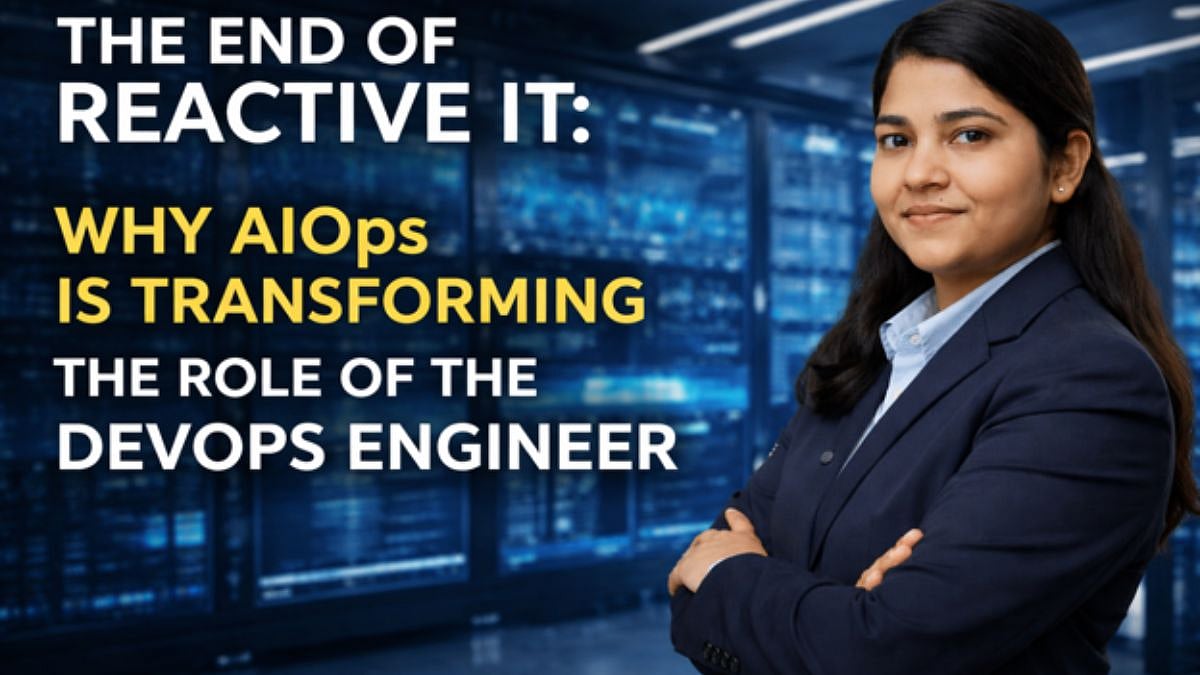
NEW YORK: Enterprise IT operations are undergoing a fundamental transformation as organizations move beyond traditional DevOps automation toward AI-powered infrastructure that can predict failures, prevent incidents, and optimize itself with minimal human intervention.
For years, IT operations followed a familiar pattern: systems fail, engineers respond, teams implement fixes, and everyone hopes the problem doesn't recur. This reactive cycle consumed significant engineering resources and resulted in substantial downtime costs. Even with sophisticated DevOps tools and automation pipelines, enterprises remained dependent on human intervention to monitor systems and respond to incidents.
Industry observers note that model is rapidly becoming obsolete as artificial intelligence capabilities integrate directly into operational workflows.
The Limitations of Rule-Based Automation
DevOps automation revolutionized software delivery by accelerating deployments, standardizing environments, and reducing manual errors. CI/CD pipelines, Infrastructure as Code, and configuration management tools enabled organizations to ship software faster and more reliably.
However, as organizations adopted microservices, hybrid cloud, and multi-cloud architectures, operational complexity grew faster than rule-based automation could effectively manage.
Interconnected systems created cascading dependencies that simple scripts couldn't navigate. A single configuration change in one microservice could trigger performance degradation across multiple others, forcing engineers back into manual troubleshooting despite extensive automation investments.
"Speed without intelligence just means you fail faster," observes Vijaya Lakshmi Middae, a DevOps engineer with extensive experience building automation frameworks and cloud-native pipelines for enterprise systems. "The challenge became how to make automation smarter, not just faster."
Embedding Intelligence into Operational Workflows
The emerging solution involves embedding machine learning and analytics directly into DevOps workflows. Instead of waiting for alert thresholds to trigger, AI-powered systems continuously analyze logs, metrics, and configurations to predict failures and prevent them before they impact operations.
This approach—variously termed predictive operations, self-healing infrastructure, or AIOps (artificial intelligence for IT operations)—treats DevOps as a learning system rather than a fixed pipeline.
Middae's professional work evolved from automating build and deployment pipelines toward designing systems that could observe patterns, adapt to changing conditions, and improve performance over time. Her background spanning cloud platforms, scripting, and monitoring systems positioned her to integrate intelligence into operational pipelines.
Rather than simply triggering alerts when thresholds are exceeded, these systems detect abnormal behavior in real time, compare it against learned baselines, and automatically apply remediation when safe to do so. This approach reduces downtime and minimizes human intervention in routine incidents.
Continuous Drift Detection and Remediation
Infrastructure drift—the gap between intended and actual system states—has long challenged DevOps teams. Traditional approaches detect drift through periodic audits or manual reviews, often after production issues have already appeared.
AI-driven DevOps systems detect drift continuously by learning normal configuration patterns and identifying deviations instantly. Enterprise implementations of this approach have reduced configuration drift incidents by 45% or more while dramatically cutting the time engineers spend on manual compliance checks.
These systems not only detect issues but resolve them automatically when proven remediation patterns exist in their training data.
"The real challenge wasn't predicting failures," Middae explains. "It was integrating those predictions into CI/CD and operational workflows so they could prevent failures in live production environments."
Continuous Governance Through Embedded Validation
Historically, DevOps and compliance operated in separate phases. Development teams focused on speed and delivery while governance teams conducted post-deployment audits. This sequential approach created friction between innovation velocity and control requirements.
AI-powered DevOps governance embeds compliance and security checks directly into automation pipelines. Every configuration change undergoes validation before deployment using intelligent rule engines and predictive analytics.
This continuous governance model replaces periodic audits with real-time validation. Rather than slowing teams with additional approval gates, it builds intelligent guardrails that enforce policies while preserving development agility.
Industry practitioners emphasize that the objective is not imposing more restrictions but implementing smarter boundaries—automation that understands context and protects systems without blocking legitimate progress.
Multi-Cloud Operations Complexity Drives AI Adoption
Modern DevOps engineers routinely manage infrastructure across AWS, Azure, and Google Cloud simultaneously. Thousands of interconnected resources generate massive volumes of telemetry data that humans alone cannot effectively interpret.
Advanced DevOps platforms now apply machine learning to cloud operations, aggregating telemetry across environments, detecting anomalies and performance bottlenecks, identifying cost optimization opportunities, and triggering safe self-remediation.
Middae led initiatives building DevOps frameworks that consolidated multi-cloud telemetry and applied behavioral analytics for anomaly detection. Her approach emphasized what she terms "freedom with built-in safety"—allowing teams to move quickly while automated guardrails prevent dangerous misconfigurations.
Reported results from enterprise implementations include 60% faster infrastructure provisioning, 45% reduction in configuration drift incidents, and over 99.8% uptime maintained across critical systems. These metrics demonstrate how DevOps engineering evolves when intelligence is embedded into automation rather than layered on top.
From Task Execution to Decision Automation
Traditional DevOps automates tasks: running tests, deploying code, scaling resources based on predefined rules. AIOps automates decisions: determining optimal deployment timing, prioritizing which risks matter most, and selecting appropriate responses to anomalies.
AIOps platforms analyze logs, metrics, and alerts to correlate events and identify root causes automatically. Instead of generating thousands of alerts that overwhelm operations teams, these systems determine what truly requires attention and act on it.
Organizations deploying these capabilities report incident response times reduced by 50% or more, with overall incident volumes decreasing as systems shift from reactive response to preventive operation.
Middae's work on AI-driven CI/CD frameworks applies machine learning to deployment orchestration. By analyzing historical build data, error rates, and resource usage patterns, these systems identify low-risk deployment windows and optimize execution sequences.
This transforms pipelines from static workflows into adaptive learning systems, measurably improving both reliability and efficiency.
Human-Centered Design for Autonomous Systems
Despite increasing autonomy, successful AIOps implementations are designed to augment engineers rather than replace them. The goal is capability enhancement, not headcount reduction.
Middae's design philosophy emphasizes human-centered automation—systems that present AI insights as clear, actionable recommendations rather than opaque decisions.
"AI doesn't replace engineering judgment," she states. "It amplifies it. The best systems make DevOps engineers more capable, not irrelevant."
Effective implementations translate machine learning insights into understandable guidance so teams know not only what action to take but why that action is recommended. Complex scenarios requiring judgment are escalated to humans, while routine decisions with established patterns are handled automatically.
This balance between automation and human oversight builds trust and enables engineers to focus on innovation and architecture rather than constant firefighting.
Accelerating Industry Adoption
AIOps adoption is accelerating as infrastructure complexity increases and downtime costs grow. Financial services, healthcare, logistics, and e-commerce organizations are leading this transformation, driven by operational requirements where minutes of downtime carry significant business impact.
For DevOps engineers, this shift changes the fundamental nature of the role—from reactive operators who respond to incidents toward designers of intelligent systems that prevent incidents from occurring.
Middae's contributions continue influencing enterprise DevOps modernization through frameworks that integrate anomaly detection, predictive governance, and self-healing automation into production environments. Her work shapes how teams approach cloud-native automation and reliability engineering.
The Trajectory Ahead
Industry analysts project the future of DevOps points toward increasingly autonomous systems incorporating natural language policy definitions, federated learning across organizational boundaries, and tighter integration between IT operations and business process automation.
Downtime may become increasingly rare as systems resolve issues before users are affected. Governance will likely evolve from periodic compliance audits to continuous validation embedded in every deployment decision.
Early implementations suggest this future is emerging faster than many organizations anticipated. The question facing enterprises is not whether DevOps will evolve into AIOps—but how quickly engineering teams can adapt from reactive troubleshooting toward predictive operations.
Intelligence as Operational Foundation
For years, DevOps success was measured primarily by deployment velocity and system uptime. Those metrics remain important, but industry leaders increasingly recognize they are insufficient. Modern DevOps infrastructure must demonstrate the ability to learn from patterns, predict problems, and evolve continuously.
The convergence of DevOps practices, artificial intelligence capabilities, and data engineering is creating systems that are genuinely self-monitoring, self-healing, and self-optimizing.
As one infrastructure leader recently observed: "We spent decades making systems faster. Now we're finally making them smarter. And smart scales better than fast."
The distinction is becoming clear to practitioners across industries: automation keeps systems running, but intelligence keeps them improving.
Analysis based on enterprise DevOps implementations, industry research on AIOps adoption trends, and case studies from financial services, logistics, and technology sectors.
