When most people think about wireless connectivity, they usually think in terms of experience: faster downloads, smoother video calls, or smart devices responding without delay. What is less visible is the engineering complexity required to make those outcomes reliable across different environments, devices, and regulatory constraints.
Behind those systems are engineers working across networking, cloud infrastructure, and device software to ensure that wireless technologies function at scale. One of them is Adesh Keremane, a Staff Software Engineer at Qualcomm, whose work has included contributions to Wi-Fi systems and the development of Automated Frequency Coordination (AFC) for the 6 GHz spectrum.
In this conversation, Keremane discusses his background, the technical challenges behind AFC, and how wireless systems are evolving as they become more data-driven and adaptive.
My career began in wireless systems engineering in Bangalore, India, where I spent around six years working on Wi-Fi-related technologies. My early work focused on device-side software and protocol-level engineering, giving me exposure to the foundational layers of wireless communication.
I later moved to the United States to pursue a master’s degree in Computer Science at the University of Texas at Arlington, where I specialized in networking and machine learning.
That combination of networking systems and applied machine learning became a consistent theme in my later work.
I’ve always been interested in problems that sit at the intersection of systems, networking, and intelligence. Wireless networks are evolving quickly, and the challenges are no longer just about connectivity. They are about making systems that can adapt, scale, and operate intelligently in real-world environments.
The introduction of the 6 GHz spectrum marked a significant change in wireless infrastructure. In 2020, the U.S. Federal Communications Commission opened up 1,200 MHz of spectrum for unlicensed use, significantly expanding the available bandwidth for Wi-Fi technologies such as Wi-Fi 6E and Wi-Fi 7.
While this expansion created opportunities for higher performance and lower congestion, it also introduced a key technical challenge: ensuring that new Wi-Fi deployments do not interfere with existing users of the spectrum, including public safety systems, utilities, and licensed microwave links.
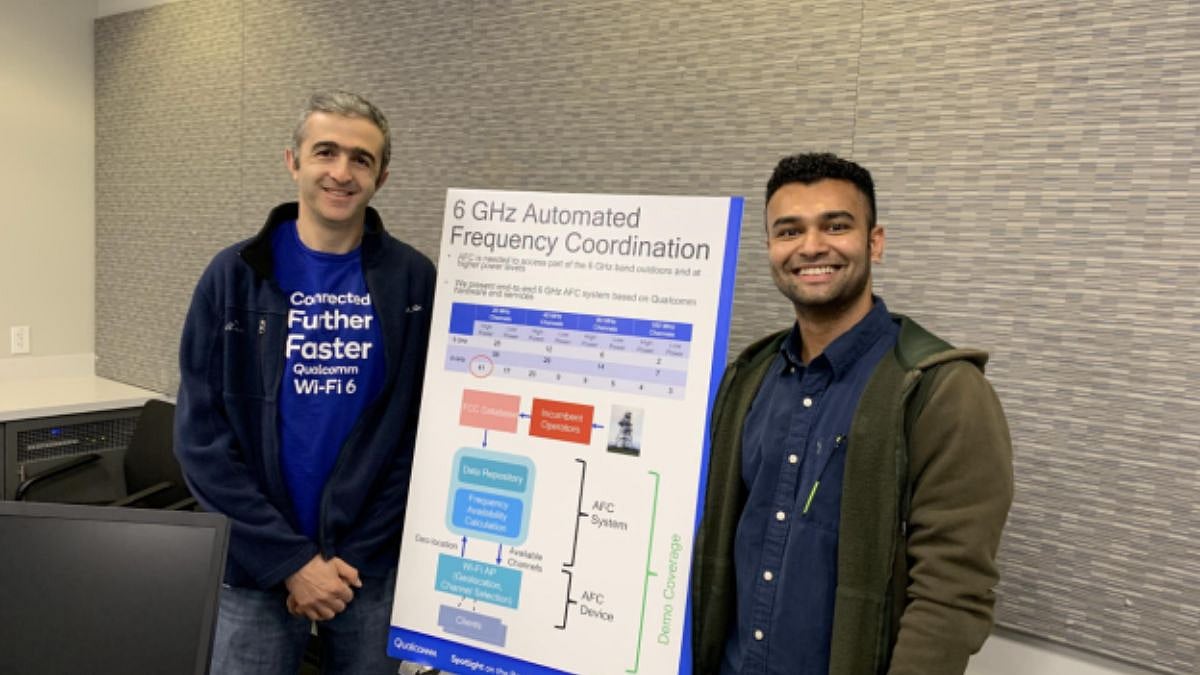
To address this, Automated Frequency Coordination (AFC) systems were developed. These systems act as centralized coordination platforms that determine which frequencies and power levels can be safely used by Wi-Fi access points in specific geographic locations.
I was involved in Qualcomm’s early AFC development efforts, which began as an internal prototype before evolving into a commercial system.
It started as a proof-of-concept where I was working across the entire stack. The complexity came from needing to understand multiple domains at once, networking, cloud systems, device communication, and regulatory requirements. It wasn’t just about building a feature; it was about building something that could operate reliably at scale and under strict constraints.
The initial AFC prototype was developed as part of a technology demonstration effort. However, as regulatory frameworks around the 6 GHz band matured, the system transitioned from experimental work into production-grade infrastructure.
My role expanded from early prototyping into designing and implementing core components of the AFC system for commercial Wi-Fi access points. This included building mechanisms for devices to retrieve spectrum availability data from cloud-based coordination services and dynamically apply those constraints in real time.
The system required integration across multiple layers, including device firmware, cloud services, and compliance logic aligned with regional regulations.
In practice, this meant ensuring that a Wi-Fi access point could determine, based on its location and environmental context, which channels were available and at what transmission power levels, and then enforce those constraints automatically.
While the underlying concept is straightforward, the engineering challenge lies in ensuring accuracy, reliability, and consistency across large-scale deployments.
I can describe a broader shift in the industry toward more adaptive and data-driven network systems, particularly as machine learning becomes more integrated into infrastructure.
Historically, wireless networks were configured using static rules and manual optimization. Engineers would analyze performance issues and adjust parameters based on observed behavior. As networks have grown in scale and complexity, that model has become less practical.
Modern systems now generate large volumes of telemetry data from devices, access points, and network infrastructure. This data can be used to identify patterns, detect anomalies, and improve performance in more automated ways.
At Qualcomm, I have worked on systems that apply machine learning techniques to wireless environments, including anomaly detection using autoencoder models and clustering techniques, as well as device classification systems that help identify behavioral patterns in network traffic.
Machine learning is changing how networks understand themselves. Instead of engineers manually identifying issues, systems can increasingly detect anomalies, classify behavior, and adjust automatically. It changes the role of the engineer from reactive troubleshooting to designing systems that can learn.
The integration of machine learning into networking systems is not limited to optimization alone. It also extends to observability, classification, and predictive maintenance.
One of the key shifts is the move from reactive systems to predictive ones. Instead of responding to failures or congestion after they occur, systems can anticipate potential issues based on patterns in historical and real-time data.
This requires building pipelines that span from device-level data collection to cloud-based analytics systems capable of processing large-scale telemetry streams.
It also requires careful consideration of privacy and system constraints, particularly when dealing with location-aware or device-identifying information.
I emphasize end-to-end ownership as a core part of his approach. Rather than focusing on a single layer of the system, my work has often involved spanning device software, cloud infrastructure, and analytics systems.
Modern wireless systems are increasingly interconnected, which requires engineers to understand how different layers interact.
Connectivity today isn’t just one thing. It involves firmware, cloud services, analytics, security, and compliance all working together. If one part is misaligned, the system doesn’t behave correctly.
This cross-layer perspective has become more important as wireless systems have evolved from relatively isolated devices into distributed, cloud-connected ecosystems.
While much of the infrastructure I work on is not directly visible to end users, I am motivated by the scale and indirect impact of the systems.
There’s a certain value in building foundational systems. Most users won’t think about how their device connects or why their network is stable, but those experiences depend on a lot of engineering decisions behind the scenes.
Wireless systems are becoming more complex as they expand into new environments, including industrial systems, smart infrastructure, and high-density urban deployments.
Looking ahead, I believe wireless connectivity will continue moving toward more adaptive and autonomous systems, particularly as AI and edge computing become more deeply integrated into infrastructure.
The expectation for users is increasingly simple: connectivity should work reliably, regardless of location or device type. Achieving that outcome, however, requires significant complexity underneath the surface.
As wireless systems continue to evolve, much of the innovation will remain in the background, embedded in coordination systems, machine learning models, and infrastructure layers that users rarely see directly.
For engineers working in this space, that invisible complexity is where much of the ongoing development is taking place.

