Unexpected costs like a medical bill or an urgent business payment can come up without warning. Not long ago, getting a loan in such moments was quick and straightforward. Now, lenders are more careful, and approvals involve closer checks before funds are released.
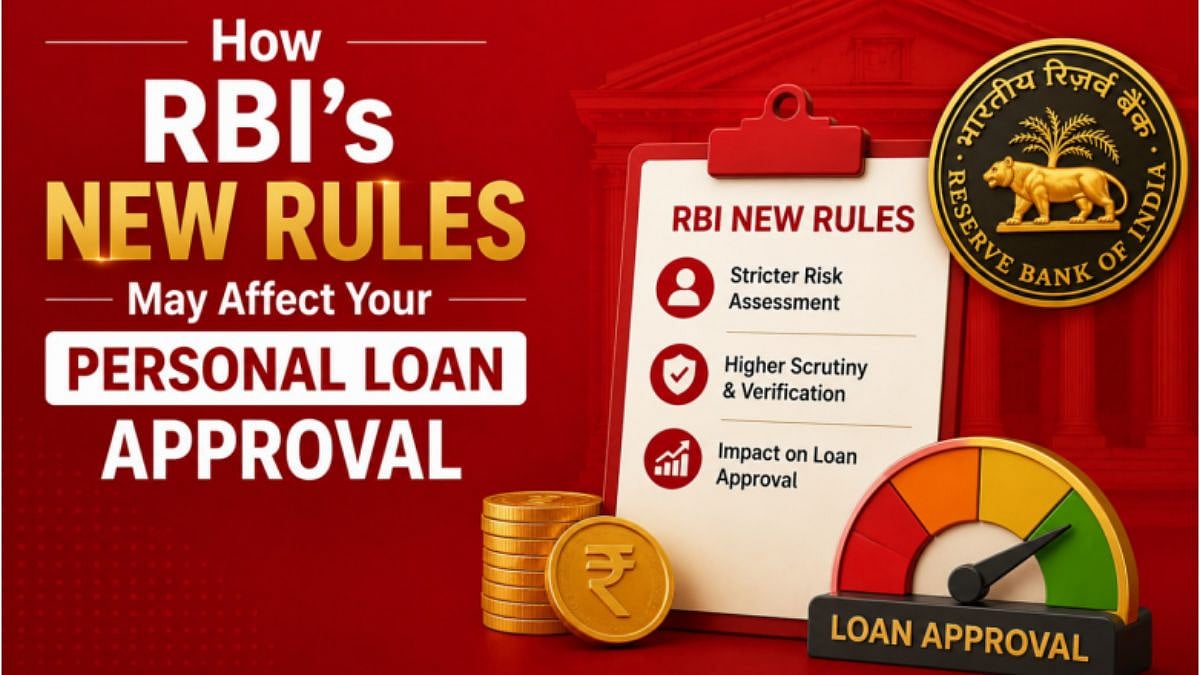
The Reserve Bank of India (RBI) rolled out crucial updates recently, bringing stricter oversight for the 2025–2026 financial cycle to prevent national debt traps. For everyday borrowers, whether salaried professionals or hardworking business owners, These rules directly affect how easily a Personal Loan is approved and how much it costs.
Here is a breakdown of what these changes mean for the average pocketbook, and how prospective borrowers can get approved without breaking a sweat.
The 125% Risk Weight Rule: Why Approvals Are Tighter
The central bank has made lending a bit stricter by increasing the risk level for loans that do not require collateral. For 2026, banks now need to be more cautious with this kind of credit. In simple terms, when a bank gives out ₹100 without any security, it now has to keep aside a larger amount of its own money as a backup in case the borrower cannot repay.
Because unsecured lending is now much more capital-intensive, lenders are logically passing that caution straight down the chain. An instant personal loan that earlier needed minimal checks may now require detailed income verification. Lenders are now taking a much closer look at how much someone earns compared to what they already owe. As a result, applications that might have been approved a few years ago are now more likely to be declined.
Expect a Shift in the personal loan interest rate
When financial institutions are forced to lock up a larger chunk of their capital, operational profit margins inevitably shrink. How is that lost margin recovered? By charging the end borrower a premium.
As a result, the personal loan interest rate has slowly moved up over time. Even when the overall economy seems steady, borrowing without collateral is still relatively expensive. Anyone looking for a Personal Loan today will notice that getting a very low interest rate is quite difficult, unless there is a strong credit history and a stable, high income.
The Critical Role of a Pristine CIBIL Score
In this risk-averse environment, credit history has evolved from a simple background check into an absolute financial lifeline. Today, the underwriting algorithms are ruthless.
● The New Normal: To have any real leverage in negotiating a favourable personal loan interest rate, maintaining a CIBIL Score of 750 or above is no longer optional; it is practically mandatory.
● Zero Tolerance for Hiccups: Modern engines assessing an instant personal loan application are highly sensitive to recent payment behaviours. Even a single 30-day credit card delay from six months ago can trigger an automatic rejection.
The Silver Lining: Transparency and Borrower Protection
The market shift is not all bad news. The latest 2026 guidelines heavily favour consumer empowerment, specifically taking aim at hidden costs and exploitative penalty structures.
● The Key Fact Statement (KFS): Before a loan is finalised, lenders now share a simple summary that pulls all the key details into one place. It gives a clear sense of the total cost, including interest and any added charges, so nothing important is hidden or left unclear before moving ahead.
● Fairer Penal Charges: Historically, missing an EMI meant banks would slap on compounding "penal interest," creating a vicious debt spiral. Under the new mandate, lenders can only levy flat "penal charges," which cannot be capitalized or added back to the principal amount.
Feature
Old Regulatory Framework
New RBI Mandates (2026)
Penalty on Defaults
Compounding penal interest
Flat penal charges only
Cost Transparency
Hidden fees buried in fine print
Mandatory Key Fact Statement (KFS)
Lender Caution
High approval rates for unsecured
Strict underwriting (125% risk weight)
Essential Tips & Caveats for 2026
Before signing the dotted line on any credit agreement this year, keep these practical caveats in mind:
● Avoid the Application Spree: Applying to many lenders at the same time can work against approval chances. Each application leads to a credit check, and too many of these close together can raise concerns and make lenders more cautious.
● Scrutinise Lock in Periods: It helps to check the fine print before taking a loan. While some loans now allow easier early repayment, others, especially fixed rate ones, may still include charges for closing the loan early.
● Before using any mobile lending app, it is important to check who is behind it. The app should be linked to an RBI regulated bank or NBFC, so there is clarity on who is handling the data and funds. This simple check can help avoid sharing sensitive information with the wrong platform.
Next Steps for the Smart Borrower
Getting a loan today is not as effortless as it once felt. Earlier, approvals came through quickly, often with very few checks. Now, the process is more careful and structured, which may take a little longer but also makes things clearer and more predictable.
For planned expenses, it helps to look at the credit report in advance and sort out any issues before applying. And when funds are needed quickly, working with a lender that keeps the process simple and steady can make a real difference. A regulated institution like Muthoot Finance is often chosen for its organised approach, timely processing, and dependable support.
With the current system, a little preparation and the right choice of lender can make the experience far smoother.

