People who follow the stock market have probably heard the term SGX Nifty many times. For years, it was one of the first indicators traders checked before Indian markets opened. A rise in SGX Nifty usually hints at a positive opening. A fall often suggested weak sentiment.
But now, SGX Nifty is no longer active in the same form. It has been replaced by GIFT Nifty.
This change created confusion among many retail investors. Some assumed a completely new index had been introduced. Others thought SGX Nifty had simply been renamed without any real difference.
The reality sits somewhere in between. The contract still tracks India’s Nifty 50 index. But the place where it trades, the exchange structure, and the regulatory setup have changed. Understanding these differences helps traders follow pre-market discussions with greater clarity.
What Was SGX Nifty?
SGX Nifty was a derivative product linked to India’s Nifty 50 index and traded on the Singapore Exchange.
Foreign investors often preferred it because they could take exposure to Indian markets without directly trading on Indian exchanges. Over time, SGX Nifty became popular beyond institutional investors. Retail traders in India also started following it daily.
One significant reason was timing. SGX Nifty traded for longer hours than Indian stock exchanges. Because of that, it reacted to overnight global market movements before Indian markets opened the next morning. For example, if US markets crashed overnight, SGX Nifty would usually react before the NSE opened in India.
That is why business news channels and traders tracked it so closely and why it became a standard part of morning market discussions for years.
What Is GIFT Nifty?
GIFT Nifty is the successor to the same contract. The core difference is that trading has shifted from Singapore to GIFT City in Gujarat.
GIFT City, short for Gujarat International Finance Tec-City, is India’s international financial services centre. Instead of trading on the Singapore Exchange, the contract now trades on NSE International Exchange (NSE IX).
The underlying benchmark remains the same: it still reflects the Nifty 50 index. But the trading platform and location are now different.
In short, SGX Nifty traded in Singapore, and GIFT Nifty trades in India’s GIFT City. That is the fundamental change.
Why Did India Shift From SGX Nifty To GIFT Nifty?
For years, a significant volume of offshore trading linked to Indian equities happened outside India’s regulatory boundaries. Indian exchanges and regulators wanted to bring this activity back into the domestic financial ecosystem.
The launch of GIFT Nifty was part of that broader plan. The move also strengthens the development of GIFT City as a global financial hub, as part of India’s drive to make it an international centre for finance and investment services.
Regulators and exchanges got more direct oversight of the ecosystem by moving Nifty-linked offshore trading to GIFT City. The migration was officially completed on 3 July 2023.
Main Difference Between GIFT Nifty And SGX Nifty
The names are different, but the contract itself still tracks the Nifty 50. The key difference lies in where and how it trades.
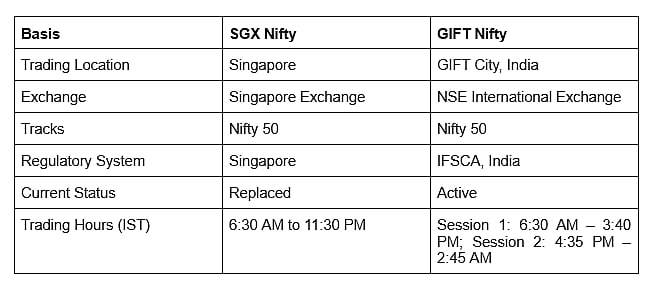
Trading Location
SGX Nifty is operated through the Singapore Exchange.
GIFT Nifty operates from GIFT City in Gujarat, India.
Exchange Platform
Earlier, trades happened on SGX.
Now, trading happens through NSE International Exchange.
Regulatory Structure
SGX Nifty followed Singapore’s market regulations.
GIFT Nifty comes under the International Financial Services Centres Authority (IFSCA) framework in India.
Strategic Importance
SGX Nifty mainly gave global investors access to Indian markets from outside India.
GIFT Nifty serves the same global investor base but through infrastructure located within India.
GIFT Nifty Vs SGX Nifty: Quick Comparison
Why Traders Watch GIFT Nifty Before The Market Opens?
Even after the transition, GIFT Nifty continues to be closely watched before market opening for largely the same reasons traders once followed SGX Nifty.
GIFT Nifty trades across nearly 21 hours in two sessions, covering Asian, European, and US market hours. This means overnight global developments like central bank decisions, geopolitical events, or sharp moves in US or European markets start reflecting in the GIFT Nifty well before Indian exchanges open at 9:15 AM. Traders use the gap between the previous day's Nifty 50 close and the current GIFT Nifty level as a rough signal for whether the market may open higher or lower.
This does not, however, guarantee how the actual market will behave once trading begins. Indian markets react to many factors once they open, and GIFT Nifty signals can reverse quickly. Most experienced participants treat it as one of several pre-market reference points rather than a standalone prediction tool.
How Retail Investors Track GIFT Nifty?
These days, pretty much all trading and investment platforms include live GIFT Nifty data right alongside other market indices. If you’re using something like Kotak Neo, you get everything in one spot. You can track GIFT Nifty, global indices, and watch how the market’s moving, all from a single dashboard. Makes getting a sense of what’s coming before the trading day starts a lot simpler.
Honestly, most retail investors glance at GIFT Nifty as part of their usual morning routine. They don’t rely on it alone.
Is GIFT Nifty Relevant For Long-Term Investors?
Short-term traders and people working with derivatives are way more tuned in, watching it closely. But if you’re in it for the long haul, you’re probably focused on things like company fundamentals and bigger economic shifts, not just what GIFT Nifty’s doing right now. That said, significant international events such as geopolitical developments, major central bank decisions, or sharp global corrections can temporarily influence even long-term investors' behaviour. During such periods, GIFT Nifty becomes relevant for a wider audience as a quick gauge of how global sentiment is running.
Conclusion
The shift from SGX Nifty to GIFT Nifty was more than a simple name change. The trading activity associated with India’s benchmark index has moved from Singapore to GIFT City, and the contract is now subject to Indian regulatory oversight. The underlying Nifty 50 benchmark remains unchanged, but the exchange structure and ecosystem have been modified. Knowing this transition helps investors to better follow the conversations in the market, especially as the market environment becomes more and more global in nature.
