Picture this. You're twenty-five, working hard, playing sport on weekends, and feeling — for all practical purposes — completely fine. You get a little short of breath sometimes, but who doesn't? You struggle to put on weight, but that's just how
you've always been.
Now imagine that a casual health check from your father changes everything.
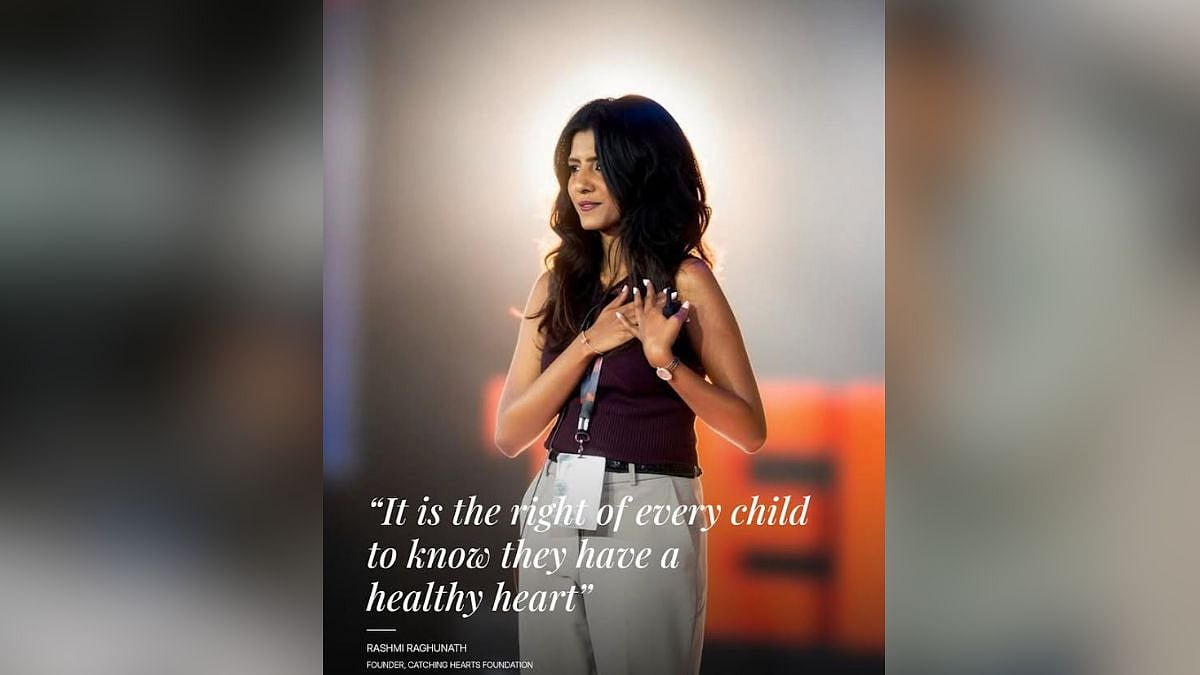
That is exactly what happened to Rashmi Raghunath. Her father, Dr. BB Raghunath, is a government doctor who has spent decades running mobile health camps across rural Karnataka. He knows what a healthy heart sounds like. When he listened to his daughter's chest during a visit home, what he heard was not that.
Six days later, Rashmi was in surgery. She had been born with hypertrophic
obstructive cardiomyopathy — a structural heart condition she had carried her entire life without knowing it. The surgery went well. She recovered fully.
But the experience left her with a question she could not shake: if her father hadn't been a doctor, if he hadn't been there that day, if she had been born into a family in rural Karnataka without access to any of this — what would have happened?
The answer to that question became Catching Hearts Foundation.
So How Big Is This Problem, Really?
Bigger than most people realise. India has the highest number of children living with congenital heart disease of any country in the world. In 2021 alone, an estimated 725,000 children in India were living with CHD. Every year, more than 200,000 children are born with the condition — and roughly one in five of those cases is
serious enough to need medical intervention within the first year of life.
Here's the problem. India has around 300 paediatric cardiac surgeons across approximately 90 cardiac centres. Almost all of them are in major cities. For a family in a rural district, getting their child to a specialist is not just difficult — it is often simply not possible.
And because congenital heart disease is frequently asymptomatic for years, many of these children are never flagged as needing care. They grow up getting a little
breathless, a little underweight, a little tired — and nobody connects the dots. Until something goes wrong.
Undetected structural heart conditions are one of the leading causes of sudden cardiac events in teenagers. Some critical defects, if not caught in the first hours of life, are fatal. The window for intervention exists. It is just not being used — because the screening never happens.
The Doctor Behind the Idea
To understand why Catching Hearts Foundation works the way it does, you have to understand Dr. BB Raghunath first.
He is not a doctor who sits in a clinic and waits for patients to walk in. He never has been. For most of his career as a Taluk Medical Officer with the Government of Karnataka, he has been the one travelling — to villages, to tribal communities, to
places where a doctor's visit is an event rather than a routine.
He's known in rural Karnataka as the "Baby Shower Doctor." In one district, he eliminated unsafe home births for three consecutive years — not by issuing directives, but by introducing community baby showers across villages in Chikkaballapura, Ramanagara, Chamarajnagar, and the Soliga tribal belt of Yellanduru. He turned pregnancy into something a whole community celebrated together. Families who had never engaged with the healthcare system started showing up. The idea spread because it worked.
He also co-founded Pacemakers 86 Trust, a general health initiative addressing cervical and breast cancer, TB, working with HIV affected children, mental health among adults to name a few, long before Catching Hearts existed. He has spoken at TEDx and received the Namma Bengaluru Award for his contributions to public health.
His core belief — unchanged after all these years — is that the healthcare system must go to the people, not the other way around. That belief is exactly what Catching Hearts Foundation is built on.
What Catching Hearts Actually Does
The model is straightforward, which is a big part of why it works.
Catching Hearts Foundation runs free cardiac screening camps for children directly in rural communities — at schools, at local health centres, wherever families can actually reach without having to travel hours to a city. The camps use echocardiography to screen children for congenital heart conditions on the spot.
For most families, the most valuable thing they take away from a camp is simple: the reassurance that their child's heart is fine. For the families where a condition is found, that screening is potentially life-saving.
The longer-term goal is bigger than a series of camps. Rashmi and her father are working to build the first scalable, replicable echocardiogram-based CHD screening
model in India — something that can be rolled out state by state, rather than rebuilt from scratch each time.
Why She Hasn't Walked Away From Her Career
Here's something worth noting. Rashmi has not quit her job to run the foundation. She still works full-time in a leadership role at MongoDB, heading teams across the Asia-Pacific region.
Every hour outside of that goes to Catching Hearts. Evenings, weekends, early mornings — that time belongs to the foundation.
She doesn't describe it as a sacrifice. It's just, in her words, where her time needs to go. Her father has operated the same way for decades — holding down a full government career while simultaneously running health camps, co-founding a trust, and now building a foundation alongside his daughter. The capacity to carry multiple things at once seems to run in the family.
In 2025, Rashmi spoke about the foundation at TEDx — not to tell her own survival story, but to make the case for why the system needs to change. The argument she made was simple: luck should not be the difference between a child being diagnosed and not. That's not a healthcare system. That's a lottery.
What You Can Take Away From This
Congenital heart disease in children is not a rare or niche problem. It is one of the most common birth conditions in India, and the majority of cases that go undetected do so not because the diagnostic tools don't exist — but because those tools never reach the communities that need them.
Catching Hearts Foundation is trying to change that. If you've ever wondered what meaningful grassroots healthcare intervention looks like, this is a fairly clear example: take the specialist to the child, not the other way around; build a model that can be replicated rather than a one-off camp; and do the work consistently, in the
places that are easiest to overlook.
Some things worth keeping in mind:
India has over 200,000 children born with cardiac conditions every year — most in communities without access to specialist care
Congenital heart disease is often invisible for years, making community screening the only reliable way to catch it early
The gap in India is not a knowledge gap or a technology gap — it is a delivery gap
Organisations like Catching Hearts are not filling that gap with charity camps
— they are trying to build the infrastructure that makes screening a standard part of rural child healthcare
Final Thoughts
Rashmi Raghunath survived because her father happened to be in the room. Millions of children in rural India do not have that kind of luck.
That is not a reason to feel helpless. It is a reason to pay attention to the
organisations that are working on this systematically — and to understand that the solution to a delivery problem is, in the end, a better delivery system.
Rashmi says it plainly: it is the right of every child to know their heart is healthy. She has been saying it since before the foundation existed, and she does not seem like she is planning to stop until they do.
Learn more at catchingheartsfoundation.com
