The used automatic car market in India has grown substantially over the past decade, driven by the increasing availability of automatics at sub-10 lakh price points and the genuine comfort advantage they offer in city traffic. For commuters in Delhi, Mumbai, or Bangalore, where stop-and-go driving can consume an hour or more each day, the case for automatic transmission is real and practical.
The appeal of used automatics, however, comes with a specific set of risks that are different from manual transmission cars. Automatic transmissions are mechanically and electronically more complex than manuals. They have more failure modes. They are more expensive to repair when they do fail. And because transmission issues are difficult to identify during a short test drive, organised used car platforms such as Cars24 include transmission-specific checks as an integral part of their buying journey. A buyer who is specifically considering a used automatic, whether an AMT, CVT, torque converter, or DCT, needs to know what to look for and how to interpret what they find.
Understanding the Four Automatic Transmission Types in Used Cars
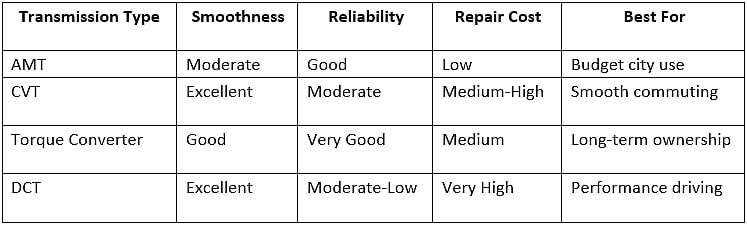
The four main automatic transmission types available in the used Indian car market each have different costs, reliability, and maintenance profiles.
Automated Manual Transmission (AMT)
AMT, or Automated Manual Transmission, is the most common type in used cars below eight lakh rupees. It uses a manual gearbox with an automated clutch actuator and gear-shift mechanism. AMTs are relatively inexpensive to maintain because they share components with manual gearboxes. The characteristic symptom of AMT wear is increased head-nod, where the gear changes become progressively more noticeable and jerky. This is often an indication that the clutch actuator or the clutch plate itself is showing wear.
Continuously Variable Transmission (CVT)
CVT, or Continuously Variable Transmission, is common in Japanese hatchbacks and compact cars. Instead of fixed gears, it uses a belt-and-pulley system that provides infinite ratio variation. CVTs are smooth when functioning well, but can produce a characteristic whining or droning sound when the belt shows wear. They are also sensitive to the quality of the CVT-specific transmission fluid; using the wrong fluid can accelerate belt wear significantly.
Torque Convertor Automatic
Torque converter automatics are the traditional type found in older sedans and in larger vehicles. They are generally robust, but they require regular transmission fluid changes that are often deferred in the used car market. A torque converter automatic with a history of fluid neglect can develop delayed engagement, where there is a pause between selecting a gear and the transmission responding.
Dual Clutch Transmission
DCT, or Dual Clutch Transmission, is the most sophisticated type, found in enthusiast-oriented cars. DCT systems offer quick gear changes but can be prone to judder at low speeds and in heavy traffic when worn. DCT repair costs are typically higher than those of other automatic types.
Warning Signs to Identify During the Test Drive
Many used automatic cars feel perfectly normal during a 10-minute drive, but start showing hesitation once the transmission warms up in traffic.
Delayed engagement is the most common early symptom of automatic transmission problems. Select Drive from Park, and note whether the car moves forward immediately or whether there is a pause of more than a fraction of a second. Similarly, when selecting Reverse, the car should move backwards with minimal delay. Any hesitation suggests that the clutch pack pressure is lower than it should be.
● During driving, note whether gear changes happen smoothly and at the expected speeds.
● Unexpected gear hunting, where the transmission cycles between two ratios without a clear reason, suggests that the transmission control module or hydraulic pressure system is not functioning optimally.
● A transmission that frequently drops a gear when climbing a mild incline is working harder than it should.
Overheating is a common issue in used automatic cars, particularly those that have been used heavily in city traffic. Look for any temperature warning lights on the dashboard. Ask the seller to demonstrate the car after it has been driven in traffic, not just from a cold start. A transmission that shows temperature-related behaviour, such as becoming sluggish or shifting abnormally after extended city driving, may be showing early overheating symptoms.
Listen for unusual sounds throughout the drive. Whining, clunking, or grinding sounds from the transmission tunnel, particularly under load or during gear changes, indicate internal wear or damage that requires investigation.
Why Transmission Repairs Can Redefine the Cost of a Cheap Automatic
Automatic transmission repairs are among the most expensive unscheduled maintenance items in any used car category. The complexity of automatic transmission systems means that most repairs require specialist workshops with specific equipment and training, which limits the available repair options compared to manual transmissions.
A CVT belt replacement on a common Japanese hatchback typically costs between thirty thousand and sixty thousand rupees at a reputable workshop using quality parts. A full torque converter automatic overhaul can exceed eighty thousand rupees on many platforms. DCT repairs, which involve specialist knowledge and tools, frequently exceed one lakh rupees for significant internal work.
These figures are relevant because they can exceed the perceived price advantage of a cheaper used automatic over a more expensive but verified option. A buyer who saves twenty thousand rupees on a used City with an AMT showing early wear signs and later spends thirty-five thousand on clutch actuator replacement plus clutch plate replacement has made a more expensive decision than buying the slightly more expensive car that passed a thorough inspection without transmission concerns.
Service History and Why It Matters More for Automatics Than Manuals
Automatic transmissions are more sensitive to maintenance history than manual transmissions for a specific reason. The hydraulic systems in most automatic transmissions depend on fluid that is in good condition to function correctly. Automatic transmission fluid degrades over time and with heat cycling. Fluid that has been used beyond its recommended interval loses its ability to maintain proper hydraulic pressure and to lubricate internal components adequately.
Most automatic transmissions benefit from fluid changes every 40,000 to 60,000 km, depending on the type and the manufacturer's recommendation. In the informal used car market, this service is frequently deferred. A used automatic with 80,000 km on the odometer and no transmission fluid change record is a car where two drain-and-fill cycles have been skipped. The cumulative effect of degraded fluid on clutch pack wear, valve body function, and bearing lubrication is difficult to assess externally but real in its impact on long-term reliability.
When reviewing the service history of a used automatic, a buyer should specifically look for evidence of transmission fluid changes. The absence of this record does not mean the service was not done, but it does mean it cannot be verified. Requesting the physical service book and checking the workshop stamps and service details is the appropriate step. For buyers buying from organised platforms like Cars24, the inspection process checks fluid quality as part of the evaluation, which at minimum establishes the current fluid condition even when a complete service history is unavailable.
How the Cars24 Inspection Addresses Automatic Transmission Checks
The Cars24 300-point inspection specifically covers transmission health as part of its mechanical assessment. For automatic vehicles, this includes checking for smooth gear transitions, evaluating clutch actuator behaviour on AMT cars, assessing transmission fluid quality and level, and testing for any signs of overheating or abnormal behaviour during the road test component of the inspection.
The ten-hour inspection duration allows a road test that is long enough to bring any latent heat-related issues to the surface, which a brief test drive cannot do. Cars that show transmission findings have those documented in the inspection report with specifics about what was observed.
The warranty layer provides an additional layer of protection specifically relevant for automatic transmission anxiety. While the platform’s 30-day repair assurance offers guaranteed, unlimited repairs for the first 30-days or 1,500 km (whichever comes first), the Lifetime Warranty Plan further covers transmission components explicitly, including both manual and automatic gearbox internals for up to 12 years or 1,50,000 km from the date of registration.
This means a buyer who purchases an eligible automatic car through Cars24 and opts for the Lifetime Warranty Plan has documented protection against transmission failures, which represent the highest potential cost in automatic car ownership. This combination of a thorough pre-purchase transmission check through the 300-point inspection and ongoing warranty coverage directly addresses the two main concerns of used automatic car buyers: getting a car with an unknown transmission condition, and facing an unprotected, expensive failure if something goes wrong later.

