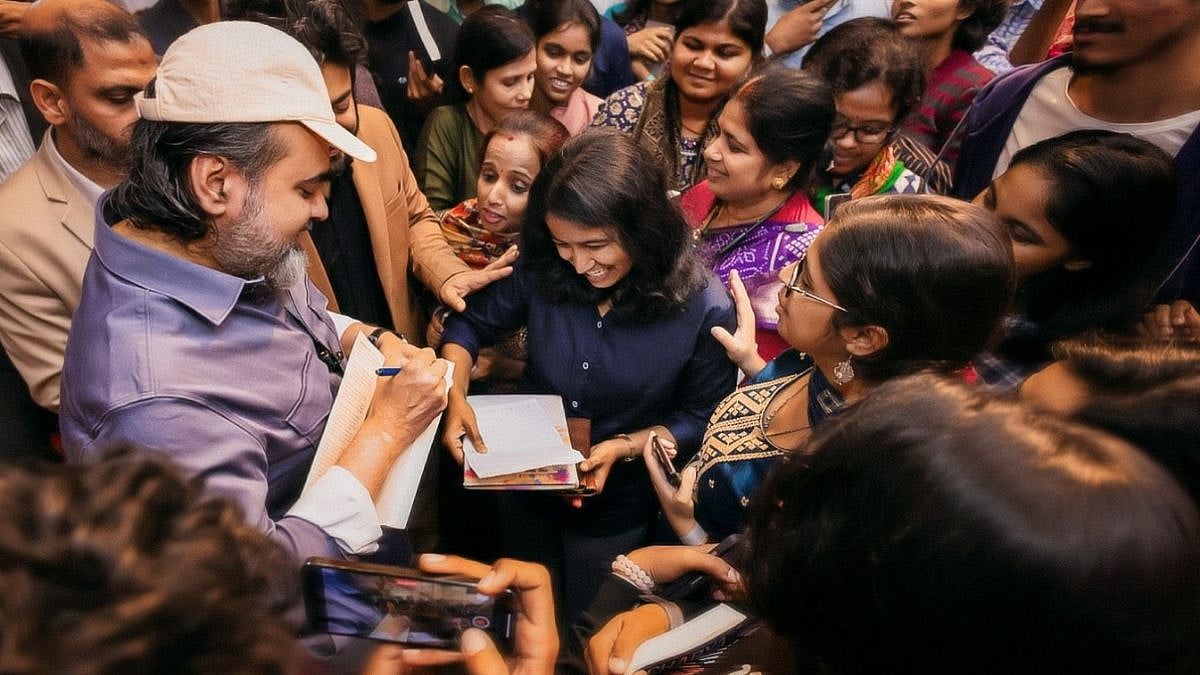
India's spiritual landscape offers women two familiar narratives. One pedestalises them as goddesses, worshipped in verse but denied the dignity of being human, flawed, striving. The other, dressed in modern vocabulary, urges them to embrace their feminine nature and find balance.
Both, in different ways, keep women tethered to the body. Acharya Prashant rejects both. The author and philosopher, whose online following now exceeds 90 million, keeps returning to a harder question: why should anyone remain imprisoned by categories that exist only at the level of flesh?
His approach to women's empowerment comes straight from Advaita Vedanta. If the self is not the body, then gender itself is a misidentification. The problem isn't how women should become equal to men. The problem is that both remain trapped in definitions imposed from outside.
In session after session, he's been clear about where conventional feminism falls short. "The usual feminism always proceeds by keeping the man at the centre," he has said.
"The woman is saying, 'The man is alright, and I want to be like the man.' This is such a low standard to set." True feminism, in his framing, would proceed from the person's real potential, what Vedanta calls the Atman. Not equality with men but equality with one's own highest possibility.
There's a distinction he draws that matters here: between external bondage and internal bondage. External bondage involves institutions, family structures, religious codes, legal frameworks, and media representation.
These shape a woman's consciousness, often in ways she doesn't recognise. But the harder problem, he argues, is the internal one. Millions of years of evolution have conditioned the female body toward security, toward the nest, toward procreation. This biological training doesn't disappear in a few thousand years of civilisation.
"Women say, 'We are empowered,' but internally, they still live in deep bondage," he has observed. "External freedom, without concern for internal freedom, becomes dangerous because it creates an illusion of freedom."
This is where Vedanta enters. Self-knowledge, Atma-gyan, is the only thing that can address conditioning at its root. A woman who knows herself as consciousness, not flesh, cannot be exploited through appeals to her femininity. She sees through the game.
When AIIMS Nagpur was looking for a chief guest for its Women's Day celebration in 2022, the organisers made an unusual choice. They invited a male philosopher. Not a politician delivering platitudes. Not a celebrity offering inspiration. A faculty member present that day made a telling observation: "You understand women better than women do."
The institutional recognition has continued. Acharya Prashant has addressed women's empowerment at IITs, IIMs, and even the Boxing Federation of India, where he was invited as a chief guest at the 7th Elite National Women's Boxing Championship.
What distinguishes these invitations is their source: institutions known for rigour, not sentiment. When IISc Bangalore invites a philosopher twice in one year, or four IIT campuses host him within ten weeks, they're not looking for feel-good oratory. They want discourse that can withstand scrutiny.
The numbers tell their own story. His Foundation runs a dedicated YouTube channel called Shakti, focused entirely on women-centric teachings, with over 1.3 million subscribers. His books on the subject, including the national bestseller Women's Revolution, along with 'Stree' and 'Maa', deal directly with the inner lives of women.
In a recent opinion piece for The Sunday Guardian titled "Delicate to Dauntless: The Myth of Female Fragility," he dismantled the civilisational assumption that women must remain delicate and desirable. "Fragility was manufactured," he wrote. "The world didn't merely admire her softness; it required it. A fragile woman is convenient. A strong woman compels man to confront his own inner slavery."
On the question of clothing and modesty policing, his position is unsparing. "To those who articulate that women should mind their clothes and dressings, the question arises: what kind of person are you, man or woman, if anything is able to disturb or provoke you so easily? Today, it is said that a woman's legs or thighs provoke you. What prevents you from saying tomorrow that her ankles and fingernails provoke you?"
This willingness to name what others avoid has made him a distinct voice. While many spiritual figures talk about respect for women, the subtext of their sermons often carries a different message: women are praised when they conform, silent, obedient, covered. Acharya Prashant calls this out directly. The ghoonghat, the restrictions on movement, the reduction of women to objects of family honour, all of it comes under scrutiny.
The Violence Nobody Wants to Name
Perhaps nowhere is this directness more evident than in his frequent addresses on female infanticide. Where public discourse often locates the threat to Indian women in external enemies or sensationalised crimes, Acharya Prashant insists on naming the danger that operates closest to home.
The numbers he has often cited in his lectures are drawn from government census data: over one crore girls have gone missing in India in the last two decades. That translates to five lakh per year, fifty-seven every hour. A population the size of Nepal, erased. And this erasure, he points out, is not happening in spite of families but because of them.
The data reveals patterns that complicate easy narratives. Female foeticide is more prevalent among the educated than the illiterate, more common in upper and middle classes than among the poor, higher in so-called upper castes than lower ones, and concentrated in urban North and West India rather than the regions typically associated with backwardness. The sex ratio at birth worsens with the second child but improves with subsequent children, a pattern that exposes the calculation: families keep trying until a son arrives, discarding daughters along the way.
He traces this to deeply embedded cultural beliefs: the daughter as "paraya dhan," someone else's property; the burden of dowry; the anxiety over family lineage. India ranked 142nd out of 146 countries in the "Health and Survival" category of the Global Gender Gap Index 2024. The Female Infanticide Prevention Act dates to 1870, enacted by the British. The problem, he argues, is not new. It is ancient.
"We worship the goddess and kill the girl," he has observed. The hypocrisy is not incidental but structural. A society that genuinely honoured the feminine would not need to be told that daughters deserve to live. The issue, in his framing, is not merely social but spiritual. Its solution cannot come from campaigns and slogans alone. It requires confronting the cultural and patriarchal conditioning that makes a family see its own daughter as dispensable.
Religion as Ally, Not Enemy
One of his more striking positions concerns the relationship between women and religion. Where many feminists see religion as inherently patriarchal, Acharya Prashant draws a distinction.
"A lot of negative attitudes towards women today are claimed to be sanctioned by religion," he has said. "The reason is that religion has been a victim of contamination. And this contaminated, mainstream, and false religion becomes a tool to exploit women. On the other hand, real religion is a woman's best friend because its effects are emancipation and empowerment."
By "real religion," he means Vedanta: the philosophical core that declares the Self to be beyond body, gender, caste, and all conditioning. "Vedanta is the religion for women," he has stated plainly. When the scriptures say "You are not the body," they're offering women the most radical freedom available: freedom from the very identity that has been used to cage them.
The historical parallels are difficult to ignore. Over a century ago, Swami Vivekananda declared: "There is no chance for the welfare of the world unless the condition of women is improved." He blamed India's decline on its neglect of women and insisted the remedy was education: "Educate your women first and leave them to themselves."
Acharya Prashant carries this inheritance forward, updated for contemporary complexities. Where Vivekananda fought against the obvious subjugation of his time, the modern challenge is subtler. The exploiter is no longer always external. "The exploiter has entered the girl's mind and is exploiting her from within," Acharya Prashant has noted, "and she often feels this is freedom."
The girl who shops compulsively, who bases her worth on social media validation, who makes relationship decisions driven by biological urges dressed up as love, she is not free merely because no one is visibly restricting her. This is why, he argues, wisdom education is doubly important for girls. Without wisdom, external freedom becomes a new form of trap.
Everything comes back to one question: what are we, really? His answer draws from Advaita Vedanta and doesn't leave much room for ambiguity. We are not the body, and if we're not the body, we can't be our gender either. Gender is just a label biology stuck on us at birth.
"A woman rises from being an object of lust to a deity worth worshipping when she drops her womanliness," he has written. This isn't misogyny. It's the Vedantic position taken to its logical conclusion. As long as a woman clings to her identity as a woman, she remains available for exploitation through that identity. Drop the identification, and the exploitation loses its handle.
During his sessions, he often poses uncomfortable questions. "What if you were never, never trained in womanhood? How would you live? You can't even think, because right now, every bit of you is a trained bit. How do you know that a woman must have long hair? How do you know?" The training runs deep: Pink for girls; Dolls, not trucks; Be polite, don't raise your hand. The girl who was in the merchandise shop buying clothes the previous evening goes to school the next morning and doesn't speak up in class. The connection isn't accidental.
Women's empowerment movements in India often treat the problem as purely social. Acharya Prashant doesn't deny the social dimension. But he insists that legislation and policy alone won't dissolve the inner conditioning. That conditioning lives in the body's evolutionary memory, in the mind's accumulated training, in the ego's need to belong to some category.
This is why he keeps saying that the ultimate answer won't come from rights alone; it has to come from self-knowledge. When the Self that the Upanishads speak of is actually realised, gender doesn't need transcending. It just becomes irrelevant.
Spirituality in India often avoids the gender question, or buries it under praise of motherhood and sacrifice. Acharya Prashant does neither. He doesn't just call patriarchy a social injustice. He calls body-identification itself a spiritual error. And in doing that, he offers something rarer than reform: a framework where the cage simply cannot hold.

