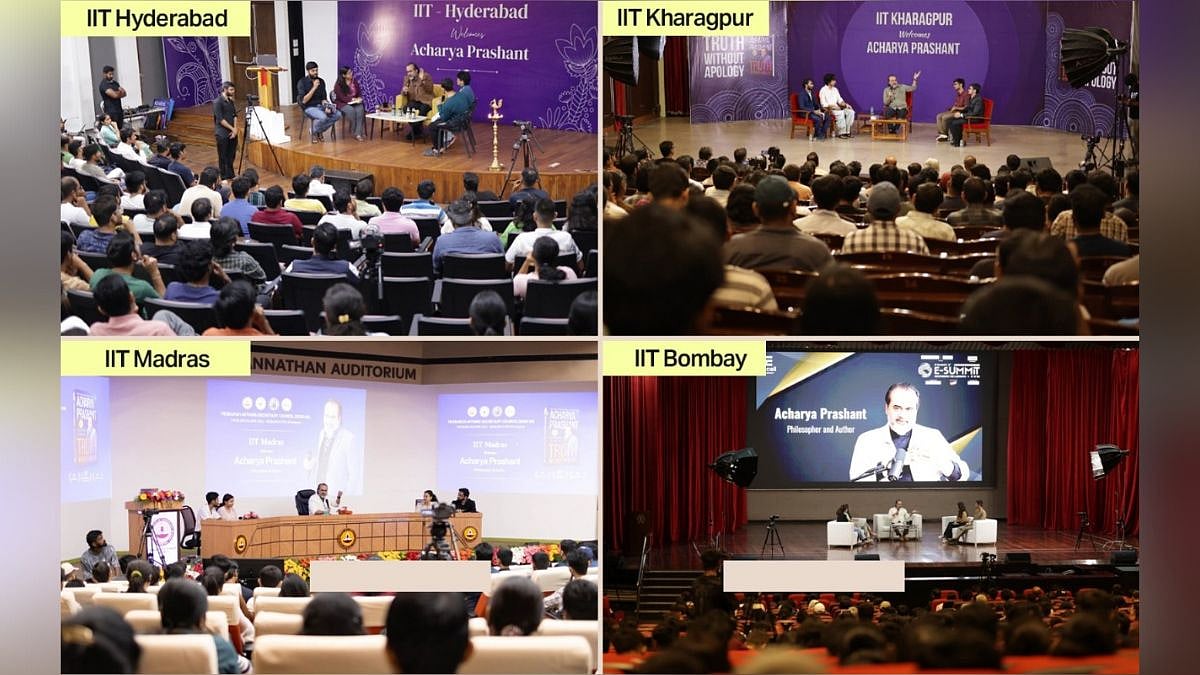
Philosophy sessions in engineering campuses are not new. What is new is a 1500 seater auditorium overflowing thirty minutes before start time, students sitting on staircases, and interactions stretching to seven hours because nobody wants to leave.
Between October and December, Acharya Prashant (the world’s most followed philosopher and author of national bestsellers) spoke at IIT Hyderabad, IIT Kharagpur, IIT Madras and IIT Bombay in quick succession. Each session drew a packed house. Each ran longer than scheduled. And in at least two sessions, students continued conversations with him informally, late into the night. Whatever one makes of this, it is not the typical guest lecture circuit.
The IIT Hyderabad session on 1st October was structured as a panel discussion followed by an open dialogue. Acharya Prashant was invited as a speaker in the prestigious Extra Mural Lectures (EML), where the institute invites the most prominent speakers from all over the world. Dr. Murthy, the Director of IIT Hyderabad, attended throughout and participated. And it was not just a ceremonial appearance: he listened intently and posed questions, and so did the students and faculty as they asked probing questions on technology, scientific thinking, the restless mind, stress, the search for purpose. When climate change came up, Acharya Prashant pushed it somewhere unexpected: "You can calculate carbon emissions and melting ice caps, but can you examine yourself and the endless desires that drive those emissions?" Not standard environmental messaging, but then again, this wasn't a standard campus talk.
IIT Kharagpur, a month later, became something else entirely.
By 5:30 PM on 1st November, the iconic Netaji Auditorium of IIT Kharagpur was already full beyond capacity. The deans did a formal welcome and felicitation, and then Acharya Prashant began speaking on fear. Not abstract fear, but fear as the hidden driver behind career choices, relationship decisions, life paths. "When it comes to our major decisions, it is not love that guides us," he said. "A fearful and insecure mind cannot love." The systems that generate our insecurities, he argued, are the same ones telling us what safety looks like. So we end up chasing aspirations we've borrowed without ever noticing. On the question of understanding: "Understanding cannot be inherited. Everyone has to see for themselves."
What happened next was not part of any plan. Hundreds of students surrounded him after the formal session and walked with him across the campus lawns. Three more hours of conversation followed, on clarity, freedom, inner strength. Total engagement: nearly seven hours. The Student Council invited him back the following afternoon for a closing interaction. Unprecedented is an overused word, but participants reached for it anyway.
The IIT Madras session on 20th November (World Philosophy Day) followed a similar arc. Venue full before time, formal introduction by the Dean of Students, discussion ranging across ethical living, values and action, climate anxiety, identity, and expectation. Acharya Prashant's responses kept circling back to psychological self-examination rather than external circumstances. Afterwards, a group of students continued talking outside the Bose–Einstein Guest House, late into the night.
IIT Bombay on 10th December, offered a different context: the 21st E-Summit, Asia's largest student-run entrepreneurial festival. The lineup featured industry leaders, investors, policymakers. And, notably (and probably unprecedented), the world's most followed philosopher. The 1500 seater Convocation Hall was packed before the session began. For over three hours, students asked about relationships, career anxiety, overthinking, ambition, the particular pressures of wanting to build something. Acharya Prashant kept redirecting toward self-understanding. He explained how it is problematic to measure success by accumulation. He spoke on the need to recognise conditioning before you chase anything. On gender, he said that meaningful progress isn't just equality, it's making gender matter less as a defining category. On freedom, he clarified how assuming one is free without examining one's conditioning doesn't lead to liberation, but rather further confusion.
Students lingered after the formal closure of the marathon four-hour session for more conversations.
What does one make of all this? The pattern is consistent: sessions end, students stay. They keep questioning, keep debating, keep showing up.
There is a certain kind of observer who might assess this as personality-driven, students drawn to a speaker rather than to ideas, but the repeated invitations from India's most competitive technical institutions clearly suggest something else is at work. Engineering students are not typically short on ambition or career focus. What they seem to be recognising is that technical capability without inner clarity of doesn't add up to much, that questions about purpose and self-knowledge aren't distractions from serious work but preconditions for it.
More premier institutions, in India and abroad, are reportedly preparing to host similar sessions with Acharya Prashant. Deep philosophy, it turns out, still has an audience, especially among the top IITs of the country.

