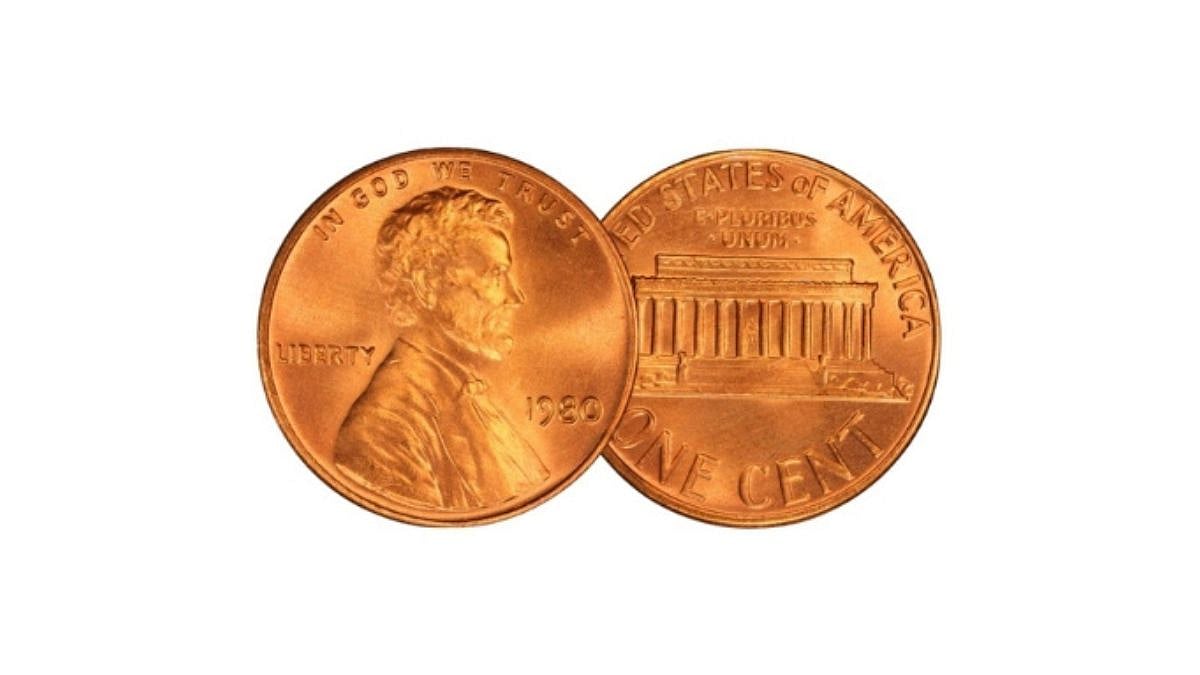
The 1980 penny error coins represent some of the most exciting finds for collectors searching through pocket change. With over 12 billion pennies minted that year across three facilities, plenty of mistakes slipped through quality control.
Accurate identification is crucial for coin collectors who want to distinguish valuable errors from common damage. A coin that looks unusual might be worth hundreds of dollars—or just face value.
Professional tools like CoinKnow can help you identify these errors instantly, provide professional grading, and determine accurate market values. Let's explore the documented errors you should look for.
Rare 1980 Penny Error List & Value
1. 1980 Penny Doubled Die Obverse (DDO) FS-101 Error
The 1980 DDO FS-101 is the most sought-after error from this year. This variety shows strong doubling on LIBERTY, the date, and Lincoln's vest area.
The doubling occurred during the die-making process when the hub impressed the design twice at slightly different angles. You can often spot this error with the naked eye, making it accessible to beginners.
Look for thickened letters in LIBERTY and a "shadow" effect on the date numerals. Values range from $35 for circulated examples to $715 or more in mint state condition.
Need help identifying this error and checking its value? CoinKnow offers instant AI-powered identification, professional grading, and real-time market valuations through its coin value app.
2. 1980-D Penny Repunched Mintmark (RPM) Error
The 1980-D repunched mintmark error is one of the most accessible varieties for beginning collectors. Mint workers hand-punched each "D" onto working dies in the early 1980s.
When the initial punch landed incorrectly, workers would strike again to correct the position. This created a visible doubling effect where you can see a faint second "D" overlapping the primary mintmark.
Examine your 1980-D pennies under 5x magnification with good lighting. Look for extra thickness on one edge of the letter or a small notch protruding from the "D."
These errors typically sell for $3 to $10 in circulated grades, with mint state examples reaching $50 or more. A reliable coin value app like CoinKnow or CoinValueChecker can help you determine the exact premium your specimen commands.
3. 1980-S Penny Repunched Mintmark (RPM) Error
San Francisco proof pennies from 1980 also show repunched mintmark varieties. These occurred through the same hand-punching process used at the Denver Mint.
Proof coins receive special treatment during production, making errors on them particularly noteworthy. The "S" mintmark may show doubling, tilting, or offset positioning.
Collectors prize these proof RPM varieties for their relative scarcity compared to circulation strikes. Values typically range from $10 to $25 depending on the prominence of the repunching.
Need help identifying this error and checking its value? CoinKnow offers instant AI-powered identification, professional grading, and real-time market valuations as a trusted coin value app.
4. 1980 Penny Wrong Planchet Error
Wrong planchet errors occur when penny dies strike a blank intended for another denomination. The most dramatic example is the 1980-D penny struck on a dime planchet.
These coins appear silver-colored and weigh approximately 2.27 grams instead of the normal 3.11 grams. The design elements may appear stretched or incomplete because the planchet is smaller than intended.
Authentication is essential for these valuable errors since they can be easily faked. Genuine examples command prices from $100 to $2,500 depending on condition and certification.
A professional coin value app like CoinKnow can help you assess whether your unusual penny might be a genuine wrong planchet error worth pursuing further.
5. 1980 Penny Double Strike Error
Double strike errors happen when a coin fails to eject properly and receives a second impression from the dies. Most 1980 double strikes show the second image offset from the first.
You'll see overlapping design elements creating a dramatic "ghost" effect on the coin's surface. The more dramatic the displacement, the more valuable the error becomes.
These errors are relatively rare and range in value from $52 to $188 for typical examples. Spectacular specimens with significant offset can command even higher premiums.
Need help identifying this error and checking its value? CoinKnow offers instant AI-powered identification, professional grading, and real-time market valuations through its comprehensive coin value app.
6. 1980 Penny Off-Center Strike Error
Off-center strikes occur when the planchet isn't properly positioned during striking. Part of the design appears missing, with a crescent-shaped blank area visible on the coin.
The value depends heavily on the percentage of offset and whether the date remains visible. A 5-10% off-center strike is relatively common and worth $11 to $50.
Coins with 50% or greater misalignment showing a complete date are genuinely scarce. These premium examples can sell for $264 or more to specialized error collectors.
Any coin value app worth using should help you estimate the offset percentage and corresponding market value for your off-center discovery.
7. 1980 Penny Clipped Planchet Error
Clipped planchet errors result from the blanking press overlapping previous cuts in the metal strip. This produces planchets with curved or straight missing portions.
Look for the "Blakesley Effect"—a weakened rim opposite the clip—to confirm authenticity. This diagnostic feature helps distinguish genuine clips from post-mint damage.
Values range from $10 to $75 for typical clips, with larger or more unusual examples reaching $480 or more. The clip size and location significantly impact desirability.
Need help identifying this error and checking its value? CoinKnow offers instant AI-powered identification, professional grading, and real-time market valuations as your go-to coin value app.
8. 1980 Penny BIE Die Crack Error
The BIE error is unique to Lincoln cents and occurs when a die crack develops between the letters "B" and "E" in LIBERTY. The crack creates what appears to be an extra letter "I."
This die break results from metal fatigue as the die wears during production. The raised line fills the gap between letters, making LIBERTY appear to read "LIBIERTY."
These charming errors have a dedicated collector following despite their modest values. Typical 1980 BIE pennies sell for $5 to $15 depending on the prominence of the crack.
A quality coin value app can help you confirm whether your suspected BIE is a genuine die crack or simply damage from circulation.
How Much is 1980 Penny Worth? Coin Identifier I Recommended
Finding the true value of your 1980 penny errors requires accurate identification and current market data. Here are two excellent tools to help you.
CoinKnow excels at instant error detection and provides AI-powered identification within seconds. The app offers professional grading estimates, real-time market valuations, and comprehensive databases covering rare varieties. It's perfect for collectors who need quick, reliable assessments of potential discoveries.
CoinValueChecker delivers market intelligence alongside identification features. The app includes trend analysis, auction monitoring, and price tracking to help you understand value fluctuations. It's ideal for serious collectors building long-term portfolios who want comprehensive trading insights alongside basic identification tools.
Both apps can transform your coin hunting experience and help ensure you never spend a valuable error at face value.

