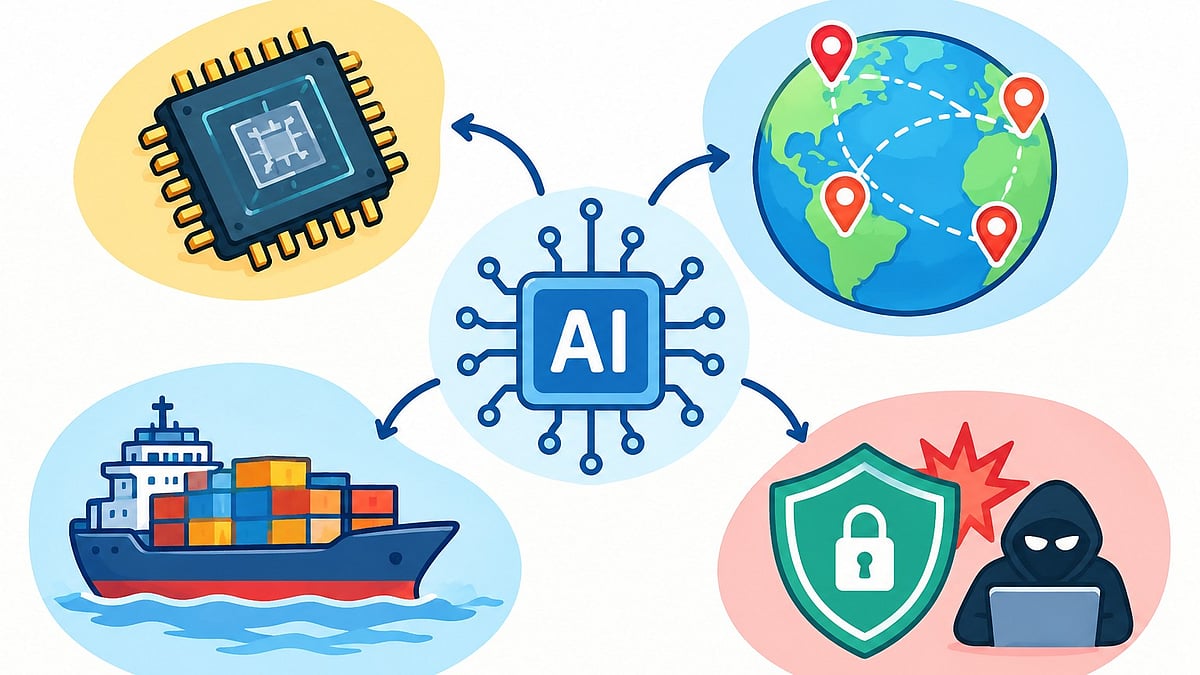
Indore (Madhya Pradesh): With wars, geopolitical tensions and cyberattacks threatening global semiconductor supply chains, a new study has developed an artificial intelligence-driven framework to help businesses identify resilient logistics hubs and transportation routes.
The study, involving Prof Tanmoy Kundu of the Indian Institute of Management Indore (IIM Indore), has been published in IEEE Transactions on Engineering Management. It combines machine learning (ML), generative artificial intelligence (GenAI) and mathematical optimisation to support supply chain decisions amid uncertainty and disruptions.
Semiconductor chips power smartphones, computers, automobiles and industrial equipment. However, their supply chains span multiple countries, making them vulnerable to disruptions at manufacturing facilities, ports and transportation links.
The global chip shortage during the Covid-19 pandemic forced several automobile manufacturers to suspend production, highlighting these vulnerabilities. Geopolitical conflicts, trade restrictions and cybersecurity threats have added to the challenges.
The study proposes a coordinated framework in which computational agents assess risks, generate disruption scenarios and recommend suitable logistics hubs and routes.
The ML component evaluates conflict-related risks using historical data and economic, geographical and cybersecurity indicators. Population size, distance from power plants and proximity to international borders emerged as the strongest predictors of conflict risk. Cybersecurity vulnerabilities, income levels and dependence on oil exports also influence the assessment.
The GenAI component generates potential scenarios involving war, sanctions and cyber warfare, considering their likelihood, severity and duration. An optimisation model uses these assessments to identify hub locations and routes that minimise disruption risks while maintaining supply coverage.
Unlike conventional approaches that assess threats individually, the framework examines how multiple disruptions can interact and spread across interconnected networks.
Asia's semiconductor network in focus
The framework is applied to semiconductor manufacturing facilities and ports across Asia, with particular attention to Taiwan, a major integrated circuit (IC) production centre.
Taiwan, South Korea and Japan are key semiconductor manufacturing centres, while Malaysia, Vietnam, Thailand and the Philippines have expanded their roles in assembly and electronics manufacturing. Taiwan hosts facilities operated by major companies, including TSMC, UMC and Micron.
The study assesses disruption risks at manufacturing facilities, ports and transportation links before selecting logistics hubs and assigning facilities to routes. It finds that a geographically convenient port may not be the most reliable option when geopolitical, cybersecurity and transportation risks are considered together.
Longer disruptions have greater impact
Model tests indicate that supply coverage remains relatively stable as disruption probabilities and severity change, but longer disruptions have a more substantial impact. This underscores the need to prepare for prolonged interruptions.
Businesses can use the framework for risk assessment, sourcing, route selection and contingency planning, while publicly available information, including news reports, can help monitor emerging threats. Policymakers could identify infrastructure vulnerabilities and guide resilience investments.
The study notes that natural hazards, changing trade restrictions, financial costs and stakeholder coordination require further consideration. Nevertheless, it demonstrates how AI and mathematical optimisation can help build semiconductor supply chains more resilient to interconnected global disruptions.