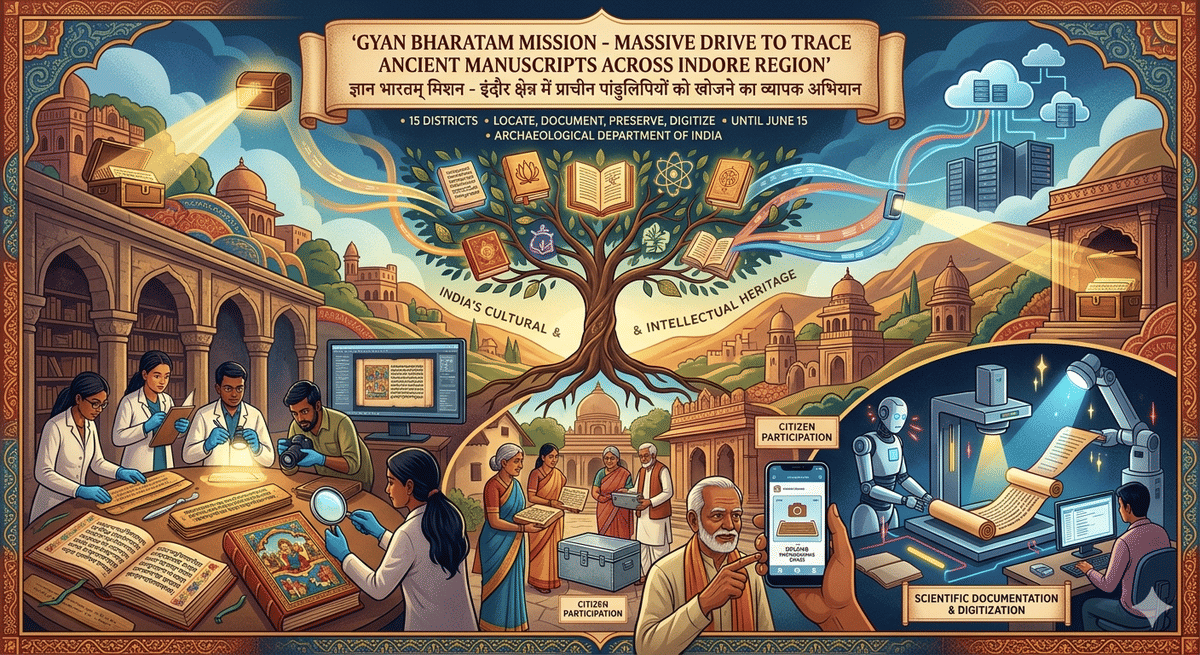
Indore (Madhya Pradesh): In a significant step toward preserving India’s rich cultural and intellectual heritage, the Archaeological Department of India has launched an extensive drive to trace rare handwritten manuscripts across 15 districts of the Indore Region. The drive is being carried out under the ambitious Gyan Bharatam Mission and will continue until June 15.
Manisha Sharma, deputy director of Archaeology, Archives and Museums (West Zone-Indore), stated that the drive aims to locate, document, and preserve ancient and unique manuscripts currently lying undiscovered in temples, private homes, trusts, and other institutions. The initiative has gained momentum in Indore, where a dedicated district-level committee has been constituted to oversee operations and coordinate efforts.
As part of the drive, Madhya Pradesh has been designated as a nodal state, with the archaeology department taking the lead in identifying valuable manuscripts. Once located, these manuscripts will undergo scientific documentation and digitisation to ensure their long-term preservation. Experts have emphasised that if any manuscript requires restoration, specialised conservation techniques will be used before returning it safely to its original custodian.
According to officials, thousands of manuscripts have already been identified during initial surveys in the region, many of which had remained hidden for decades. Authorities believe that several historically significant documents, covering literature, religion, science, and traditional knowledge, could emerge through this drive, offering new insights into India’s past.
To streamline the process, the administration has also appealed to citizens to actively participate. People can provide information about manuscripts in their possession or knowledge through a designated digital platform by uploading photographs and relevant details. The department will then verify the authenticity and take further action.
A special committee in Indore includes senior administrative officials, academic representatives, and experts from archaeology and archives. Their role is to ensure proper coordination, verification, and preservation processes. Awareness campaigns and outreach programmes are also being planned to encourage public participation, especially in rural and heritage-rich areas.
Officials noted that the drive is not just about discovery but also about creating a digital repository of India’s manuscript heritage for researchers, scholars, and future generations. With the increasing role of digitisation, this effort is expected to bridge the gap between traditional knowledge systems and modern accessibility.

