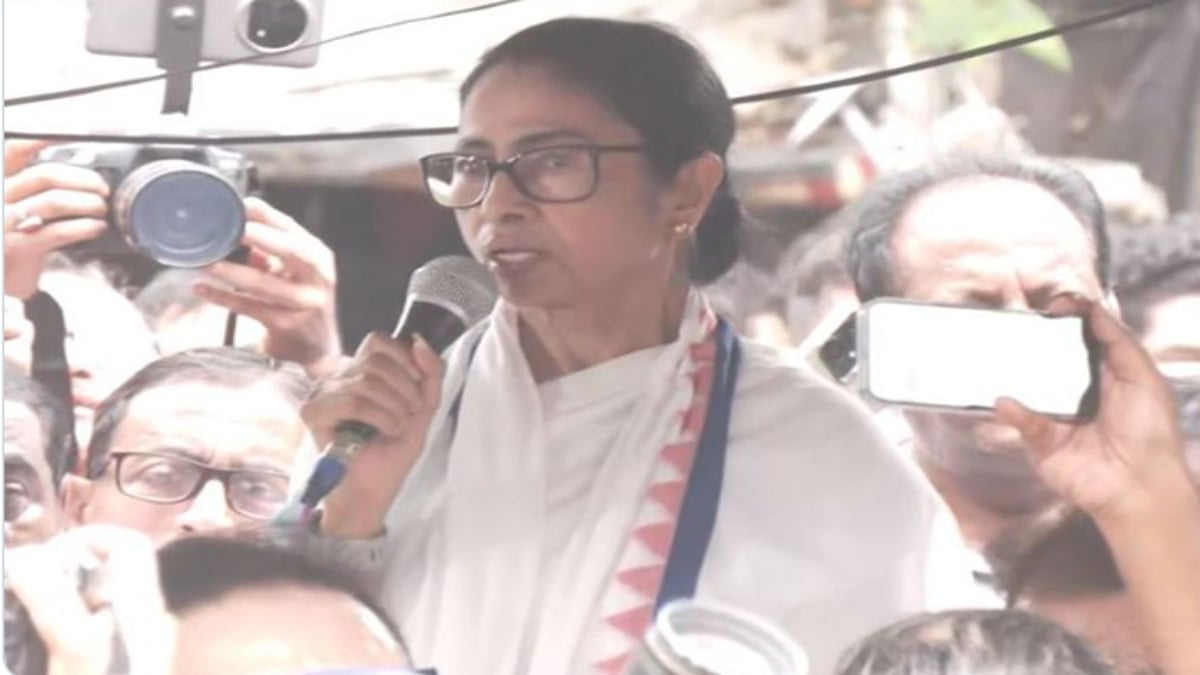
On Tuesday, June 2, 2026, a high-voltage political drama unfolded on the streets of Kolkata as Trinamool Congress (TMC) chairperson Mamata Banerjee led a defiant protest march at Rani Rashmoni Avenue near Esplanade. Officially, the rally was organised to voice outrage against post-poll violence and a string of recent physical assaults targeting senior party figures, most notably her nephew and TMC All India general secretary, Abhishek Banerjee. However, the truth reveals a far more volatile, deeper reality.
This protest was not merely a reaction to street-level law and order issues. It was a high-stakes gamble for ultimate political survival. Marking her very first appearance in a public, on-the-road political programme since the Trinamool Congress’s shattering Assembly election defeat 28 days prior, Mamata took to the dharna stage at Dharmatala's Y Channel with the Indian Constitution in hand, vowing a relentless battle to defeat the newly elected BJP government.
Yet, the true story of the day was found not in her fierce rhetoric, but in the empty chairs behind her. The Kolkata rally laid bare an unprecedented internal mutiny that threatens the core existence of her party, transforming the protest into an aggressive defensive manoeuver designed to project public strength while her legislative foundation crumbles.
What exactly triggered the Kolkata protest
The immediate catalyst for the street demonstration was a violent incident on Saturday in Sonarpur, South 24 Parganas. Abhishek was aggressively targeted with eggs, bricks and shoes while visiting the home of a deceased party worker. According to Mamata, the assault was severe enough that a flying stone would have caused fatal injuries had he not been handed a protective helmet just moments before. In tandem, veteran TMC MP Kalyan Banerjee claimed he had narrowly survived a pre-planned attempt to murder near the Chanditala Police Station while attempting to submit an official deputation.
In a direct response to these flashpoints, Mamata hit the streets of Kolkata on Tuesday afternoon. Pushing forward despite a flat refusal of official police permission, the TMC leadership forced a sit-in that quickly led to chaotic scuffles between party supporters and law enforcement on Rashmoni Avenue. Speaking through a hand mic, Mamata fiercely lashed out at what she termed bulldozer politics being orchestrated from Delhi, framing her unauthorised dharna as an urgent civic battle to 'save lives and livelihoods'.
An existential crisis rather than a security issue
While the public messaging from the TMC focuses heavily on the physical safety of its top leaders, the actual emergency for Mamata is an internal legislative coup. The party is facing a catastrophic, vertical split that could mirror recent political disintegrations seen in Maharashtra.
According to public disclosures by suspended national spokesperson Riju Dutta, a staggering number of elected public representatives are actively cutting ties with the high command. On Monday afternoon, more than 50 of the TMC’s 80 elected MLAs held a closed-door meeting at the Gateway Hotel in Kolkata.
There, they openly rebelled against Mamata's leadership, declaring their faction to be the 'real Trinamool'. The systemic rot extends to the federal level, with internal party reports revealing that 12 Lok Sabha MPs and 6 Rajya Sabha MPs have already placed a tentative pencil booking to switch their allegiances to the BJP, leaving the central leadership completely isolated.
Mass absence of TMC lawmakers redefine rally
The sheer scale of this legislative desertion became undeniably visible on Tuesday afternoon. For a leader accustomed to drawing thousands of loyalists and dozens of lawmakers to her side, the mass absence of public representatives completely overshadowed the fiery presentation at Dharmatala. Out of the 80 MLAs who won on the TMC symbol, Mamata found an incredibly thin line of support on the stage, surrounded by a mere 8 MLAs and 6 MPs.
The brief list of loyalists who stood by her during the Y Channel dharna was limited to MLAs Shobhandeb Chatterjee, Biman Banerjee, Firhad (Bobby) Hakim, Madan Mitra, Ashok Dev, Naina Banerjee, Asima Patra and Kunal Ghosh. Among the parliamentarians who joined her were Lok Sabha MPs Kalyan Banerjee and Mala Roy and Rajya Sabha members Derek O'Brien, Dola Sen, Samirul Islam and Nadimul Haque.
With 72 MLAs and the overwhelming majority of her parliamentary delegation choosing to deliberately boycott the event, acute doubts have risen across West Bengal regarding whether the TMC can survive the week as a unified legislative entity.
Dispute over signatures ignite full-scale mutiny
The technical spark that blew this long-simmering internal rift into the public eye was a signature forgery scandal within the state Assembly, now being referred to as the 'Signgate'.
Following their election defeat, the TMC leadership officially nominated veteran leader Sobhandeb Chattopadhyay to fill the crucial role of Leader of the Opposition (LoP). However, MLAs Ritabrata Banerjee and Sandipan Saha came forward to claim that the resolution document submitted to the Assembly Secretariat contained forged signatures of several legislators who were never consulted.
When Ritabrata and Saha bypassed internal party channels and took their forgery complaints directly to Assembly Speaker Ratindra Bose, it triggered an immediate official investigation by the CID. Multiple TMC MLAs who were called in for questioning reportedly admitted to investigators that the signatures appearing above their names were completely fabricated. Viewing this public intervention as an act of absolute insubordination, TMC vice-president Chandrima Bhattacharya issued a letter on June 1 summarily expelling Ritabrata and Saha from the primary membership of the party.
Instead of suppressing the dissent, the expulsions acted as a powerful catalyst. The dissident majority instantly rallied behind the expelled Ritabrata, formatting a plan to submit a completely new list of legislators to the Speaker and backing Ritabrata as their alternative choice for Leader of the Opposition.
Who is Mamata blaming for the collapse?
A furious Mamata has squarely blamed a combined conspiracy between the Central government, the state police force and internal traitors for the unfolding collapse. She alleged that the BJP is pouring vast sums of money and utilising Central investigative agencies like the ED and the CBI to systematically intimidate her lawmakers into switching sides.
During her address, she shared that four individual MLAs had approached her in confidence, claiming that police officers were acting as intermediaries for the BJP. These officers allegedly threatened the MLAs that if they attended official TMC organisational meetings at Kalighat, they would be immediately slapped with fabricated arrest warrants under the Arms Act and narcotics laws. This coordinated pressure, she argued, explained why 60 out of 80 MLAs boycotted her emergency strategy meeting on Saturday.
However, Mamata did not spare her own ranks, launching a scathing critique against the rebels, labelling them as unethical individuals who enjoyed power when the party was winning but are now manufacturing excuses to defect just to protect their personal wealth from state scrutiny.
What is the rebels' next move?
The rebel faction is wasteing no time in translating their legislative numbers into concrete administrative action. In a development that signals a total shift in state dynamics, the expelled Ritabrata announced on Tuesday that the TMC MLAs representing the strategic Howrah Rural district will officially cross the aisle to participate in a high-level administrative meeting on Wednesday. Crucially, this meeting is set to be chaired directly by the state's new Chief Minister Subhendu Adhikari.
Despite this rapid realignment, the BJP leadership is proceeding with immense institutional caution to avoid internal complications. Speaking from New Delhi, West Bengal BJP president Samik Bhattacharya explicitly stated that the party’s doors remain tightly shut to incoming TMC defectors. Bhattacharya pointed out that the BJP managed to achieve its historic majority of 207 seats purely by building its political strategy from the grassroots up, without 'importing' outside leaders. Emphasising that the party has no intention of allowing a 'Trinamoolisation' of the BJP, he questioned the integrity of the fleeing lawmakers, asking how the BJP could absorb individuals whom the public had just voted against as "tainted."
What choices Mamata has?
Faced with a rapidly evaporating legislative footprint, Mamata is steering away from parliamentary arithmetic and returning to her original political avatar of a confrontational street fighter. By placing herself on a public road at Rani Rashmoni Avenue, she is attempting to bypass her rebellious MLAs entirely, appealing directly to the sentiment of the grassroots party workers whom she designates as her true, uncorruptible assets.
