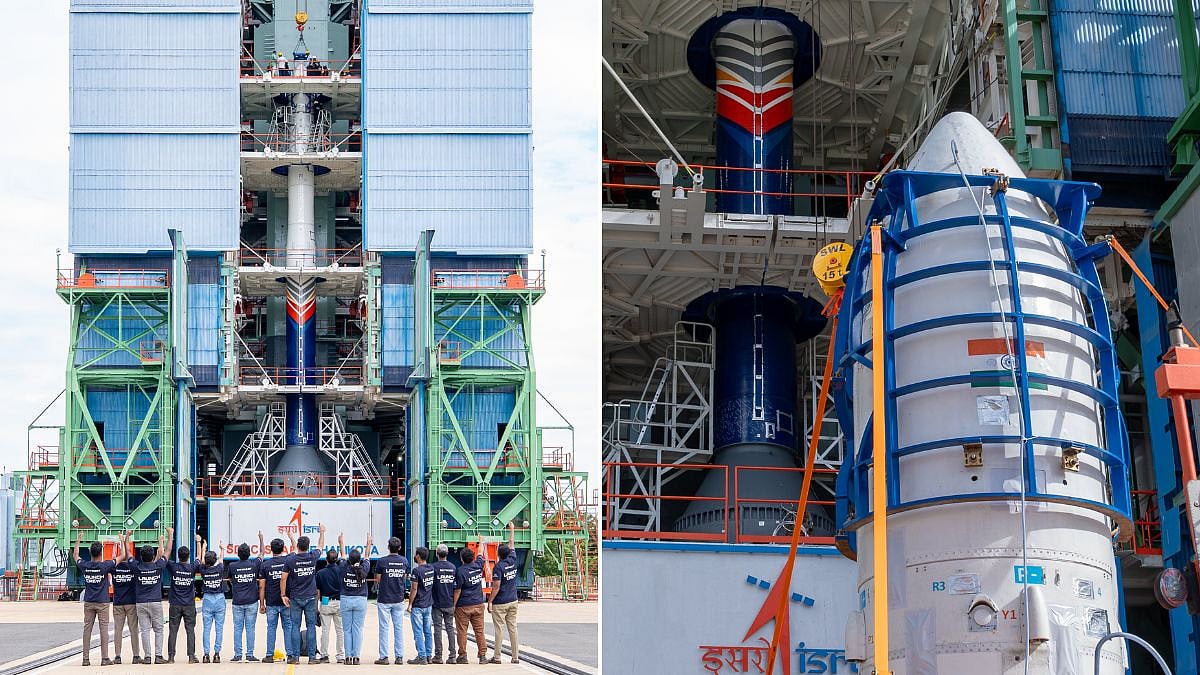
Sriharikota, July 2, 2026: India’s private space industry is on the verge of a historic milestone as Skyroot Aerospace prepares to launch Vikram-1, the country’s first privately developed orbital rocket.
The Hyderabad-based space-tech company has unveiled the fully stacked launch vehicle at the Satish Dhawan Space Centre in Sriharikota ahead of a launch window that begins on July 12 and continues until August 4, subject to weather conditions, final tests and regulatory clearances.
Named after Dr Vikram Sarabhai, the father of India’s space programme, Vikram-1 is the country’s smallest orbital rocket. Its launch is expected to become a defining moment for India's private space ecosystem, which has expanded rapidly since reforms opened the sector to private companies.
A Historic Launch
Skyroot Aerospace, valued at over USD 1.1 billion, is India’s first space technology unicorn. Its maiden orbital mission has been named Aagaman, a Sanskrit word meaning “arrival”, symbolising the arrival of India's private orbital launch capability on the global stage.
The mission is about much more than sending a rocket into orbit. It reflects the growing confidence of Indian private companies in developing advanced launch vehicles and competing in the global commercial space market.
Compact Rocket Big Ambitions
Standing seven storeys tall, Vikram-1 has been designed to place satellites weighing up to 350 kg into Low Earth Orbit. During its maiden mission, the rocket aims to reach an orbit about 450 km above Earth with an inclination of 60 degrees.
The launch vehicle has been built using an all-carbon composite structure, making it both lightweight and strong enough to withstand the intense forces of launch. It also incorporates several technologies developed in-house by Skyroot, including 3D-printed rocket engines that are expected to reduce production time, improve design flexibility and lower manufacturing costs. High-thrust solid rocket motors and modern guidance, navigation and control systems are also part of the vehicle's design.
Mission Objectives
Founded by former ISRO scientists Pawan Kumar Chandana and Naga Bharath Daka, Skyroot has emerged as one of India’s leading private space start-ups. According to Chandana, the biggest objective of Mission Aagaman is to collect real flight data that cannot be generated through ground testing alone.
“The single most important objective of Mission Aagaman is to capture the real in-flight performance data from every system on Vikram-1. We want to understand how the vehicle performs from lift-off through every phase of ascent. This data cannot be fully replicated through ground testing. It will help us validate our designs and inform subsequent vehicle development as we build a reliable, high-cadence commercial launch programme,” he said, NDTV reports.
Chandana believes the mission will mark a turning point for India's private space industry.
“The moment Vikram-1 lifts off, India’s private space industry will cross a threshold it has never crossed before,” he said.
Even so, the true test will come only if the rocket successfully places its satellites and payloads into the intended orbit, where there is little room for error.
Building On Vikram S
Mission Aagaman follows the successful launch of Vikram-S, which became the first privately built rocket to reach space from Indian soil on Nov. 18, 2022. That suborbital mission validated Skyroot’s core technologies and paved the way for its first orbital launch.
Daka described Vikram-1 as the company’s biggest step yet.
“From a dream to build a private launch vehicle in India to now attempting an orbital flight has been a journey like no other. With Vikram-S in 2022, we validated the foundation of our technology stack. With Vikram-1, we take our biggest step yet toward a reliable, high-cadence launch programme built in India, for India and the world,” he said.
He also credited the Government of India, ISRO, the Indian National Space Promotion and Authorisation Centre (IN-SPACe), investors, customers and Skyroot's engineers and scientists for supporting the programme.
Commercial Mission With Global Significance
The mission will carry a mix of domestic and international customer payloads, making it partially commercial while also serving as a technology demonstration.
Engineers will closely monitor the performance of the propulsion systems, stage separation, guidance, navigation, control systems and the rocket's overall behaviour throughout the flight. The data collected is expected to shape future operational missions.
Also Watch:

As Vikram-1 awaits lift-off at Sriharikota, it has already become a symbol of India’s growing capabilities in private space technology. A successful Mission Aagaman would not only be a milestone for Skyroot Aerospace but could also signal the beginning of a new phase in which Indian private companies play a much bigger role in the global space economy.
To get details on exclusive and budget-friendly property deals in Mumbai & surrounding regions, do visit: https://budgetproperties.in/

