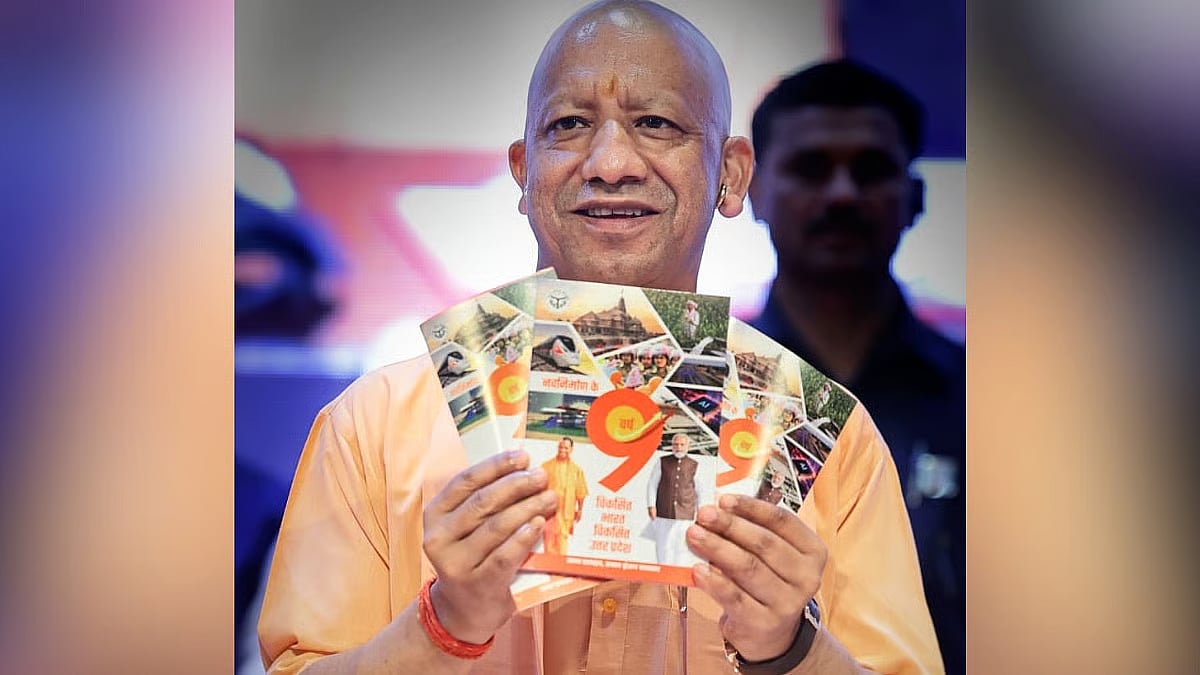
Lucknow: Nine years after Yogi Adityanath took charge of Uttar Pradesh, the state government is pitching its tenure as a story of economic repositioning, driven by infrastructure expansion, tighter law and order, and technology-led governance.
When Adityanath assumed office in 2017, his elevation had surprised many. Despite a long stint as a parliamentarian from Gorakhpur, he lacked administrative experience in the executive. His past differences with sections of the Bharatiya Janata Party leadership had further added to scepticism within political circles.
Nearly a decade later, the state’s narrative has shifted. The government claims Uttar Pradesh has moved from being tagged as an underperformer to emerging as one of India’s fastest-growing state economies, backed by a combination of infrastructure-led growth and governance reforms.
Adityanath has described trust and technology as the twin engines of this transformation, stating that the state economy has expanded threefold during his tenure. A key highlight has been the rapid growth of road infrastructure, with the government claiming Uttar Pradesh now accounts for a significant share of India’s expressway network.
Improved law and order has been central to this pitch. Officials say stricter policing and action against organised crime have helped create a more stable environment for investment. Measures such as cyber police stations in all districts, forensic labs and mobile forensic units are being cited as efforts to modernise policing and address emerging challenges.
On the industrial front, the government has focused on attracting large investments. The Defence Industrial Corridor, spanning nodes including Lucknow and Kanpur, is being projected as a major driver. A BrahMos missile manufacturing unit in Lucknow is expected to anchor ancillary industries, while other nodes are witnessing fresh proposals.
Large infrastructure projects continue to anchor the state’s growth strategy. The upcoming Jewar international airport and the Ganga Expressway are among flagship projects aimed at boosting connectivity and logistics. Alongside, the government is pushing data centres and digital infrastructure to position the state in emerging sectors such as artificial intelligence.
Industry voices indicate a perceptible shift. Mukesh Singh of the Indo-American Chamber of Commerce said the past nine years have helped reposition the state as a more stable and investment-friendly destination.
Economists, however, offer a nuanced view. Yasbir Tyagi, former head of economics at the University of Lucknow, said the state has recorded strong gains, with gross state domestic product and per capita income more than doubling. He described the model as infrastructure-led growth that has improved connectivity and logistics.
At the same time, he flagged the need to bridge the gap between investment proposals and actual execution, noting that while large-scale memorandums of understanding have been signed, conversion into real investments remains a key challenge.
Fiscal management has emerged as another area the government highlights. The state’s budget for 2026-27 has been pegged at ₹9.12 lakh crore, with officials claiming that fiscal deficit and debt indicators remain within manageable limits. The administration also points to declining unemployment and increased economic activity across sectors.
Welfare delivery has been streamlined through direct benefit transfer systems, reducing leakages and ensuring targeted support. More than one crore beneficiaries, including the elderly, widows and persons with disabilities, are receiving financial assistance. Housing schemes have also expanded, with over 62 lakh homes allocated under central programmes.
Also Watch:
Reforms in the public distribution system, including the digitisation of fair price shops, have been cited as improving transparency. Drinking water access has also expanded under flagship schemes, contributing to better living standards in rural areas.
Programmes like One District One Product have aimed to boost local industries and create employment at the grassroots, while religious tourism in cities such as Ayodhya and Varanasi has been developed as an economic lever.
As the government looks ahead, it has outlined priorities including job creation, women’s empowerment, farmer welfare and building a self-reliant economy by 2047. Nine years on, Uttar Pradesh’s trajectory is increasingly being assessed through the lens of economic competitiveness, infrastructure scale and governance outcomes.
