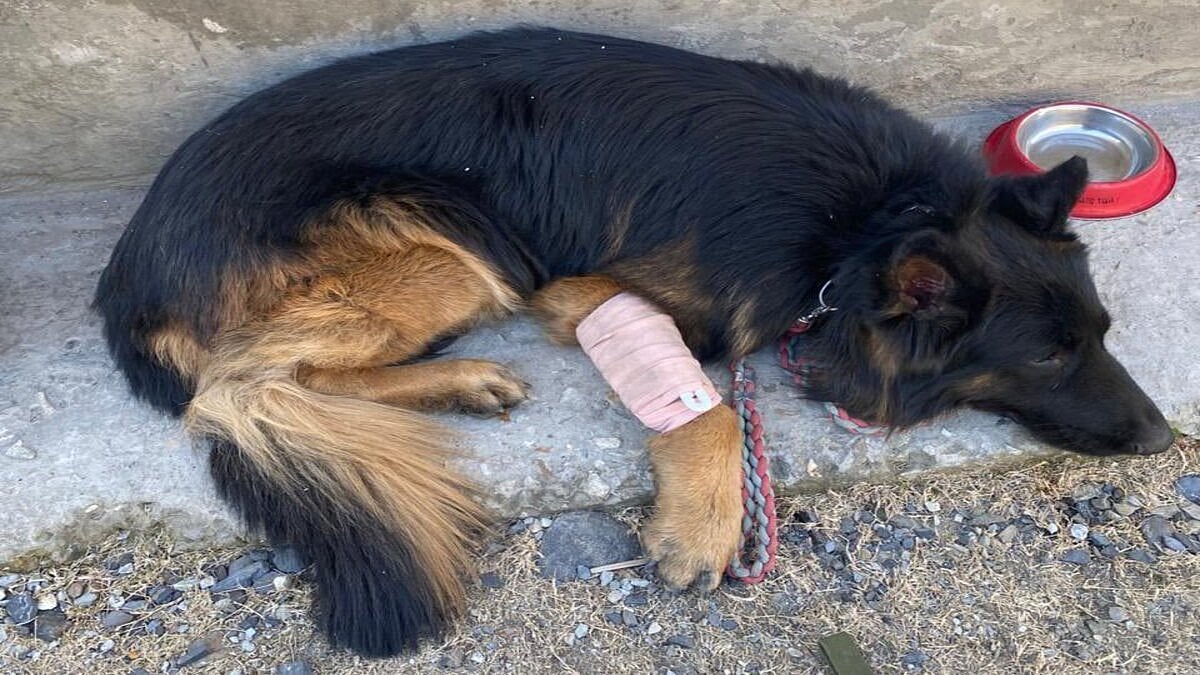
In the high-altitude forests of Kishtwar, the legendary status of the Indian Army’s 2 Para (Special Forces) was further cemented on Sunday by a German Shepherd named Tyson. During Operation Trashi-I, Tyson was the lead scout as the team closed in on a hidden mud hutment, or dhok, where three high-ranking Jaish-e-Mohammed (JeM) terrorists were entrenched. As Tyson crawled toward the structure to confirm their presence, the terrorists opened fire, striking him in the front right leg. Despite the trauma of a direct bullet wound and heavy bleeding, Tyson did not retreat. Instead, he pushed forward, barking and maintaining contact with the target.
Precision strike and strategic success
Tyson’s refusal to back down provided the critical tactical window the Special Forces needed. By pinpointing the exact corners of the hut where the terrorists were hiding, Tyson allowed the troops to engage with surgical precision. The resulting firefight led to the elimination of all three terrorists, including a notorious commander named Saifullah who had evaded capture for nearly two years. Senior officials have explicitly credited Tyson’s unwavering bravery as the primary reason the operation was concluded successfully without a single human casualty among the Indian security forces.
Recovery at the Command Hospital
Immediately following the conclusion of the battle, the priority of the Para SF team shifted to saving their four-legged brother-in-arms. Tyson was stabilised on-site by army medics before being airlifted to the Command Hospital in Udhampur. Official reports released today confirm that he is in stable condition and responding exceptionally well to treatment. His survival has sparked a wave of national pride, with military personnel and citizens alike hailing him as a hero who "took the first bullet for the team."
A beacon for modern K9 roles
Tyson’s survival is a testament to the advanced medical logistics the Indian Army now provides for its K9 units, treating their injuries with the same urgency as those of human soldiers. His actions have highlighted the indispensable role of sniffer and assault dogs in the rugged terrain of Jammu and Kashmir, where human senses are often limited by dense foliage and steep slopes. As he recovers, Tyson stands as a living symbol of the "Silent Warriors" who continue to serve as the nation's first line of defence in the most dangerous corners of the border.
The last stand of Phantom (2024)
Before Tyson, the name that echoed through the hills of Jammu was Phantom, a Belgian Malinois who made the supreme sacrifice in October 2024. During an intense counter-ambush operation in the Battal region, Phantom was sent to track a group of terrorists who had attacked an army convoy. Under heavy fire, Phantom surged ahead, detecting hidden explosives and identifying the exact escape routes of the militants. Tragically, he drew the enemy's fire toward himself, shielding his human teammates. His sacrifice wasn't in vain. His last actions ensured the containment of the group leading to the successful conclusion of the mission. He was posthumously honoured for his "raw courage" on Republic Day 2025.
Legend of Zoom and Axel (2022–2023)
The Belgian Malinois breed became a national household name largely due to Zoom and Axel. In October 2022, Zoom was tasked with clearing a house in Anantnag. Despite taking two bullets to the face and leg, he did not stop. He pounced on the terrorists, destabilising them enough for the Para SF to move in. He fought for his life for two days before passing away, leaving behind a legacy that earned him a posthumous Mention-in-Despatches. Similarly, Axel was hit by three bullets during an encounter in Baramulla in July 2022. He pinned down a terrorist even while bleeding out, ensuring the safety of the search party. These dogs proved that even when the body fails, the spirit of a soldier remains unyielding.
Mansi and the bond of the LoC (2015)
One of the most emotional stories in the history of the Remount Veterinary Corps (RVC) is that of Mansi, a Labrador and her handler, Rifleman Bashir Ahmed War. Serving in the dangerous Tangdhar sector near the Line of Control, Mansi was a master at sniffing out IEDs. In August 2015, they were tracking a group of infiltrators when they were caught in an ambush. Mansi refused to leave her handler's side and both were killed in the ensuing firefight. They were buried together with full military honours—a rare and touching tribute to a bond that was stronger than the fear of death.
The 2026 shift: Indigenous valour
As we move through 2026, the story is no longer just about foreign breeds like Labradors or Malinois. The Republic Day Parade 2026 was a historic turning point where India’s indigenous breeds—the Mudhol Hound, Rajapalayam and Kombai—finally marched as part of the operational contingent. These "Desi" warriors are now being deployed in the Northeast and the Rann of Kutch. Unlike their predecessors, these breeds are naturally adapted to India’s extreme heat and terrain, showing remarkable results in long-range tracking.
Beyond the army: police guardians
It isn't just the military. The Central Armed Police Forces (CAPF) have their own hall of fame. In Operation Sindoor last year, BSF and CRPF K9s were instrumental in detecting cross-border tunnels and IEDs. In November 2025, the first-ever National Canine Bravery Awards (K9 Heroes) was held in Hyderabad to recognise these unsung police dogs. From Zanjeer, who detected thousands of kilos of explosives during the 1993 Mumbai blasts, to the modern-day sniffer squads of the CISF guarding our airports, the line of duty for these animals is constant and often invisible.
To ensure these names are never forgotten, the Indian Army maintains a dedicated War Memorial for Dogs at the RVC Centre in Meerut. Every name mentioned here is etched there, serving as a reminder that India's peace is often bought by those who cannot speak, but who never hesitate to act.
