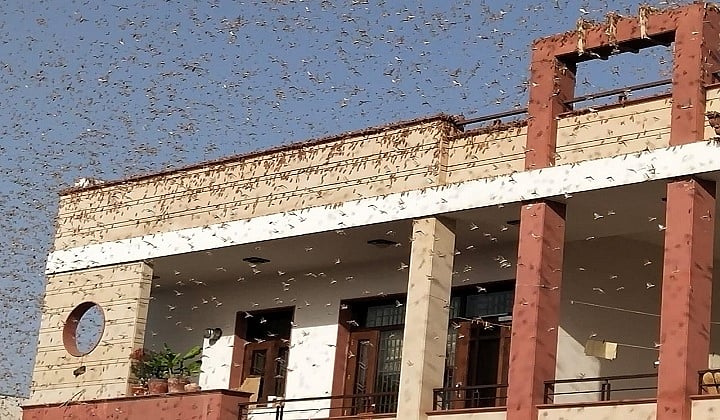
Rajasthan has been reeling under the most widespread locust attack for the last three decades. Swarms of locusts coming into India from Pakistan have travelled hundreds of kilometres to spread across most parts of Rajasthan. The locusts have also reached the districts of Madhya Pradesh and Gujarat. Efforts at containing the swarms are proving insufficient and difficult as the swarms have travelled with the winds to reach districts, traditionally not attacked by locust swarms.
It was almost 30 years ago in 1993 that a locust attack of such severity was witnessed in Rajasthan. Monday saw the swarm reach the city areas of Jaipur almost 600 kms from the border.
The swarms have been regularly coming across the Indo-Pak Border for the last month. 2-3 swarms have been coming from Pakistan almost every alternate day through Jaisalmer, Barmer and Sriganganagar. The locust swarms fly in the direction of the wind and they have been covering almost a hundred kilometres a day to cover most of the state.
The only relief is the Rabi crop has been harvested and monsoon crops are yet to be sowed. But the pests have inflicted serious damage to vegetable and fruit crops. This is the time when fodder for cattle is also sown and that too has been damaged. Reports from districts like Dausa say entire crops of mango and jamun have been damaged.
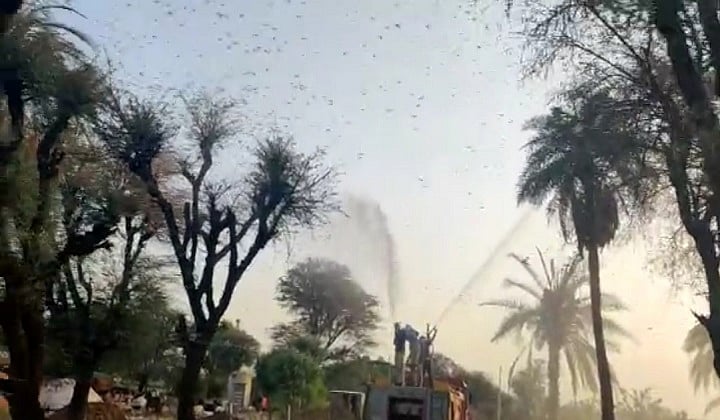
Speaking to ‘The Free Press Journal’ BR Karwa, Additional Director Agriculture said, “Control measures are being adopted, but the locust swarms cannot be killed completely. Only about 50-70% are killed by the pesticide spray. Further, WHO norms about type of pesticides and concentration need to be followed for the spray. The recommended time is 2 am when the swarm has settled down.”
“This time the swarms have reached non traditional areas with tall trees and vegetation. It is quite different from the traditional attack areas in desert districts. There vegetation is sparse and close to ground so spraying is easy. Now we need spray machines mounted on tractors and even fire brigades to reach the trees where locusts are resting,” added Karwa.
Locust swarms have been coming from Pakistan for almost a year now. They have been defying their traditional behaviour pattern in terms of timing and duration of swarms attack, flying pattern and intensity. The swarms were present all through winter which is an unheard of phenomenon.
LS Rathore, former Director General Meteorological Dept said, “Locust swarms coming for almost a year is unnatural and mismanagement is a major reason for this sustained attack. Food and Agriculture Organisation (FAO) facilitates international collaboration to deal with such cross-border exigencies. There has been poor coordination to this end.”
“Most importantly the scientific inputs have been highly questionable. Swarms fly along with the wind and technology has made possible easy availability of wind direction, speed and temperature assessment. Why is it not being used to predict where they will fly to give out advanced warning and work out containment plans? Studies needed to be carried out about the presence of locusts in winter, about mutations and successive generations arising in the area,” added Singh.
It cannot be denied now that ground level efforts to eliminate the swarms will not prove to be enough. India will have to work in tandem with FAO and Pakistan to check these locust swarms.
Locust attack in UP farms, govt sounds alert
The Uttar Pradesh government on Monday announced a state-wide alert after an army of locusts invaded farms in several districts. Locust is a pest which destroys crops and vegetation.
Authorities fear that the pests have affected crops in 17 districts of the western UP including Agra, Aligarh, Bulandshahr, Etah, Kanpur and Mathura. The district administrations have sounded the bugle and directed fire brigade to keep vehicles ready with chemicals to tackle the swarm of locusts. Besides, a team has come from Kota, Rajasthan, to deal with the locust meance. Rajasthan and Madhya Pradesh have already been affected by the pests. “The swarm of locusts, which is moving in the state is small in size. We have got the news that nearly 2.5 to a 3-kilometre long swarm of locusts has entered the country,” said Deputy Director Agriculture Kamal Katiyar. The crop-eating pests had first entered Rajasthan from Pakistan in the second week of April. It destroyed crops in 18 districts of Rajasthan and a dozen in Madhya Pradesh. Last year, it had ravaged farms in North Gujarat.
