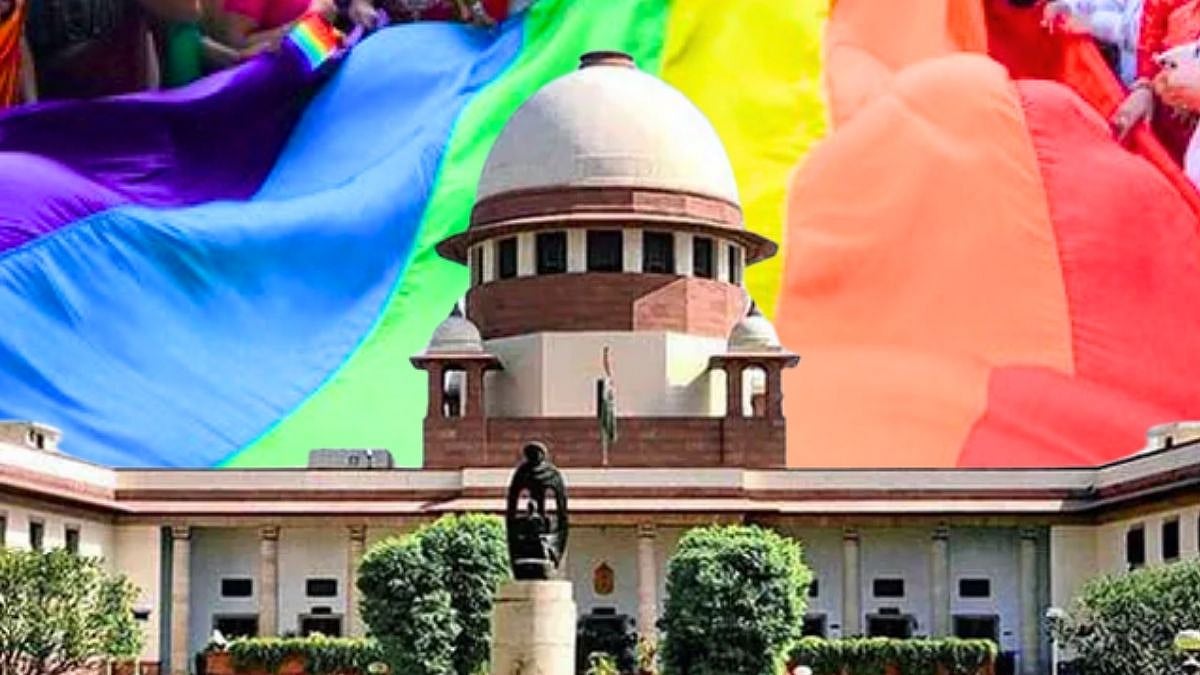
There was despair in the air as the group that gathered at a suburban five-star hotel on Tuesday morning watched the television broadcast of the Supreme Court's judgment on petitions pleading for the legalisation of marriages among members of the LGBTQ community.
Inder Vhatwar, 41, a LGBTQ events manager, who was there with his partner of 12 years, Ashish Shrivastava, 33, a software engineer, was hoping to take part in the hoisting of the national flag in the hotel compound in case the court.
There was no such ceremony. As the five-member bench of the apex court started pronouncing the judgment the dismay was palpable. "We were positive when Justice Chandrachud (the chief justice who headed the bench) started reading out his comments," said Harish Iyer, one of the two Mumbai petitioners in the case. “But when the other judges read out their comments it was disheartening.”
"We were hoping to get married as soon as possible if the verdict was favourable," said Vhatwar who once managed a clothing store that specialised in clothes for the LGBTQ community.
A larger group had gathered at the Santa Cruz office of Humsafar Trust, one of the first advocacy groups for the gay community. Ankit Bhuptani, 31, from the group Queer Hindu Alliance was one of the 100-odd people at the centre. “In the beginning it was a happy crowd. There were even claps when Justice Chandrachud started dictating his notes. We thought we were getting what we wanted,” said Gupta. “Then the other judges started speaking and we realised that the judgement was not clear. When we heard the notes from the other judges, we felt that the judgment was without any outcome. We were disappointed.”
Not everyone was disappointed with the judgment. Groups of transgenders celebrated the court's decision to allow concessions in case of marriages where one of the partners is a transgender.
A statement issued by the two petitioners in the case from Mumbai said, “The judgement has passed the onus to the legislature which may take its own course of time. This will delay the rights and benefits of LGTBIQ+ Indians related to the ability to jointly adopt children, inherit property from their partners, own financial and physical assets together, and receive state benefits as a couple, rights enjoyed by heterosexual couples.”
“It is disheartening”
“It is a mixed bag, as I see it (the judgment). The Supreme Court has given directions to the authorities on discrimination against LGBTQ people. They are trying to strike down on adoption law to permit gay people to adopt. The judgment is a mixed bag because we thought they will frame some regulations under the Special Marriage Act [to allow gay marriage] but that has not happened. It is disheartening. It will take a lot of effort for the legislature to bring in a law, especially because they also have other things to look at. Every member of parliament is elected and there are people for and against gay marriage in all parties. We are still interpreting the scope of directions given by the court to the authorities. As far as our group is concerned, we are looking at what the Supreme Court directions will do for economic inclusion of LGBTQ people. With these directions, discrimination should cease. We will build up on these directions. The community faces bias and stereotyping. Trans-people do not have access to credit. In a workplace scenario, there are companies that are more inclusive but there are other places that need sensitisation. Sustaining and growing a career gets affected in such places. More guidance on the court’s directives will come from our legal experts,”said Kaniksh Chaudhry, Samavesh Chamber of Commerce, an Advocacy group for businesses run by LGBTQ people.
“It is like a tight slap”
This is total abdication of duty and responsibility to a section of the population, except acknowledgement of transgenders which could have been sorted out anyway; others have got no recognition. It is like a tight slap. It is like saying that rights (of LGBTQ people) are accepted by the Indian Constitution but not accepted by the state. The court has asked the government to form a committee and just like the committee for police reforms nothing will come out of it. Even in matters of transgender rights nobody could do anything about it. The first time we wrote about how Section 377 (which earlier criminalised sex between consenting adults of same gender) was in the 1990s in the Humsafar magazine when we said that law will come in the way of work among the gay community. The judgment which read-down the law came three decades later. Now this. It is disheartening but it also shows total abdication of responsibility. It was also a total disaster because different LBGTQ groups were working in different directions. I will keep on fighting but I am weakening,” said Ashok Row Kavi, Founder, Humsafar Trust, LGBTQ rights advocacy.
“I feel terribly let down by the Supreme Court because when there was dissent in the judgment there was abdication of duty. Nobody (the judges) said that they did not feel for the community but we felt let down. We understand that there are constraints in the situation. If the court did not want marriage equality they could have given some semblance of civil unions instead of giving the issue to a committee of the government. I filed the petition in 2019 as an indicidual in the Delhi High Court and later the petitions were clubbed together to be heard by the Supreme Court. I think the battle is still on. I am fine; i will fight for the case. We will make want is available to us. We are not adverse to working with the government and we will keep on exploring what we can do. It was a day of sadness and yet of a firmer resolve,” said Zainab Patel, Petitioner in the case.
“We are at the same place where we started”
"When I heard Justice Chandrachud it was very positive but when we heard other judges we lost hope. Chandrachud is a progressive judge and has often been the target of vile comments because of this. But it was clear even from Chandrachud's remarks the way the judgement was going to go. Despite the eloquent English from the judges we are at the same place where we started. The intent of the judges was good, but in the end it did not yield any results. We had a ride to the Supreme Court and nothing more. The government has made its stance very clear. Most of the homophobic comments came from the Solicitor General representing the government. I am hopeful that the next elections will change this,” said Harish Iyer, petitioner.


