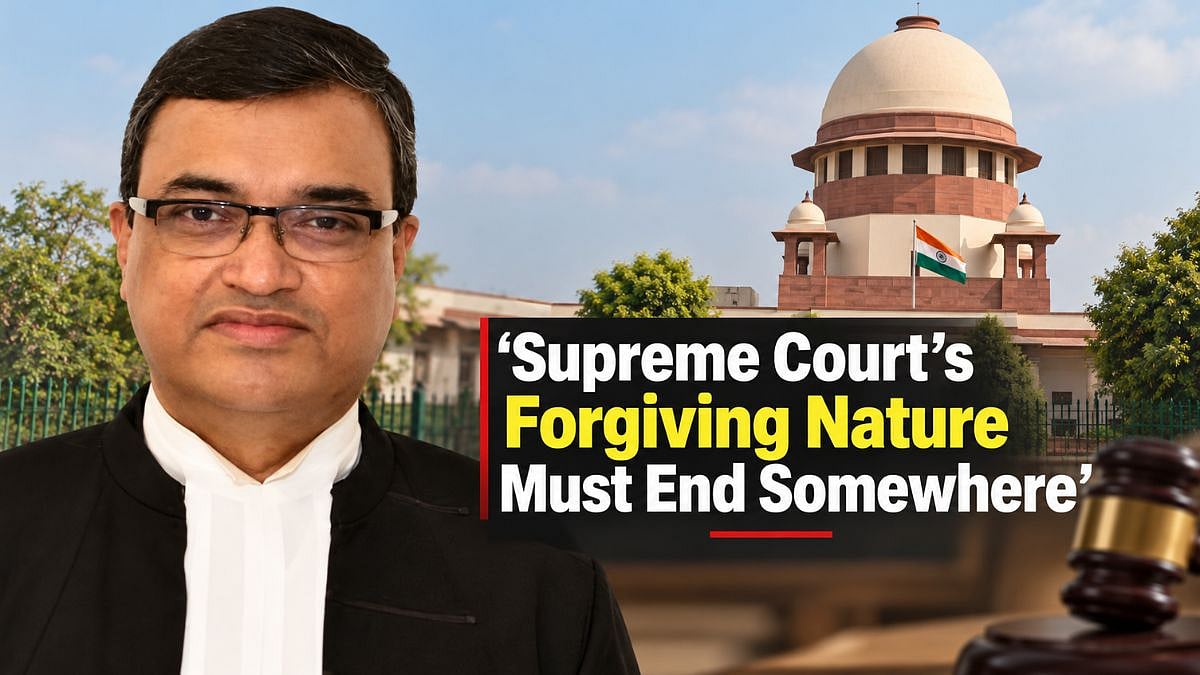
New Delhi, October 8, 2026: Supreme Court Justice Dipankar Datta on Thursday, October 8, expressed concern over the rising number of crimes in India and questioned the court’s approach to commuting death sentences to life imprisonment. He observed that the Supreme Court’s forgiving nature could not continue indefinitely and that a line would have to be drawn at some point.
The remarks came during the hearing of a remission plea filed by a murder convict. A bench comprising Justice Dipankar Datta and Justice Sheel Nagu was hearing the matter when Justice Datta referred to the ‘rarest of rare’ doctrine, which is used in deciding whether a death sentence should be imposed. He observed that there was a time when murders were relatively rare, but the situation had changed, Live Law reports.
Our Forgiving Nature Has To End
Justice Datta criticised the Supreme Court’s approach to commuting death sentences, suggesting that excessive leniency in serious criminal cases could have troubling consequences.
“It’s because of the Supreme Court’s forgiving nature, India is facing this... This is the Supreme Court. That is why, we say, our forgiving nature has to come to an end somewhere,” he remarked during the hearing.
His observations raised questions about how courts should balance mercy with the seriousness of crimes, particularly in cases involving repeated acts of violence.
Justice Datta Recalls Murder Case
To explain his concerns, Justice Datta recalled a disturbing case involving a father who raped and murdered his elder daughter. The man was convicted and sentenced to life imprisonment based on the testimony of the children’s mother.
However, after being released on parole, he murdered his wife in the presence of their younger daughter. Justice Datta said the man had killed his wife to take revenge for testifying against him in the earlier case.
The younger daughter’s testimony subsequently led to the father being sentenced to death. However, the Supreme Court commuted the death sentence to life imprisonment on the grounds that he had not murdered the younger child.
Just Hear The Facts
Recalling the case, Justice Datta referred to a judgment involving one of the judges who had also authored the Shatrughan judgment.
“This Court in a particular case, and the author of the judgment is one of the authors in Shatrughan judgment. Death was commuted in a case, just hear the facts,” he said.
Justice Datta then described how the father had raped and murdered his elder daughter, subsequently secured release on parole and killed his wife, who had testified against him.
“On the basis of the younger child sister’s testimony, he is given death and the death is commuted to life on the grounds that he didn’t commit the murder of the younger child,” he said.
Also Watch:

The example formed the basis of Justice Datta’s criticism of the court’s approach to commuting death sentences. His remarks highlighted the difficult questions surrounding judicial leniency, punishment and the consequences of granting relief to those convicted of serious crimes.
While the Supreme Court’s approach to capital punishment involves weighing several legal considerations, Justice Datta’s observations reflected his concern that the court’s willingness to show mercy must have limits.
To get details on exclusive and budget-friendly property deals in Mumbai & surrounding regions, do visit: https://budgetproperties.in/

