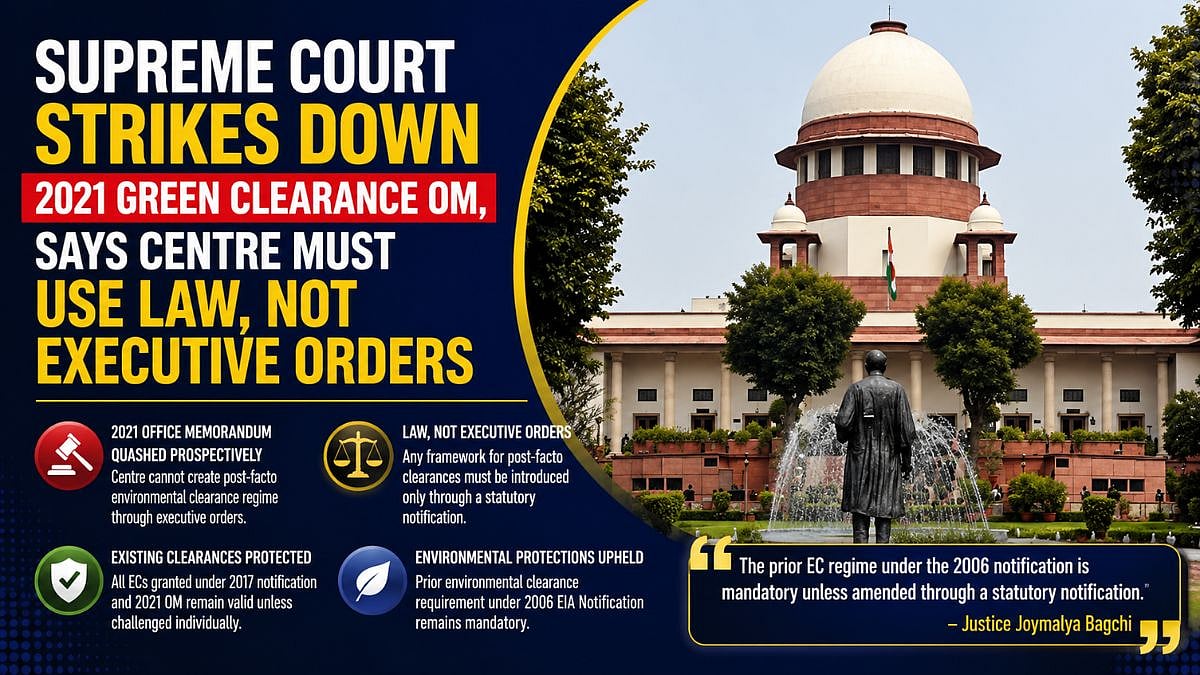
New Delhi, July 29, 2026: The Supreme Court on Wednesday ruled that the Central government cannot create a mechanism for granting post-facto environmental clearances (ECs) through an administrative Office Memorandum (OM), holding that any such framework must be introduced only through a valid statutory notification under the Environment (Protection) Act, 1986.
A Bench of Chief Justice Surya Kant, Justice Joymalya Bagchi and Justice Vipul Pancholi quashed the Union government's July 7, 2021, Office Memorandum, which had laid down a standard operating procedure for granting environmental clearance to projects that had begun construction or operations without obtaining prior environmental clearance.
However, the Court gave its ruling prospective effect and protected all environmental clearances already granted under the 2021 OM and the 2017 notification unless they are challenged individually in accordance with law, Bar & Bench and Live Law reported.
Executive Shortcuts Fail Constitutional Test
The Court held that the 2021 OM was ultra vires the Environment (Protection) Act, 1986, because it sought to substantially alter the environmental clearance regime created under the Environmental Impact Assessment (EIA) Notification, 2006, through an administrative order instead of a statutory notification.
"The prior EC regime under the 2006 notification is mandatory unless amended through a statutory notification," Justice Bagchi said while pronouncing the judgment.
The Bench observed that the 2006 EIA Notification makes prior environmental clearance mandatory before a project begins. Since the 2021 OM created a continuing mechanism for granting clearances after projects had already commenced, it effectively replaced delegated legislation through an executive instruction, which the Court said is legally impermissible.
The Court further held that the 2021 OM envisaged a "perpetual amnesty scheme" for projects that violated the prior clearance requirement without laying down any intelligible basis for selecting cases that deserved such relief in the public interest.
It ruled that the OM failed the constitutional test of proportionality and reasonableness and violated Articles 14 and 21 of the Constitution. Consequently, it declared the 2021 OM unconstitutional and quashed it prospectively.
Limited Relief Wider Powers Remain
At the same time, the Court clarified that there is no absolute legal bar on granting post-facto environmental clearances. It said the Central government retains the power to introduce a narrowly tailored amnesty scheme in exceptional cases, provided it is done through a valid notification issued under Section 3 of the Environment (Protection) Act, 1986.
The Bench explained that its earlier decisions in Common Cause and Alembic Pharmaceuticals, which described ex post facto environmental clearance as "alien" to environmental jurisprudence, were delivered in the context of the statutory framework created by the 2006 EIA Notification. Those judgments, the Court said, do not prevent the Centre from introducing a limited statutory framework if overriding public interest so requires.
The Court also examined subsequent judgments, including Pahwa Plastics, D. Swami and Electrosteel. It approved the reasoning in Pahwa Plastics and D. Swami insofar as they upheld the validity of the 2017 notification, which created a limited and time-bound mechanism for dealing with violations. However, it overruled those decisions to the extent they upheld the validity of the 2021 OM.
The Bench said the Electrosteel decision turned on its own facts and "cannot be read as statutes."
The Court made it clear that no further applications for environmental clearances can now be entertained under either the 2017 notification or the 2021 Office Memorandum.
It also restrained the Central government from issuing administrative orders in future granting post-facto environmental clearances to projects that commenced operations in violation of the 2006 EIA Notification. Any such mechanism, it said, must be created only through a valid statutory notification issued under Section 3 of the Environment (Protection) Act, 1986.
The Bench clarified that its judgment would not prevent the Supreme Court from exercising its powers under Article 142 of the Constitution to grant post-facto environmental clearance in appropriate cases.
Background Of The Case
The case arose from petitions filed by Vanashakti and other NGOs challenging the Ministry of Environment, Forest and Climate Change's July 7, 2021, Office Memorandum, which laid down a standard operating procedure for identifying and dealing with projects that commenced operations without prior environmental clearance.
The petitioners argued that Section 3 of the Environment (Protection) Act, 1986, could not be used to regularise projects that violated environmental laws.
They also contended that the regime discriminated against project proponents who complied with the law while rewarding violators, making it violative of Articles 14 and 21 of the Constitution.
The Union government defended the Office Memorandum, arguing that it did not create a post-facto environmental clearance regime but merely established a process for dealing with violation cases.
It submitted that impermissible projects could still be shut down, while permissible projects would undergo environmental damage assessment, remediation measures, compensation and appraisal before any prospective environmental clearance was granted.
During the hearings, the Supreme Court examined whether courts could impose a blanket prohibition on post-facto environmental clearances and whether Parliament or a delegated law-maker could provide for such a mechanism.
The litigation has seen multiple turns over the past year. In May 2025, a Bench led by Justice Abhay S. Oka barred the grant of post-facto environmental clearances.
In November 2025, another Bench led by then Chief Justice B.R. Gavai recalled that judgment after observing that it appeared to conflict with earlier precedents. The matter was then heard afresh by the present Bench led by Chief Justice Surya Kant, which reserved judgment on April 1, 2026.
Also Watch:
With Wednesday's ruling, the Supreme Court has drawn a clear line between executive convenience and statutory authority. While leaving the door open for narrowly tailored exceptions in exceptional public interest, it has reaffirmed that the mandatory requirement of prior environmental clearance cannot be diluted through executive instructions alone.
To get details on exclusive and budget-friendly property deals in Mumbai & surrounding regions, do visit: https://budgetproperties.in/

