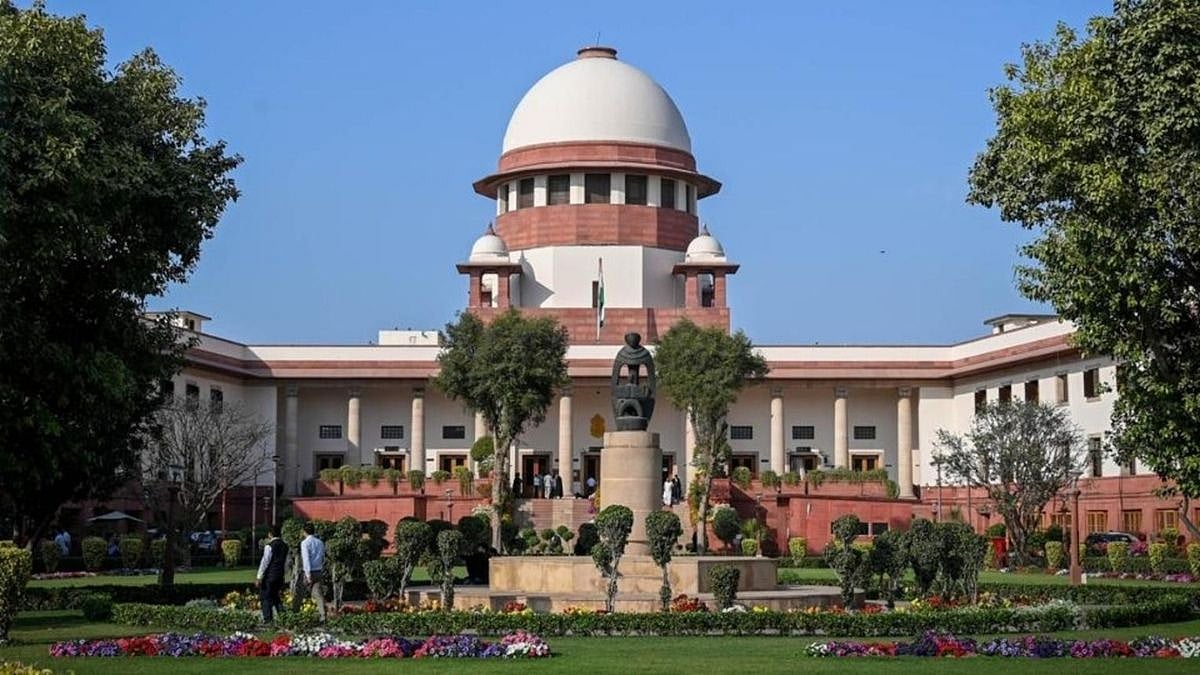
The Supreme Court has ruled that a divorce granted by a foreign court does not automatically end a marriage solemnised in India. The court made it clear that foreign divorce orders must comply with Indian law to be legally recognised in the country.
The court also held that a divorce granted abroad solely on the ground of irretrievable breakdown of marriage cannot be considered valid in India if the couple married under the Hindu Marriage Act, 1955.
The ruling highlights the legal risks faced by people who obtain a divorce abroad and remarry without ensuring that their first marriage has legally ended in India.
Supreme Court Refuses To Quash Bigamy Case
A bench of Justices Prashant Kumar Mishra and Shree Chandrashekhar made the observations on Tuesday, November 10, while hearing a petition filed by a man seeking to quash criminal proceedings against him for bigamy and criminal conspiracy.
The bench dismissed his plea, holding that a foreign divorce decree must satisfy the conditions laid down under Section 13 of the Code of Civil Procedure (CPC) before Indian courts can recognise it.
“In our view, the foreign divorce decree was passed in contravention of the existing matrimonial law in India and on a ground that is not even recognised statutorily,” the bench observed.
The judges explained that a marriage performed under Indian law cannot be treated as dissolved merely because a court in another country has granted a divorce. They also rejected the argument that acquiring foreign citizenship could protect a person from legal consequences arising from an earlier marriage in India.
Marriage In Andhra Pradesh, Divorce In England
The case dates back to April 18, 2003, when the man married his first wife in Sattenapalli, Andhra Pradesh, according to Hindu rites and customs.
After their marriage, the couple lived in Hyderabad, where the husband was pursuing postgraduate studies at Osmania Medical College. On February 4, 2005, he moved to the United Kingdom to build his career as a doctor, and his wife joined him later.
In August 2007, the woman returned to her parental home in Sattenapalli for childbirth. According to the husband, she did not return to the UK despite his repeated requests, PTI reported.
As their relationship deteriorated, the husband approached a court in Narasaraopet in Guntur district, seeking divorce and child custody. However, the court dismissed the proceedings. He subsequently challenged the decision before the Andhra Pradesh High Court but later withdrew his appeal.
British Citizenship And Second Marriage
The man acquired British citizenship on February 1, 2013, and later approached the Cambridge County Court in England to seek a divorce.
In 2014, the English court granted him a divorce on the ground of irretrievable breakdown of marriage. Following the decree, he married another woman in Norfolk, UK.
Nearly two years after his second marriage, his first wife approached the Sattenapalli town police station and filed a complaint alleging bigamy and criminal conspiracy under Sections 494 and 120B, read with Section 34, of the Indian Penal Code (IPC).
The husband subsequently sought to have the criminal proceedings quashed, arguing that he had already obtained a divorce abroad and had become a British citizen.
Foreign Citizenship Does Not Override Indian Law
The Supreme Court rejected the husband’s argument that his British citizenship and the foreign divorce decree could free him from liability under Indian law.
“We cannot accept this submission in the manner canvassed as accused No.1/husband was married to respondent No.2/first wife in India under the Hindu rites, rituals and customs,” the bench said.
The court further observed that even though the second marriage took place outside India, the allegations of bigamy under Section 494 of the IPC could not be dismissed without examining whether the first marriage was still legally valid.
However, while refusing to quash the criminal proceedings against the husband, the Supreme Court set aside the proceedings against his parents and second wife.
What The Ruling Means For Couples Married In India
The judgment makes it clear that obtaining a divorce in another country does not necessarily mean that a marriage performed in India has legally ended.
For Indian courts to recognise a foreign divorce decree, it must meet the requirements under Section 13 of the CPC. These include proper jurisdiction, legally recognised grounds for divorce, compliance with the principles of natural justice and the absence of fraud.
The ruling also underlines an important distinction between obtaining a divorce abroad and securing legal recognition of that divorce in India. A decree that is valid in a foreign country may not necessarily have the same legal effect under Indian matrimonial law.
Also Watch:
The key takeaway is that foreign citizenship or a divorce order from an overseas court does not automatically remove legal obligations arising from a marriage solemnised in India. Anyone who remarries on the basis of a foreign divorce decree that is not recognised under Indian law may still face criminal proceedings for bigamy.
Level up your brain the fun way. Play daily games and quizzes on FPJ Smart!
To get details on exclusive and budget-friendly property deals in Mumbai & surrounding regions, do visit: https://budgetproperties.in/

