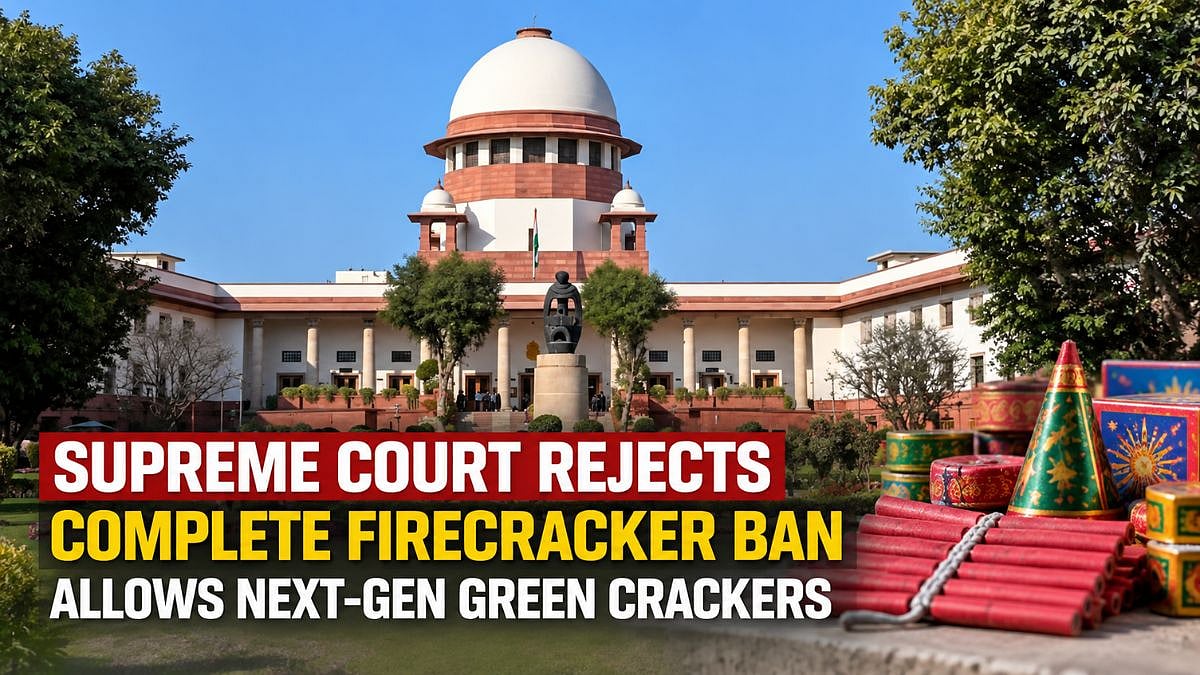
New Delhi, September 30, 2026: The Supreme Court on Wednesday refused to impose a complete ban on firecrackers and permitted specified next-generation joint green crackers, or “laris”, while stressing the need to balance environmental concerns with public sentiment. The court, however, made it clear that its decision would not mean unrestricted bursting of crackers.
A Bench of Justices MM Sundresh and PB Varale said it would neither allow a total ban nor permit crackers to be burst throughout the day. “We will neither allow a total ban nor will we allow 24 hours bursting of crackers everywhere. A total ban will hurt certain sentiments and allowing 24 hours will have a huge impact on people, including old people, sick persons and children,” the Bench observed. The Supreme Court’s cause list for September 30 confirms that Justices Sundresh and Varale were sitting together in Court No 3.
Court Seeks A Middle Path
The order came in a petition filed in 2015 by three minors, including Arjun Gopal, seeking a complete nationwide ban on firecrackers because of their impact on air quality and the resulting health risks, particularly for children and senior citizens.
The ruling reflects the difficult balance before the court: allowing festive celebrations while limiting their environmental and health impact. Instead of choosing between a blanket prohibition and unrestricted use, the Bench has, for now, backed a regulated approach based on expert assessment.
The court accepted the Centre’s submission, based on consultations with experts from the Council of Scientific and Industrial Research-National Environmental Engineering Research Institute (CSIR-NEERI), Petroleum and Explosives Safety Organisation (PESO) and Central Pollution Control Board (CPCB), that specified next-generation joint crackers could be permitted with safeguards, Hindustan Times reports.
Laris are strings of crackers fused together so that they go off one after another. Additional Solicitor General Aishwarya Bhati told the court that experts found the new-generation joint crackers produced noise below 125 decibels, compared with conventional crackers that generate between 140 and 160 decibels. She also said the permitted variants did not contain barium.
Strict Conditions For Manufacturers
Experts have prescribed conditions concerning the “shell number, shell size, and time between burst”. Manufacturers will have to comply with these requirements for their crackers to qualify for use.
The permission comes after the court earlier in September asked the Centre to examine whether a limited exemption from existing restrictions could be worked out before the festive season.
In October 2025, the Supreme Court had allowed green firecrackers to be burst during Diwali. The latest decision extends the relaxation nationwide and includes joint crackers, or laris, which had remained prohibited under the 2025 rules.
The question of green crackers containing barium, however, remains unresolved.
Barium Question Still Open
Bhati told the court that open-ground tests were necessary to determine the actual impact of barium-containing crackers on ambient air quality. The Centre and expert bodies have been given until October 15 to complete their assessment.
Advocate Pooja Dhar, appearing for the petitioners, submitted that the Supreme Court had specifically prohibited firecrackers containing barium and had disapproved of green-cracker formulations using the chemical.
The issue has been under scrutiny for years. In 2018, the Supreme Court barred the use of barium salts in firecrackers. Its October 31, 2018 order specifically clarified that “barium salts in the manufacture of firecrackers will not be used”.
Barium salts, chiefly barium nitrate, help firecrackers burn more intensely by supplying oxygen and are also used to produce a green colour.
Tests Show Lower PM10 Emissions
On September 2, the court gave the Centre three weeks to specify the conditions under which new-generation green crackers could be permitted. The Bench said courts should give due weight to expert opinion in environmental matters.
“We may have a particular view that crackers are bad. But we need to have a balanced approach,” the Bench had said, adding that courts should be “extremely slow” in substituting their views for those of experts.
The Centre told the court that controlled laboratory tests conducted by NEERI on new-generation green crackers containing barium showed a 45 per cent to 60 per cent reduction in PM10 emissions. It nevertheless proposed open-ground tests in Delhi, Bhopal, Kolkata and Chennai to study their impact under actual conditions.
The scientific assessment is important because laboratory reductions in emissions do not by themselves settle the wider question of how crackers affect air quality when used on a large scale. The open-ground tests are therefore expected to play a key role in deciding how the barium-containing variants are treated.
No Licence For Unrestricted Bursting
The Supreme Court also stressed that permitting specified crackers would not amount to allowing them to be burst without restrictions.
“We will neither allow a total ban nor will we allow 24 hours bursting of crackers everywhere,” the Bench reiterated, indicating that the regulatory framework would have to determine both the types of crackers allowed and the hours during which they could be used.
Firecracker manufacturers and retailers, represented by senior counsel K Parameshwar and Pranav Sachdeva, among others, had approached the court citing urgency. They argued that formulations approved by the Centre would have to be manufactured, distributed and sold in time for Dussehra and Diwali.
Delhi-NCR Case Also In Focus
The nationwide proceedings overlap with a separate case concerning firecracker restrictions in Delhi-NCR. The Supreme Court noted the overlap and allowed the parties to approach the Chief Justice of India for the possibility of hearing the matters together.
In October 2025, a Bench led by then Chief Justice of India BR Gavai partially modified the April 3, 2025 ban on crackers in Delhi-NCR, allowing their sale and use between October 18 and 20 during specified hours for Diwali.
Referring to the Supreme Court’s 2018 judgment in the Arjun Gopal case, which introduced the concept of green firecrackers, the Bench had said a balance had to be struck between festive sentiments, the livelihood concerns of the industry and the right to clean air.
Delhi Pollution Raised Fresh Concerns
Delhi subsequently recorded a sharp Diwali pollution peak. An analysis of eight monitoring stations with consistent data found average PM2.5 concentrations peaking at 785.6 micrograms per cubic metre after Diwali, the highest level since 2021, despite warm temperatures and fewer farm fires that would otherwise have helped pollutants disperse.
The Delhi-NCR hearings also highlighted enforcement problems. In September 2025, the Commission for Air Quality Management told the court that licensed producers had sold QR codes, intended to identify genuine green crackers, to unregistered manufacturers. It also said there was no mechanism to verify whether crackers sold in the market actually met emission standards.
Senior advocate Uttara Babbar, who was assisting the court as amicus curiae, had also pointed out that PESO had no testing facilities in Delhi. During 2018 and 2019, when limited use of green crackers was permitted in the Capital, police and local officials had struggled to distinguish them from conventional firecrackers.
Also Watch:
These enforcement gaps remain significant because restrictions on paper can have limited impact if authorities cannot identify compliant products in the market. For now, the Supreme Court has chosen regulated use over either extreme, while leaving the crucial question of barium-containing green crackers to further scientific examination.
To get details on exclusive and budget-friendly property deals in Mumbai & surrounding regions, do visit: https://budgetproperties.in/

