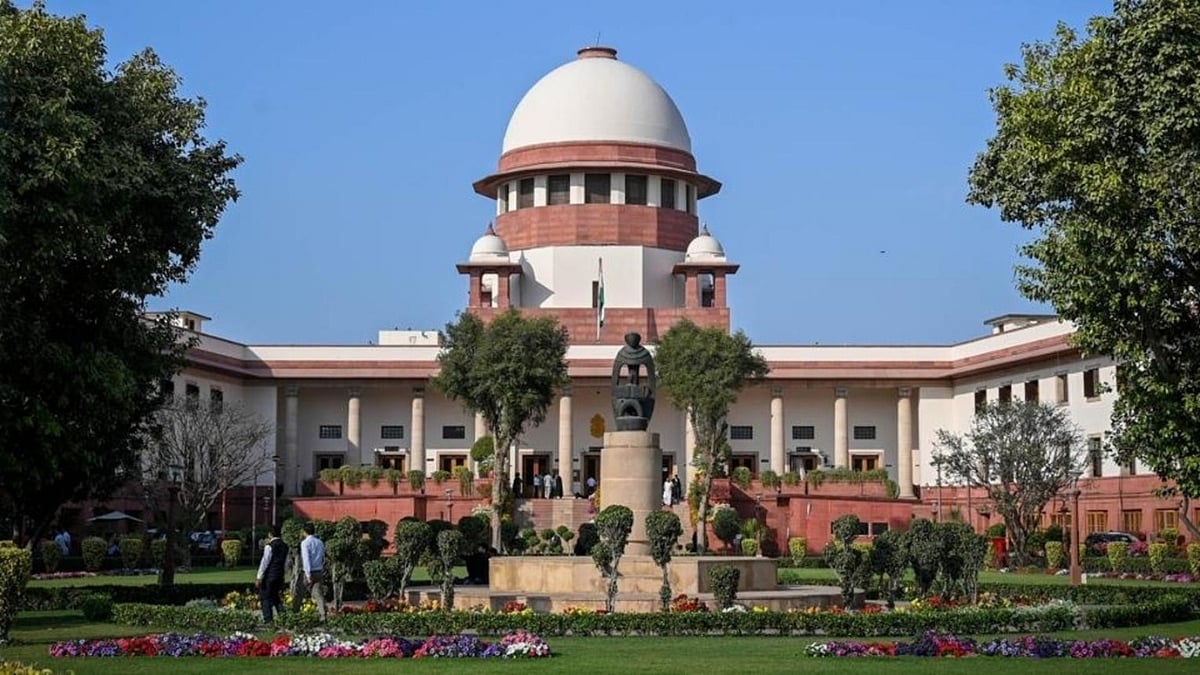
The Supreme Court on September 21 held that disciplinary proceedings must be initiated against a police officer who arrests a person without furnishing the grounds of arrest in writing, stressing that compliance with Article 22(1) of the Constitution is mandatory.
A Bench of Justices Ujjal Bhuyan and Atul S Chandurkar held that an arrest becomes illegal if the grounds are not furnished in writing. It said that if an investigating agency subsequently wants to re-arrest the person, it must first provide the written grounds of arrest and seek permission from the Magistrate concerned, Live Law reports.
The court also directed that further investigation must be handed over to another officer and departmental inquiry initiated against the officer responsible for the violation.
If the inquiry results in adverse findings, departmental action should follow and an entry should be made in the officer’s service book, the court said. It also directed that a copy of the judgment be sent to the Directors General of Police of all states and Union Territories.
Arrest Without Written Grounds Is Unconstitutional
The Supreme Court issued the directions while declaring illegal the arrest of Shiromani Akali Dal (SAD)-affiliated Mullanpur Dakha constituency in-charge Jaskaranjit Singh in connection with allegations involving the sexual assault of a minor. The court held that the grounds of arrest had not been furnished to him.
Singh approached the Supreme Court after the Punjab and Haryana High Court stayed a local court order that had declared his arrest illegal and directed his immediate release.
Pronouncing the judgment, Justice Bhuyan said: “This appeal raises an important question of wide constitutional import. Can an accused who has suffered a breach of both clauses (1) and (2) of Article 22 of the Constitution of India be re-arrested and if so, under what circumstances, in what manner and what is the procedure which is required to be followed?”
The court referred to its earlier decisions and held that Mihir Rajesh Shah v State of Maharashtra (2025) laid down the binding legal position on furnishing grounds of arrest.
It said the grounds of arrest must be provided in writing and in a language understood by the arrested person. A copy must be furnished without exception and at the earliest.
“Such a fundamental right being sacrosanct can't be breached under any situation. Any breach or non-compliance would entail immediate release of the arrested person because such arrest is unconstitutional. We can't tinker with the most important safeguard provided under Article 22. ”
The court also held that subsequently filing a chargesheet or an order taking cognisance would not validate an arrest made in violation of Article 22.
Article 22 Safeguard Applies Across Offences
The Supreme Court said the protection under Article 22 applies across the spectrum, including offences under the Indian Penal Code (IPC) and special laws, and is not merely a procedural formality.
“The safeguards enumerated in Article 22(1) are not mere procedural safeguards; these are fundamental principles which are required to be followed in the event the liberty of a person is sought to be curtailed. Therefore, it is not correct to say that procedural lapses in furnishing grounds of arrest don't ipso facto render the custody illegal or entitle the accused to bail. When the accused is released for violation of his fundamental rights under Article 22(1), he is not released on bail; he is released from illegal and unconstitutional detention.”
The court said that when a person is released because of a violation of Article 22(1), the investigating agency cannot simply re-arrest the person at its discretion.
Magistrate’s Permission Required For Re-Arrest
If investigators believe custodial interrogation is necessary after a person has been released because of an Article 22(1) violation, they must apply to the Magistrate concerned and explain why re-arrest and custody are required.
The application must also explain why the written grounds of arrest were not provided initially. However, such an application can be filed only after the grounds of arrest have subsequently been furnished to the person.
The application must carry the endorsement of the immediate superior authority to guard against foul play or collusion and to ensure that the constitutional violation by the officer is brought to the superior’s notice.
The Magistrate must decide the application expeditiously and, in accordance with the principles laid down in Mihir Rajesh Shah, preferably within a week while adhering to the principles of natural justice.
“What is sought to be highlighted is that, once there is a breach of Article 22(1), the power to re-arrest the accused must not be left to the discretion of the very same authority which has violated the same provision of the Constitution. It must be judicially implemented.”
If the Magistrate is satisfied that there were bona fide reasons for not furnishing the grounds initially, that the grounds were subsequently provided and that re-arrest is necessary, permission may be granted.
Departmental Inquiry, Change Of Investigating Officer
On the administrative side, the Supreme Court directed that when the superior authority receives an application seeking endorsement for further custody following an Article 22(1) violation, the investigation must be handed over to another officer.

The superior authority must also order a departmental inquiry into the lapse. If the inquiry returns adverse findings, departmental action must follow, along with an entry in the police officer’s service book.
The court further said that the same procedure must be followed in cases involving a breach of Article 22(2) if the investigating agency seeks custody after the person has been released because of the constitutional violation.
It also said that, depending on the facts and circumstances, High Courts may direct payment of compensation as a public law remedy for violations of Article 22(2), while leaving the person free to pursue remedies under private civil law.
Emphasising that constitutional safeguards must be strictly observed regardless of the gravity of the alleged offence, the court said: “Therefore, violation of the Constitution or the constitutional provisions can't be countenanced. It has to be dealt with strictly. It is not dependent on the nature or gravity of the offence, and it can't be interpreted in a restrictive manner.”

