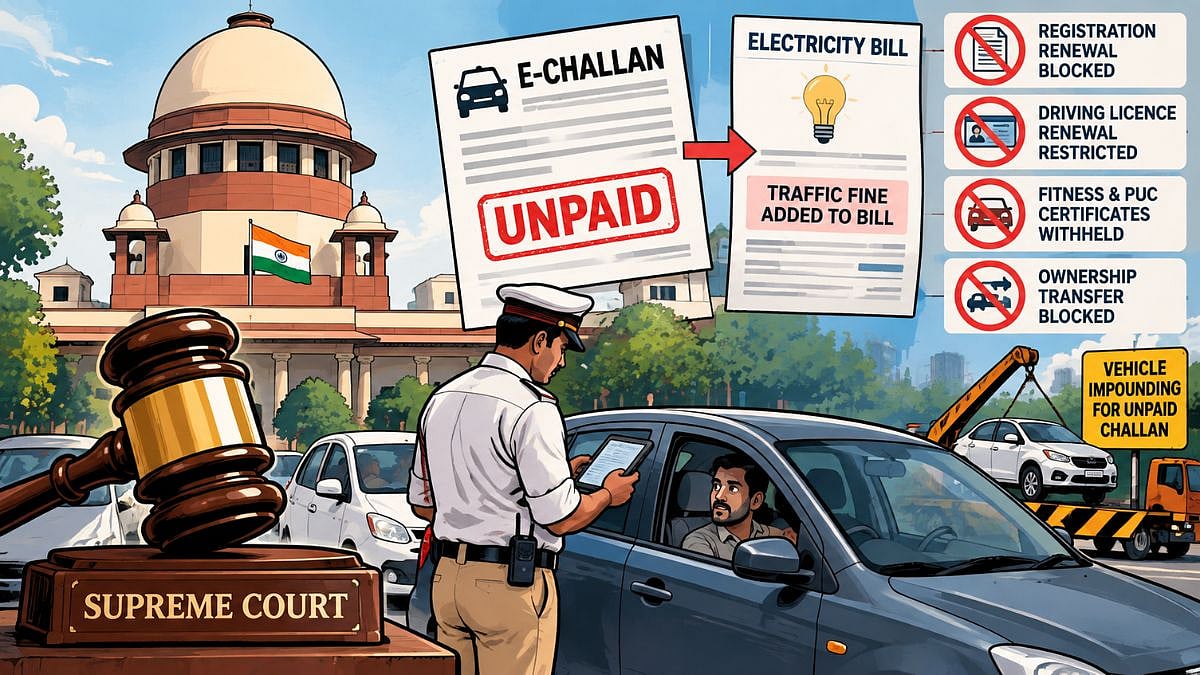
New Delhi, October 1, 2026: The Supreme Court on Thursday directed all states and Union Territories to block key vehicle-related services for motorists with unpaid traffic fines, including registration renewal, fitness and pollution-under-control (PUC) certificates, ownership transfers and driving licence renewal, as it sought stricter enforcement and recovery of pending e-challans across the country.
A bench of Justices JB Pardiwala and KV Viswanathan also ordered vehicles with outstanding e-challans to be blacklisted on the central Parivahan portal, preventing their sale or transfer. The court was informed that about Rs 49,194.05 crore was outstanding against e-challans issued over a period of time, of which Rs 26,175.05 crore had been recovered.
Pay Challans Or Lose Services
The court said merely issuing thousands of e-challans served little purpose unless authorities recovered the fines and implemented enforcement measures on the ground.
It directed authorities not to renew registration certificates, issue duplicate registration certificates or entertain requests to update an owner’s address until pending traffic fines are cleared. Fitness certificates must also be denied to vehicles with unpaid fines.
The court specifically directed that no centre should issue a PUC certificate to such vehicles.
For multiple traffic violations, authorities have been told to stop renewal of the driving licence and take steps to suspend a licence already in force.
The court also ordered random checking of vehicles. If a vehicle is found with an e-challan that has not been honoured, authorities should take necessary steps to impound it.
For motorists, the directions mean an unpaid traffic fine could now affect several essential services linked to a vehicle and driving licence, rather than remaining merely an outstanding monetary penalty.
E-Enforcement Gets More Teeth
The Supreme Court directed all states and Union Territories to immediately implement the Standard Operating Procedure prepared by the Ministry of Road Transport and Highways on October 28, 2025.
It also directed compliance with Section 136A of the Motor Vehicles Act, 1988, read with Rule 167A of the Central Motor Vehicles Rules.
The provisions require electronic monitoring and enforcement of road-safety rules through technology such as speed cameras, CCTV cameras and speed guns, Hindustan Times reports.
States and Union Territories have been asked to notify e-enforcement sites and finalise the procurement, deployment and calibration of enforcement devices. The National Road Safety Board has been directed to monitor implementation.
The bench also took note of amended Rule 21(25), which came into force in 2026. Under the provision, committing five or more offences or contraventions under the Motor Vehicles Act or Rules within a one-year period constitutes an act of nuisance or danger to the public.
Delhi Faces Compliance Test
The bench also questioned whether its earlier road-safety directions were being implemented in Delhi.
Amicus curiae and senior advocate Gaurav Agrawal informed the court that there had been no response despite his September 19 communication to the Delhi Chief Secretary regarding directions issued on September 15.
Those directions concern pedestrian safety on Mathura Road near the Delhi High Court and the National Zoological Park. They include functional pedestrian signals, synchronised red lights, speed-limiting measures and electronic enforcement.
The Supreme Court directed the Delhi Chief Secretary to file a compliance report and warned that the Chief Secretary would have to personally appear before the bench on the next date if the directions were not implemented.
The bench, noting that it had spent almost a year issuing directions in the matter, questioned whether its efforts had yielded positive results on the ground.
It asked the amicus to prepare a comprehensive chart of all directions issued by the bench, specifying the date of each direction, the time granted for implementation, its current status and his remarks. State counsel have been asked to provide the information sought by the amicus through interrogatories.
Overloaded Vehicles Cannot Move On
The Supreme Court also directed authorities to act against overloaded transport vehicles, including preventing them from proceeding beyond the point of detection until the excess load is removed.
The application before the court pointed out that overloading increases braking distance and the risk of brake failure, tyre blowouts and rollovers. It also reduces steering control and vehicle stability.
The proposed enforcement framework includes integrating weigh-in-motion and weighbridge systems with toll-management and electronic enforcement systems so that action cannot be avoided merely because a vehicle is registered in another state or moves across state borders.
BMC Footpath Policy Under Lens
The bench also sought a more comprehensive report from the Brihanmumbai Municipal Corporation (BMC) on the implementation of its Universal Footpath Policy of May 26, 2023.
The BMC informed the court that it was preparing a geospatially mapped digital inventory of existing and missing footpaths and integrating the exercise with its Geographic Information System platform and 3D city model.
The court directed the civic body to file a report on further steps taken and stressed adherence to the timelines for implementing the policy.
The directions came in S Rajaseekaran vs Union of India, a road-safety case dating back to 2012 in which the Supreme Court has been monitoring the implementation of the Motor Vehicles Act and Central Motor Vehicles Rules for nearly 14 years.
Also Watch:
The latest directions put the focus firmly on implementation. Instead of allowing e-challans to remain unpaid, the court has sought to link outstanding fines with services motorists regularly need, making recovery an integral part of traffic enforcement.
To get details on exclusive and budget-friendly property deals in Mumbai & surrounding regions, do visit: https://budgetproperties.in/

