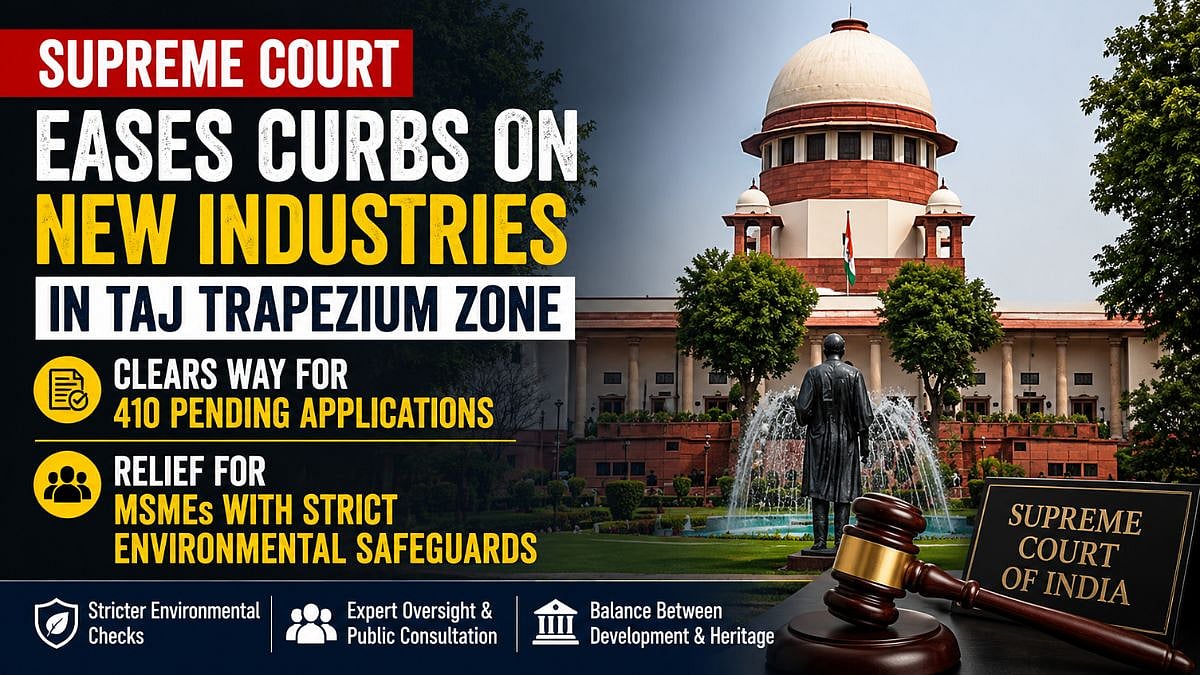
New Delhi, July 23, 2026: The Supreme Court on Thursday relaxed its earlier order that had effectively barred fresh industrial activity in the Taj Trapezium Zone (TTZ) without its prior approval, allowing the TTZ Authority to process around 410 pending applications, most of them filed by micro, small and medium enterprises (MSMEs) seeking permission to set up, expand or relocate industries.
A Bench comprising Chief Justice of India Surya Kant and Justices Joymalya Bagchi and V Mohan modified its October 14, 2024 order in the suo motu case, In Re Regulation of Industries in Taj Trapezium Zone. While the Court retained strict environmental safeguards, it held that delays in completing key studies and policy documents should not indefinitely stall industrial applications, especially those involving small businesses.
Relief For MSMEs
The Court directed that the TTZ Authority can now process pending applications in consultation with one expert each from the Court-appointed Central Empowered Committee (CEC) and the National Environmental Engineering Research Institute (NEERI). No meeting to consider industrial proposals can take place unless both experts are present.
If either expert concludes that an industry cannot be classified as non-polluting, the application cannot be approved without the Supreme Court's permission. However, where both experts and the TTZ Authority unanimously support an application, it can be processed and taken to its logical conclusion in accordance with law without referring the matter to the Court.
The Bench also introduced an additional layer of scrutiny. Every approval granted by the TTZ Authority must be uploaded on the CEC website to invite objections or suggestions from the public. The Authority will have to consider these representations in consultation with CEC and NEERI experts before taking a final decision.
Further, all final decisions must be communicated in advance to the amicus curiae. If the amicus believes any approval requires judicial scrutiny, an appropriate application may be moved before the Supreme Court. The Court also directed the TTZ Authority to provide all relevant material concerning each industry to the CEC and NEERI experts well before meetings are held.
The directions will apply not only to glass industries but also to all other industries in the TTZ. The arrangement will remain in force until the cumulative impact assessment study is completed or a final definition of "non-polluting industries" is determined.
Court Stresses Environmental Safeguards
Explaining its decision, the Court observed that while three major initiatives remain incomplete—a vision document for the TTZ, a cumulative impact assessment study and a final report defining non-polluting industries—their pendency should not become an obstacle to processing applications.
"While all three pending initiatives are undoubtedly required to be completed at the earliest and in a time-bound manner, their pendency should not be an impediment in processing applications. What is of utmost importance is that well-known precautionary principles must be strictly adhered to under the supervision of domain experts," the Bench said.
The order came on an application filed by the TTZ Authority in the suo motu proceedings, which stem from the long-running MC Mehta environmental litigation concerning pollution in the TTZ. The original MC Mehta case was closed earlier this year, following which separate suo motu proceedings were registered to deal with issues concerning industries in the protected zone.
Arguments Before The Court
Attorney General R Venkataramani argued that the Court's October 2024 order had brought many small-scale industries to a "grinding halt". He said the pending applications largely involved small businesses such as atta chakki units and paper product manufacturers.
Appearing for the Central government, Additional Solicitor General Aishwarya Bhati submitted that the blanket restriction had affected industries across the 10,400 sq km TTZ area. She told the Court that around 400 MSME applications were pending and none related to coal- or coke-based industries. Stressing that only non-polluting MSMEs were under consideration, she argued that a complete ban was affecting livelihoods and the aspirations of millions.
Senior Advocate Aparna Bhat opposed the government's submissions, contending that the authorities had earlier granted permissions arbitrarily, particularly in the Firozabad glass industry cluster, despite environmental concerns. She maintained that the earlier intervention by the Supreme Court became necessary because the TTZ Authority had failed to perform its duties properly.
During the hearing, the Attorney General questioned Bhat's locus, arguing that the applicant was motivated by business rivalry. Bhat objected to the remarks and maintained that the applicant was a public-spirited individual who had raised genuine environmental concerns before the Court.
Balancing Development And Conservation
The Bench noted that there was broad agreement that only non-polluting industries should be permitted in the TTZ. Referring to an interim report submitted by NEERI on April 21, 2025, the Court observed that the institute had advised against adopting a rigid definition of non-polluting industries. Instead, NEERI recommended that factors such as Agra's heritage, legacy and Geographical Indication status should also be considered while evaluating industries.
Also Watch:

The TTZ is a 10,400 sq km protected area created to safeguard the Taj Mahal and other heritage monuments in and around Agra from environmental pollution. By easing its earlier restrictions while strengthening expert oversight, the Supreme Court has attempted to strike a balance between protecting one of India's most important heritage zones and allowing economic activity that does not compromise environmental safeguards.
To get details on exclusive and budget-friendly property deals in Mumbai & surrounding regions, do visit: https://budgetproperties.in/

