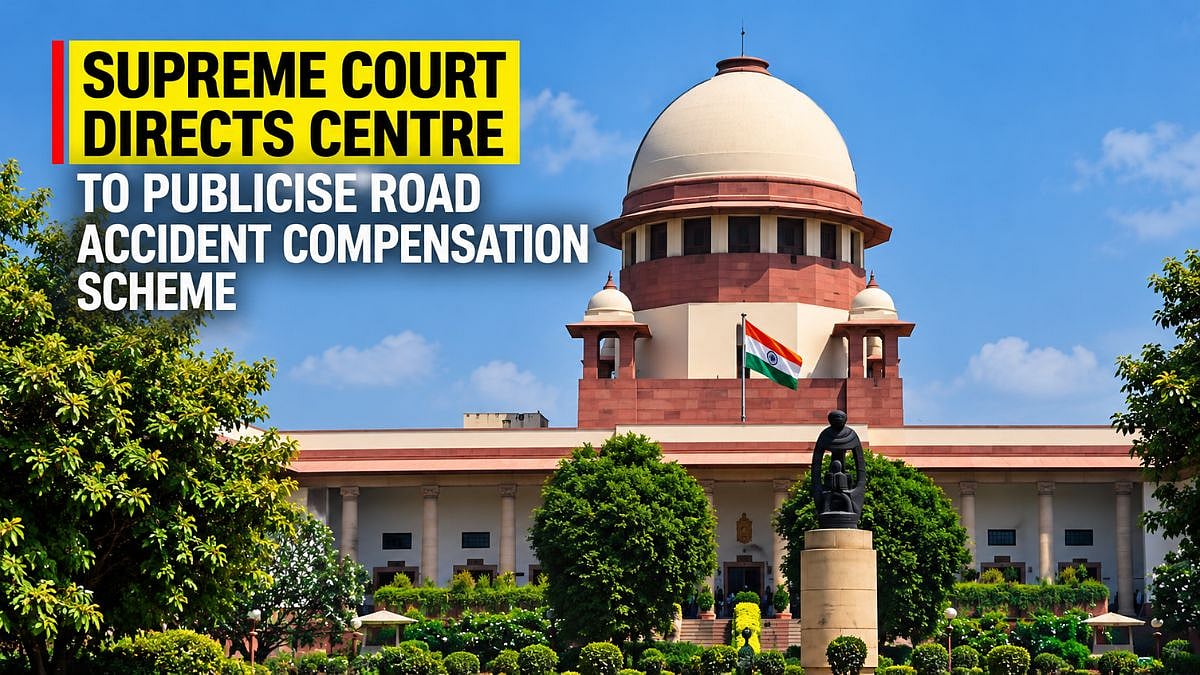
New Delhi, October 20, 2026: The Supreme Court has directed the Central Government to widely publicise the Compensation to Victims (Interim Relief) Scheme, 2026, to ensure that road accident victims are aware of their right to seek interim compensation. The court has also asked the Centre to clarify whether the scheme covers accidents involving uninsured vehicles.
A bench of Justices JB Pardiwala and KV Viswanathan issued the directions on October 16 while hearing contempt petitions concerning the implementation of earlier court orders and the publication of road accident data. The court also directed the Centre to publish the scheme in the Official Gazette at the earliest and explain how it plans to implement it, Live Law reports.
Why The Court Stepped In
The scheme was framed under Section 164A of the Motor Vehicles Act, 1988, which allows the Central Government to introduce measures for providing interim relief to people seeking compensation after road accidents.
The Supreme Court had earlier directed the Centre on April 28, 2025, to frame the scheme within four months. At the time, the court noted that Section 164A had come into force on April 1, 2022, but remained unimplemented for three years.
During the latest hearing, Additional Solicitor General Vikramjit Banerjee informed the bench that the Ministry of Road Transport and Highways had framed the Compensation to Victims (Interim Relief) Scheme, 2026.
How Victims Can Claim Compensation
Under Clause 6 of the scheme, an accident victim or the legal heirs of a deceased victim can apply for interim compensation through a designated online portal.
Applicants must provide details of their compensation claim filed or pending before the Motor Accident Claims Tribunal.
The application will then be forwarded electronically to the Department of Financial Services under the Ministry of Finance and the investigating officer concerned. The department will subsequently send the application to the insurance company of the vehicle involved in the accident.
The investigating officer must upload the Detailed Accident Report on the portal within 90 days of the accident. The insurance company must then accept or reject the application within 30 days of the report being uploaded and provide reasons for its decision.
If the insurer accepts liability, it must make the payment before the Claims Tribunal within 30 days of acceptance.
What About Uninsured Vehicles?
A major concern raised during the hearing was whether people involved in accidents with uninsured vehicles would also be eligible for interim compensation.
Senior Advocate Gaurav Agrawal, appearing as amicus curiae, and an applicant appearing in person pointed out that the scheme appeared to cover only accidents involving insured vehicles.
They submitted that it did not address cases involving uninsured vehicles, where the driver could be held liable to pay compensation.
Taking note of the concern, the bench asked Banerjee to obtain instructions on whether the scheme would also cover such vehicles.
The clarification is important because the scope of the scheme will determine whether victims of accidents involving uninsured vehicles can seek relief through the same process.
Public Awareness Key To Implementation
The Supreme Court also stressed that introducing a compensation scheme would serve little purpose if people remained unaware of its existence.
The bench observed that an ordinary citizen might not know about the right to seek interim compensation unless the government took steps to publicise the scheme.
The court further noted that the scheme, framed under Section 164A, was a statutory scheme covered by Section 212 of the Motor Vehicles Act, which deals with the publication and commencement of rules and notifications.
It directed the Centre to ensure publication in the Official Gazette at the earliest and inform the court at the next hearing about its plans to make the scheme operational.
Push For Faster Compensation Claims
The hearing also brought attention to delays in settling motor accident compensation claims across the country.
The applicant suggested that the Ministry of Road Transport and Highways collect and publish district-wise information on compensation claims pending before Motor Accident Claims Tribunals, appeals pending before High Courts, recovery proceedings and compensation awards that remain unpaid.
The applicant also proposed that states and Union Territories submit the relevant information to the ministry every quarter. This would allow the Centre to publish consolidated district-wise, state-wise and national statistics.
According to the applicant, making such information available would help identify delays and other obstacles in the compensation process and ensure that victims and their dependants receive financial relief without unnecessary delays.
Better Facilities For Claims Tribunals
Another suggestion focused on improving the infrastructure available to Motor Accident Claims Tribunals.
The applicant sought adequate presiding officers, supporting staff, courtrooms and digital facilities for these tribunals, in consultation with the respective High Courts.
Uttar Pradesh was highlighted as an example of the problem, with the applicant claiming that compensation cases in the state reportedly take more than five years on average to be decided because of infrastructure constraints.
The Supreme Court asked the Centre to examine the suggestions and submit its response at the next hearing.
Centre Faces Questions Over Accident Data
In a separate contempt petition, the Supreme Court issued notice to the Union Government over its alleged failure to comply with an earlier direction concerning the publication of road accident statistics.
On April 17, 2025, the court had directed the Ministry of Road Transport and Highways to publish the annual road accident report for 2023 by the end of August 2025.
Also Watch:
The court had also directed the ministry to publish future annual reports within six months of the end of each calendar year, noting that the usefulness of such reports depended on their timely release.
The bench has now asked the Centre to explain why its earlier direction was not followed and what steps it intends to take.
The contempt petitions and connected applications will be heard next on November 25, 2026.
To get details on exclusive and budget-friendly property deals in Mumbai & surrounding regions, do visit: https://budgetproperties.in/

