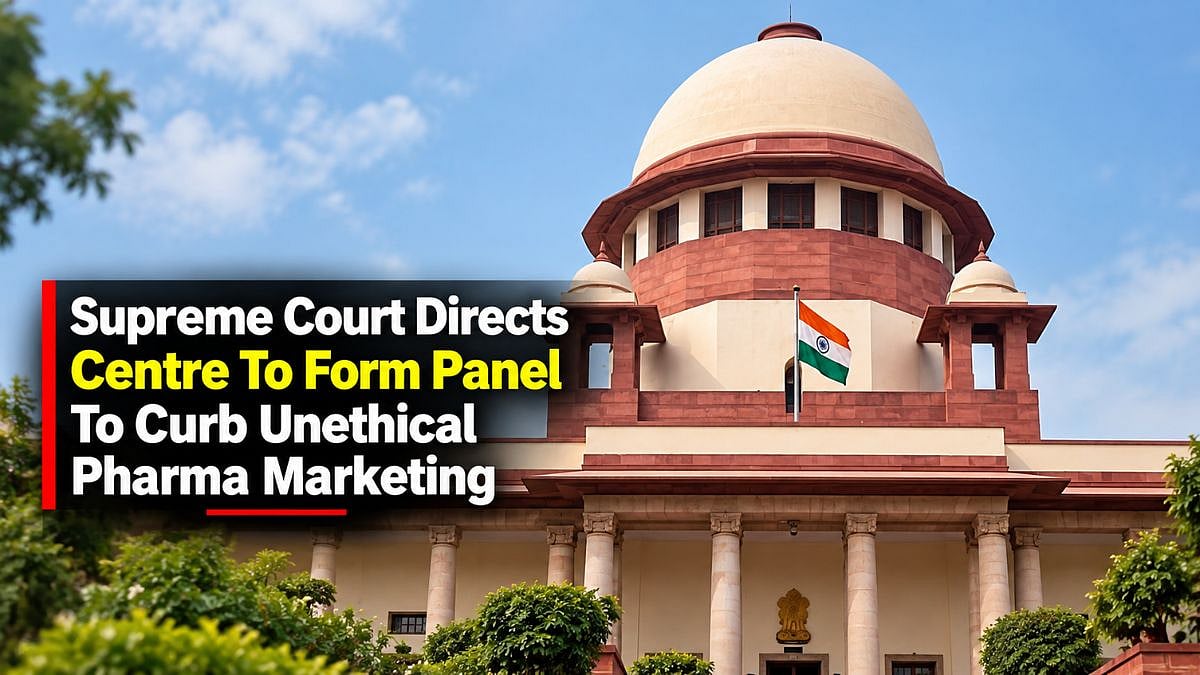
New Delhi, October 8, 2026: The Supreme Court on Thursday, October 8, directed the Centre to constitute a committee to recommend measures to curb unethical marketing practices by pharmaceutical companies, including offering gifts and other benefits to doctors.
A bench of Justices Vikram Nath and Sandeep Mehta passed the order while hearing a petition seeking stricter regulations on pharmaceutical companies. The petitioners urged the court to frame guidelines to prevent unethical marketing practices until the government introduced an effective law, Live Law reports.
Centre Asked To Submit Compliance Report
“We have directed the Union of India to constitute a committee and the committee will consider the suggestions, representations and thereafter give its recommendations to the Union of India,” the bench said while pronouncing its order.
The Supreme Court also directed the Centre to submit a compliance affidavit and scheduled the next hearing for January 29.
During an earlier hearing on September 8, the Centre had informed the court that it would constitute a three-member committee to examine whether a statutory framework was necessary to regulate pharmaceutical companies and what form such regulations should take.
Solicitor General Tushar Mehta had sought two months for the committee to prepare its report, which would then be placed before the court for approval.
Existing Rules Under Scrutiny
The Supreme Court had earlier questioned whether the Uniform Code for Pharmaceutical Marketing Practices (UCPMP), 2024, had adequate enforcement mechanisms to prevent unethical practices.
The court had also raised concerns about the absence of government control over the code, observing that a regulatory framework described as mandatory could become almost voluntary without proper enforcement.
During the proceedings, Mehta referred to the Centre’s affidavit dated August 17, 2026, and said detailed discussions had taken place among the Department of Pharmaceuticals, Department of Health and Family Welfare and Department of Legal Affairs.
He informed the court that the existing regulatory framework provided for disciplinary action against doctors who accepted gifts, travel facilities, hospitality or monetary grants from pharmaceutical companies.
However, the Centre acknowledged the need to strengthen the mechanism to ensure that pharmaceutical companies themselves did not engage in unethical practices.
The government maintained that the UCPMP, 2024, would continue to govern pharmaceutical marketing practices until the committee submitted its report and a decision was taken on its recommendations.
Petitioners Question Need For Another Panel
The petitioners questioned the decision to form another committee, pointing out that the Centre had informed the Supreme Court in a 2022 affidavit that a high-level committee had already been constituted to examine the need for a legally enforceable mechanism.
Senior Advocate Sanjay Parikh, appearing for the petitioners, argued that the existing framework penalised doctors for accepting gifts and other benefits but lacked a corresponding statutory mechanism to punish pharmaceutical companies offering such inducements.
He submitted that this imbalance allowed pharmaceutical companies to influence doctors’ prescriptions and urged the Supreme Court to direct the government to introduce statutory regulations or frame interim guidelines.
Concerns Over Influence On Prescriptions
The petitioners also referred to the Supreme Court’s 2022 judgment in Apex Laboratories Pvt Ltd v Deputy Commissioner of Income Tax, in which the court highlighted the relationship of trust between doctors and patients.
The judgment observed that medical practitioners had a quasi-fiduciary relationship with patients and that benefits offered by pharmaceutical companies could influence their prescriptions.
The court had also referred to pharmaceutical companies offering doctors gifts, electronic goods and funding for foreign trips and medical conferences, describing the practice as creating a “publicly injurious cycle”.
Also Watch:

The case highlights a key concern in pharmaceutical regulation: while doctors can face disciplinary action for accepting benefits, the question of corresponding statutory penalties for companies offering them remains unresolved.
The committee’s recommendations will therefore be important in determining whether the existing regulatory framework needs stronger legal backing to hold pharmaceutical companies accountable for unethical marketing practices.
To get details on exclusive and budget-friendly property deals in Mumbai & surrounding regions, do visit: https://budgetproperties.in/

