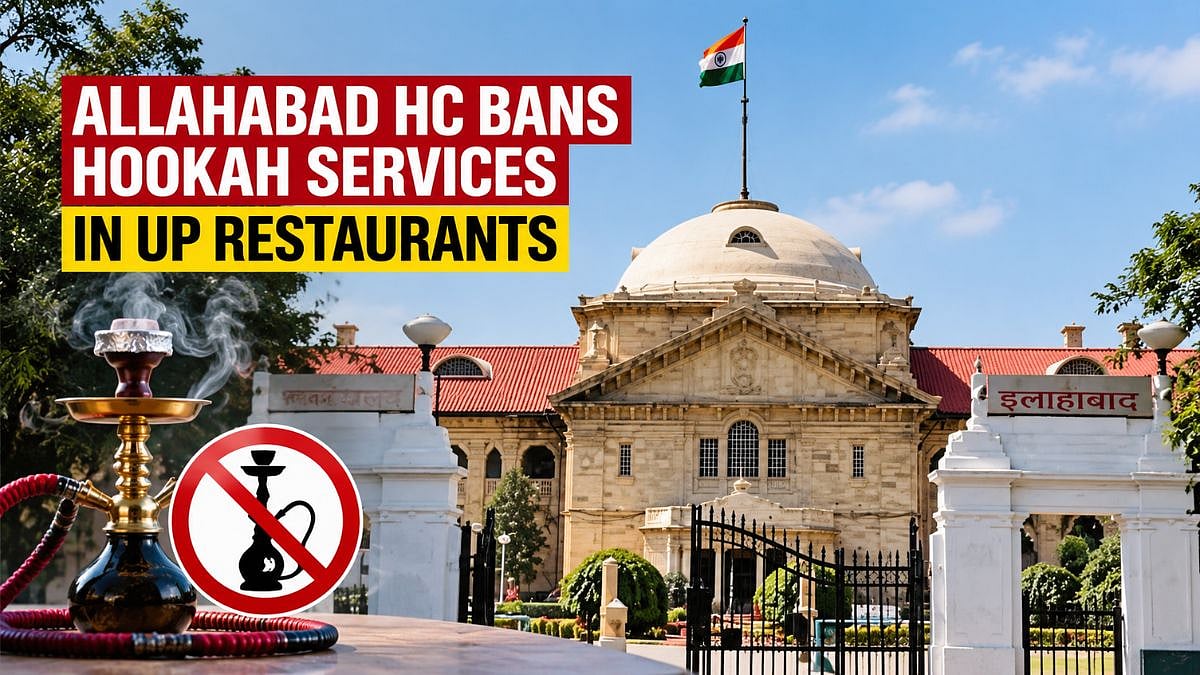
Allahabad, September 29, 2026: The Allahabad High Court has held that hookah bars cannot operate in Uttar Pradesh and restaurants cannot provide hookah services even in designated smoking areas.
A Bench of Justice Shekhar B Saraf and Justice Abdhesh Kumar Chaudhary dismissed a batch of connected petitions concerning the operation of hookah bars and provision of hookah services in restaurants.
The court said the right of non-smokers to breathe clean air in a public place cannot be abridged by the commercial interests of an establishment claiming a right to trade, Live Law reports.
It held that providing hookah services in a designated smoking area is prohibited under Rule 4(3) of the Prohibition of Smoking in Public Places Rules, 2008, as amended in 2017, read with the Cigarettes and Other Tobacco Products Act, 2003.
Smoking Area Does Not Permit Hookah Service
The issue before the court was not whether smoking tobacco through a hookah, in isolation, was prohibited. It was whether restaurants and similar establishments could provide hookah as a service in a designated smoking area.
The court answered in the negative.
It observed that the general rule under the Cigarettes and Other Tobacco Products Act is a prohibition on smoking in public places, while a designated smoking area is an exception to that rule.
However, the court said the exception permits smoking but does not allow a restaurant to provide hookah services because the amended Rule 4(3) prohibits “any service” in a smoking area.
The Bench observed:
“The right of the non-smoker to breathe clean air in a public place is a fundamental right guaranteed under Article 21 of the Constitution of India, that cannot be abridged by commercial interest of an establishment having Right to Trade under Article 19(1)(g) of the Constitution of India”.
The court ultimately held that the “operation of hookah bars and rendering of hookah services by restaurants in the State of Uttar Pradesh” was a flagrant violation of Rule 4(3) and contrary to the scheme and object of the Cigarettes and Other Tobacco Products Act.
2017 Amendment Changed Smoking Area Rules
The court relied heavily on the 2017 amendment to Rule 4(3) and referred to the Supreme Court's judgment in Narinder S. Chadha v. Municipal Corporation of Greater Mumbai.
Under the earlier Rule 4(3), a smoking area or space was to be used only for smoking and “no other service(s) shall be allowed”. In Narinder S. Chadha, the Supreme Court had implicitly allowed hookah service in smoking zones, although services involving food and other eateries were prohibited.
The Central Government subsequently substituted Rule 4(3) in 2017. The amended provision states: “No service shall be allowed in any smoking area or space provided for smoking”.
The Allahabad High Court treated the change in language as material. It held that the Supreme Court's interpretation in Narinder S. Chadha had to be understood in the context of the earlier statutory language and that the amended rule now prohibits hookah service even inside a designated smoking area.
The court therefore rejected the contention that hookah service could continue merely because customers smoked inside an officially designated smoking area.
Court Rejects Self-Service, Rental Arguments
The petitioners had argued that restaurants could adopt a “self-service” model in which the hookah would be prepared and handed over to customers, who would smoke it without assistance from the restaurant.
The court rejected the argument, noting that preparing a hookah involves assembling the apparatus, placing tobacco in the bowl, filling the base with water, preparing the foil and placing heated charcoal.
The Bench said the process requires expertise and cannot realistically be treated as ordinary self-service.
“The self-service model hypothetically synthesised by the petitioners to skirt around the clutches of the COTPA and the amended Rules is not a viable model as procedural operation of hookah intrinsically involves 'service' which needs to be carried out by the one having expertise in it and is not an operation that can be carried out by patrons who are not trained and are novices”, the court said.
The petitioners also argued that supplying a hookah apparatus amounted to renting equipment rather than providing a service. The High Court rejected this argument.
The Bench distinguished the arrangement from ordinary rental transactions, where possession and control of rented property are transferred to the customer.
In the case of a hookah provided by a restaurant, the customer remains within the designated smoking area and is required to consume it there.
“The factum of mandatory consumption of hookah inside the Designated Smoking Area by the patron makes it abundantly clear that he is being provided a 'service' only”, the court observed.
The court also considered the assistance ordinarily required to operate a hookah, including replenishing charcoal, removing ash and changing tobacco.
It held that preparing, assembling, delivering, lighting, replenishing and maintaining a hookah for consideration amounts to rendering a service.
Court Clarifies Licensing Powers
The High Court accepted the petitioners' contention that certain authorities lacked jurisdiction to grant licences for operating hookah bars.
It held that the Food Safety Department and Municipal Corporation cannot issue licences authorising the operation of hookah bars.
The court said the statutory framework governing food safety does not confer such authority in relation to hookah bars and that the Municipal Corporation also lacks a statutory provision empowering it to issue a separate hookah-bar licence.
At the same time, the court rejected the challenge to police enforcement powers under the Cigarettes and Other Tobacco Products Act.
It held that Sections 12, 13 and 15 of the Act empower police authorities to enforce its provisions, including powers relating to search, seizure, confiscation and penalties in appropriate cases.
The judgment makes clear that the existence of a designated smoking area does not, by itself, authorise a restaurant or hookah bar to provide hookah services.
The court rejected attempts to characterise the transaction as self-service or rental and held that the substance of the transaction, rather than the terminology adopted by an establishment, has to be considered.
The connected petitions were accordingly dismissed.
In the concluding portion of the judgment, the Bench referred to legislative measures adopted by Gujarat, Punjab, Rajasthan, Maharashtra and Karnataka, which have enacted provisions specifically dealing with hookah bars and providing for enhanced punishment and fines.
The court said it expected Uttar Pradesh to “rise to the occasion” and take necessary steps, including considering a notification providing for stringent punishment for serving hookah in designated smoking areas.
Also Watch:
The Bench also referred to health concerns associated with hookah smoking and noted the misconception that hookah is necessarily less harmful than cigarettes.
A copy of the judgment was directed to be sent to the Chief Secretary and Director General of Police, Uttar Pradesh, for information and necessary compliance.
To get details on exclusive and budget-friendly property deals in Mumbai & surrounding regions, do visit: https://budgetproperties.in/

