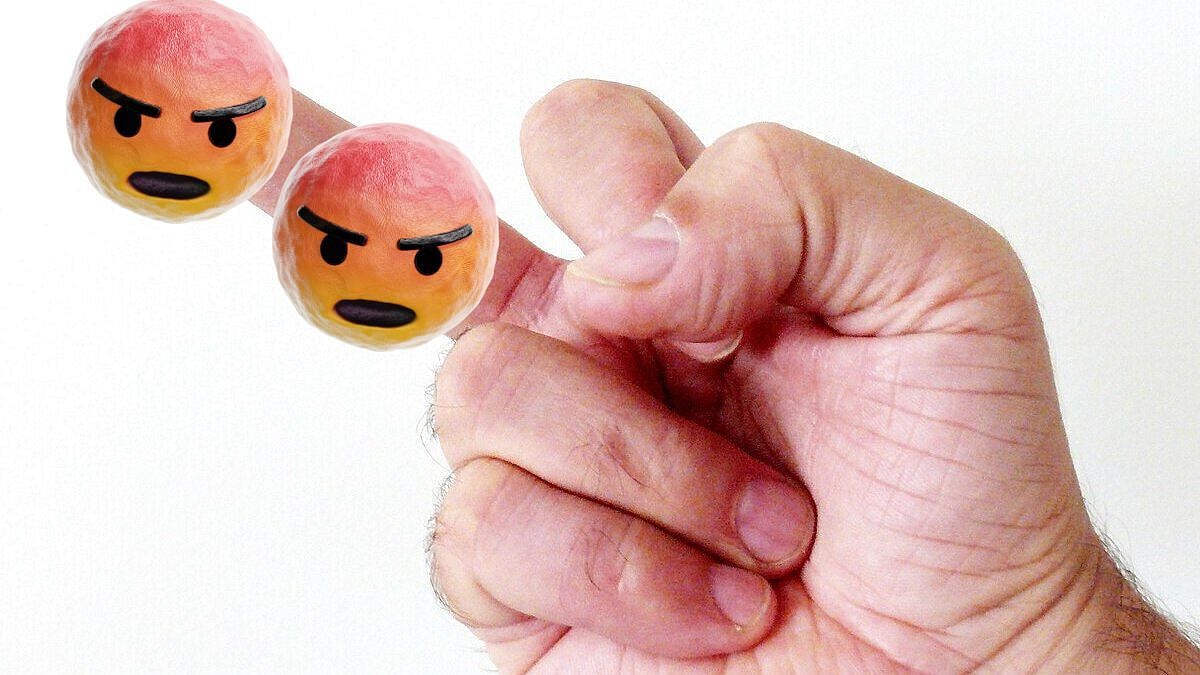
A viral video captured a moment of pure defiance in Pune, as Siya Goyal, the prime accused in the high-profile Ketan Agarwal murder case, flashed her middle finger at a crowd of media personnel.
As police escorted her from her residence in the Market Yard area, Goyal—wearing a black T-shirt and a printed scarf to obscure her face—looked directly toward the cameras and raised her middle finger. The brief clip shared by news agency IANS spread rapidly across social media platforms, drawing intense criticism from a public already gripped by the disturbing details of the investigation.
This silent, crude gesture instantly communicated intense hostility, bridging a gap between a modern true-crime investigation and an ancient insult. To fully understand why this moment caused such a public uproar, it helps to examine both the immediate criminal context surrounding the incident and the deep-seated historical reasons why this particular finger remains humanity's most offensive digit.
Anatomy of a primal phallic insult
While Goyal used the gesture as a modern shorthand for anger and contempt, the middle finger carries a highly specific, anatomically explicit meaning that has endured for thousands of years.
Renowned anthropologist Desmond Morris explains that the gesture is fundamentally a phallic display according to a report in the BBC News Magazine. When a person extends their middle digit while keeping the remaining fingers curled beneath the thumb, they are creating a visual representation of male genitalia. In this anatomical shorthand, the extended middle finger symbolises an erect penis, while the clenched fingers on either side represent the testicles.
By thrusting this shape toward another person, the individual is effectively delivering a primitive, non-verbal display. According to Morris, the act originally served as a highly aggressive and sexually degrading insult, mimicking a wild phallic threat. Over time, the physical meaning morphed into a broader symbol of defiance, but the underlying power to inflame and insult remains anchored to these raw, primeval origins.
From ancient Greek comedies to Roman tyranny
The lineage of "flipping the bird" stretches back more than 2,500 years to classical antiquity. As documented by historians, the ancient Greeks referred to the gesture as the katapygon, which translates roughly to a "downward rump."
As per a CNN report, according to classical civilisation scholar Max Nelson, the Greeks utilised the gesture to mock, taunt or proposition one another. The playwright Aristophanes famously integrated "the long finger" into his 419 BC comedy The Clouds.
The gesture later travelled to ancient Rome, where it was codified into law and literature as the digitus impudicus—the shameless, indecent or offensive finger. The gesture carried such immense weight as a tool of humiliation that the notoriously tyrannical Emperor Caligula routinely forced his political rivals to kiss his extended middle finger instead of his hand.
How a suppressed medieval myth went global
During the Middle Ages, the middle finger largely vanished from public view across Europe. The growing influence of the Catholic Church, which strictly disapproved of overtly sexual or obscene gestures, successfully suppressed its usage for centuries. However, its historical absence gave rise to popular modern myths.
A widespread legend suggests that the gesture originated during the Battle of Agincourt in 1415, claiming that English archers waved their two fingers at French soldiers who had threatened to cut them off. However, historians have soundly debunked this story as pure mythology.
The gesture re-emerged prominently in Western culture during the late 19th century, largely arriving in North America via Italian immigrants. The earliest known photographic evidence of the gesture dates back to 1886, when baseball pitcher Charles "Old Hoss" Radbourn slyly flipped off the camera during a joint team photograph between the Boston Beaneaters and the New York Giants.
Modern evolutionary shift
As the world entered the 20th and 21st centuries, the rise of photography and automobile culture gave the gesture a massive global boost. When isolated behind a car windshield or caught in front of a silent media lens, humans naturally relied on this universal visual shorthand to project instant rage, anti-authority rebellion or severe displeasure.
Over the decades, the gesture transitioned from an explicit sexual reference into a broader tool for cultural and political expression. Figures ranging from country legend Johnny Cash at San Quentin State Prison to pop star Britney Spears confronting aggressive paparazzi have used it to signal defiance against authority or unwanted intrusion.
When Siya Goyal turned to face the media cameras in Pune, she tapped into this exact multi-millennial lineage of defiance, using a single digit to signal her complete rejection of public and media scrutiny.

