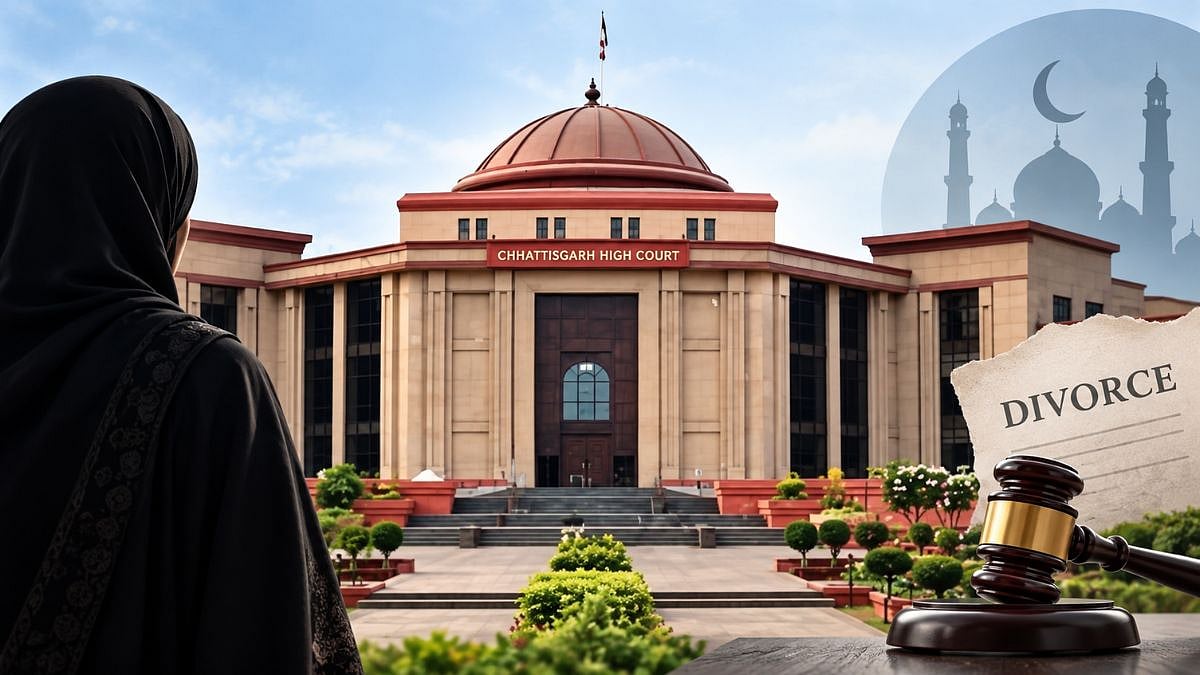
Raipur, September 9, 2026: The Chhattisgarh High Court has held that a private Sharia body has no legal authority to decide whether a Muslim woman is divorced or determine her marital status.
Justice Amitendra Kishore Prasad, while delivering the judgment on September 7, said such adjudicatory powers must come from a law enacted by a competent legislature and cannot be assumed by a private religious institution, Live Law and Bar & Bench report.
Religious Bodies Cannot Act As Courts
The court was hearing a petition challenging a January 2022 communication issued by the Idara-E-Shariya Islami Court at Raipur, which declared that the petitioner, a Muslim woman, had been divorced by her husband.
The High Court said religion may guide an individual's conscience and personal faith, but no religious institution or private body can assume the authority of a court established by law or use religious belief to determine or enforce the legal status and rights of an individual.
"The rule of law and the constitutional framework remain paramount," the court observed.
The woman had married for a second time in July 2020 after the death of her first husband. According to the petition, disputes later arose between the couple and her husband sought to divorce her.
She also alleged harassment and cruelty, following which a first information report (FIR) was registered in November 2021 under Section 498A of the Indian Penal Code (IPC) for cruelty to wife.
The husband told the High Court that he had pronounced Talaq-e-Hasan in three phases through communications dated August 31, September 30 and October 30, 2021. He argued that the Idara-E-Shariya had only communicated or recorded those pronouncements and had not adjudicated the rights of the parties.
The Idara-E-Shariya also maintained that it was only a religious and advisory institution and did not exercise statutory or judicial powers.
Fatwa Has No Legal Force
The High Court relied on the Supreme Court's 2014 judgment in Vishwa Lochan Madan v. Union of India, which held that Dar-ul-Qazas and fatwas do not form part of the judicial system recognised by law and that their opinions are not binding.
The court reiterated that a fatwa or decision issued by such a body is not a decree, has no force of law and cannot be enforced through coercive means.
It said religious bodies cannot assume the status or authority of courts established under law.
The court held that the Idara-E-Shariya's communication could not create, extinguish or alter any legally enforceable right or marital status. It added that any verdict or decision issued by the body could not be treated as a binding adjudication of civil or matrimonial rights.
"It has no jurisdiction to adjudicate upon the marital status of the petitioner or to pass an order which, in law, determines whether the petitioner stands divorced," the court said.
The High Court, however, did not decide the constitutional validity of Talaq-e-Hasan. It noted that the issue is pending before the Supreme Court and left the question open.
The court clarified that the pendency of proceedings before the Supreme Court could not give jurisdiction to a private body that otherwise did not possess such authority.
It added that the Idara-E-Shariya's decision could not be treated as a substitute for adjudication by a court established under law.
Limits On Private Religious Bodies
The High Court held that the Idara-E-Shariya Islami Court cannot be recognised as a court constituted under the Constitution or any statute.
It said the body had no jurisdiction to decide the woman's marital status or pass an order determining whether she stood divorced from her husband.
The court declared that the communication issued by the Idara-E-Shariya, insofar as it attempted to determine the petitioner's marital status or dissolve the marriage, had no legal authority and could not confer or alter any legal right, status or obligation.
Also Watch:

The court allowed the writ petition in part and restricted its decision to the competence and legal effect of the communication issued by the private religious body.
Advocate Devershi Thakur appeared for the petitioner.
Central Government Counsel Abhishek Banjare represented the Union of India.
Additional Advocate General RK Gupta appeared for the State.
Senior Advocate Fouzia Mirza, along with advocate Ali Afzaal Mirza, represented the husband.
To get details on exclusive and budget-friendly property deals in Mumbai & surrounding regions, do visit: https://budgetproperties.in/

