
When Japanese Prime Minister Sanae Takaichi touches down in New Delhi on July 1, 2026, for the 16th India-Japan Annual Summit, her first official state visit will carry weight far beyond traditional diplomacy. This three-day summit comes at a moment of unprecedented economic and military brinkmanship between Tokyo and Beijing. Because China is the central geopolitical adversary for both nations, this meeting cannot be all hat and no cattle. To matter, the summit must deliver a concrete strategy for both Quad members to cut the Gordian knot of Beijing's regional encirclement.
Following Sanae's warnings that Japan could militarily intervene if China attacks Taiwan, Beijing has aggressively retaliated, capping off on June 29, 2026, by blacklisting an additional 20 Japanese defence and technology firms from accessing critical Chinese raw materials like rare earths. In this round the blacklisted entities include the state-affiliated National Institute for Defence Studies, Naval Systems Research Center and Ground Systems Research Center, Mitsubishi Precision, MHI Logitech and Kawajyu Gifu Manufacturing. This follows a major enforcement action earlier this year on February 24, 2026, when Beijing slapped export controls on top Japanese firms like Mitsubishi Heavy Industries, Subaru and Hino Motors.
Cut off from easy access to the Chinese market and facing severe scrutiny on dual-use technologies, Japan is accelerating its 'China+1' strategy. Tokyo needs a massive, stable partner to secure alternative supply chains, decouple from Chinese rare earths and balance Beijing's military assertiveness in the Indo-Pacific. India, with its vast manufacturing push and shared anxieties over China, fits the bill perfectly.
Rare earth trap and need for economic security
The most acute vulnerability driving Japan toward India is its dangerous dependence on Chinese critical minerals. According to Japanese government data, Japan relied on China for roughly 70 percent of its rare earth imports. These minerals are the lifeblood of Japan’s high-tech economy, essential for manufacturing everything from electric vehicles and smartphones to advanced missile guidance systems.
Beijing has proven highly willing to use this leverage. Ever since China restricted rare earth flows during a 2010 territorial dispute, Tokyo has been looking for an exit strategy. The recent blacklists have made finding alternative supply hubs an immediate emergency rather than a long-term goal.
As global supply lines face compounding stress exacerbated by ongoing trade conflicts elsewhere, such as the friction between the US and Iran, Japan sees India as a primary node for economic resilience. During the upcoming July summit, Prime Ministers Takaichi and Narendra Modi are expected to fast-track agreements on semiconductor supply chains, clean energy technology and critical mineral processing to permanently reduce exposure to Chinese trade choke points.
From pacifism to proactive defence collaboration
Japan’s need for India expands far beyond trade logistics. It is fundamentally a security necessity. Over the weekend of June 27–28, 2026, a combined convoy of roughly 15 Chinese and Russian bombers and fighter jets conducted joint strategic air patrols over the Sea of Japan, the East China Sea and the western Pacific. The incident forced both Japan and South Korea to scramble fighter jets. Japanese government spokesman Minoru Kihara noted on Monday that this marked the 10th time since December 2025 that such long-range joint manoeuvers have occurred near Japanese airspace.
With regional threats compounding, Tokyo has aggressively loosened its self-imposed rules on exporting lethal weaponry. To build a robust counterweight to Beijing, Japan is systematically deepening ties with democratic nations that hold concurrent maritime interests.
India’s Act East policy and Indo-Pacific Oceans Initiative align directly with Japan’s vision of a 'Free and Open Indo-Pacific'. While neither New Delhi nor Tokyo officially brands their bilateral ties as an anti-China military alliance, Beijing’s muscle-flexing in the South China Sea and along the Himalayan borders acts as the primary engine for closer cooperation.
The two nations are already bound by the Acquisition and Cross-Servicing Agreement (ACSA)—a defence pact enacted in 2021 allowing their militaries to share logistics and supplies—and they continue to routinely align their defence strategies alongside the US and Australia within the Quad framework.
There is no doubt that China will never discard its Machiavellian intentions when it comes to India or Japan. A united and firm posture is essential so that neither New Delhi nor Tokyo appears hesitant, reactive or easily intimidated.
Bullet trains and bilateral tradelines
While the strategic undercurrents are stark, the foundation of the modern India-Japan relationship relies on massive, long-term economic investment. India remains the single largest recipient of Japanese Official Development Assistance (ODA). Tokyo has used ultra-concessional loans through the Japan International Cooperation Agency (JICA) to fund transformative infrastructure across India, including the Delhi Metro system and industrial corridors linking South and Southeast Asia.
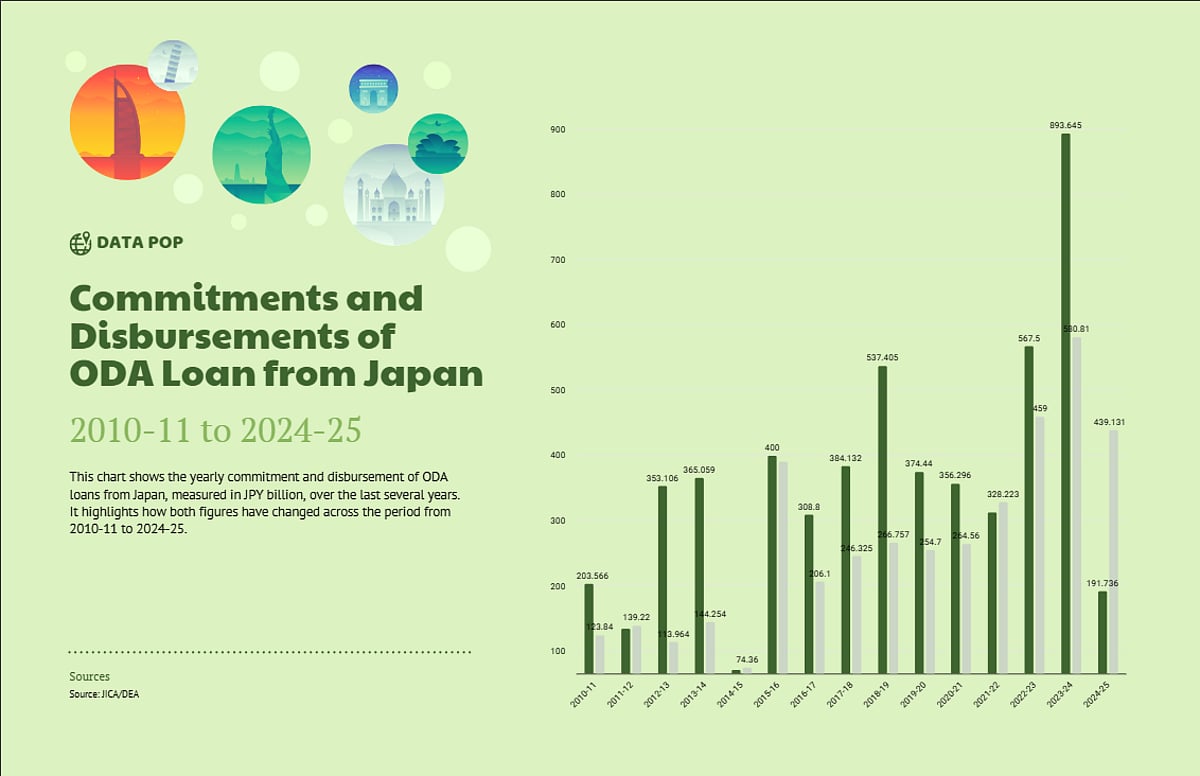
The most prominent symbol of this synergy is the ongoing Mumbai-Ahmedabad High-Speed Rail project, which is built using Japanese Shinkansen bullet train technology.
While Japan's private sector fleeing regulatory hostilities in China, the 1,439 Japanese corporate branches currently operating in India are poised to multiply. In 2022, Japan committed to a 5-trillion-yen target for public and private financing in India over five years.
Countering Beijing's rhetoric
With Prime Minister Takaichi arriving in New Delhi this week, India and Japan must urgently elevate their bilateral ties. As the summit gets underway, Beijing's state-controlled media is highly likely to unleash an aggressive rhetorical assault on both nations. In the face of these inevitable diatribes, India and Japan cannot afford to appear divided or succumb to China's incorrigibly mendacious behaviour.

